
Complex or Unique Features
- Custom algorithms
- Custom UI
- Full flexibility
Scalability and Performance
- Handle millions of users
- Optimize every line
Data Security & Compliance
- Custom security
- GDPR, HIPAA, SOC2 readiness
Long-Term Costs & Ownership
- No vendor lock-in
- No hidden license fees
If your product depends on complex logic, full-code is your best bet.
The Hidden Costs of Low-Code
Low-code looks easy but has pitfalls:
- Vendor Lock-In
- Your app runs on their terms
- Migrating later is expensive and hard
- Customization Limits
- Hit walls with advanced features
- Difficult to maintain large projects
- Technical Debt
- Copy-paste culture
- Poor refactoring tools
- Performance Issues
- Slower as userbase grows
- Ongoing Costs
- Per-user licensing fees
Low-code for core IP is like building your house on rented land.
A Smart Hybrid Strategy
You don’t have to choose just one forever.
Prototype in Low-Code → Move to Full-Code
- Validate quickly, migrate later
Split Core vs Non-Core
- Core logic → Full-code
- Admin/Dashboards → Low-code
Use Low-Code Inside Dev Toolbox
- Treat low-code as just one tool
Modular Architecture
- Keep data and APIs outside low-code
- Reduce vendor dependency
Planning beyond MVP and thinking about scalability, hiring models, and long-term success? → Check out our complete guide on what actually drives custom software cost and build smarter from day one.
Use low-code when convenient. Don’t make it your whole platform.
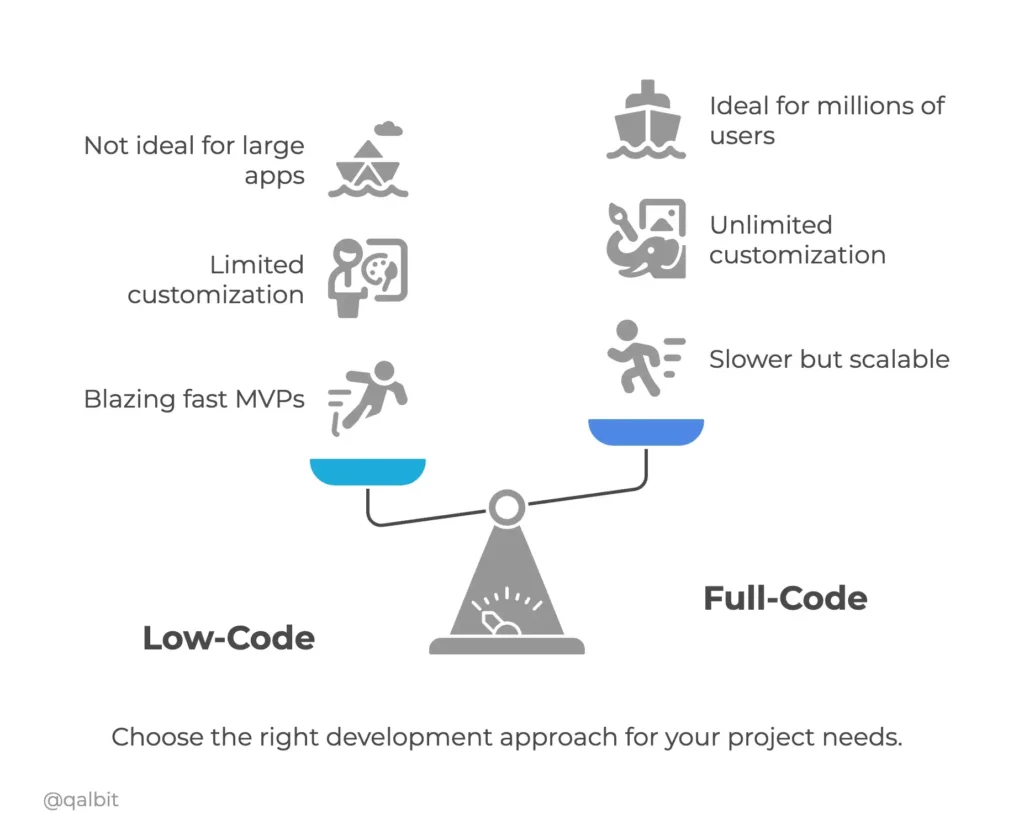
Brutally Honest Decision Table
| Factor / Question | Low-Code (Good When…) | Full-Code (Good When…) |
|---|---|---|
| Speed to launch | Blazing fast MVPs | Slower but scalable |
| Required customization | Limited | Unlimited |
| Scalability & performance | Not ideal for large apps | Ideal for millions of users |
| Core product / IP | Risky (vendor lock-in) | Ideal (you own everything) |
| Developer availability | Great for no/low engineering | Requires engineers |
| Long-term costs | Variable & ongoing | Upfront but predictable |
| Best for… | MVPs, internal tools | SaaS, scalable platforms |
Ready to Build Right? Talk to QalbIT
Choosing between low-code and full-code is crucial. Do it right and avoid painful rewrites and scaling issues.
If you’re serious about building a scalable product — not just an MVP — you need expert engineers.
👉 QalbIT Custom Software Development will help you:
- Architect and build custom, scalable solutions
- Avoid vendor lock-in and technical debt
- Launch with confidence
Book a free consultation today and build smart from day one.

You’re a startup founder with an idea to test and a shoestring timeline. Do you glue together an MVP with Bubble or hire engineers to write every line of code?
The truth is: low-code and full-code each have brutal trade-offs. Low-code lets you launch fast, but risks lock-in and limited customization. Full-code takes longer and costs more upfront, but gives complete control, scalability, and ownership of your core IP.
In this no-bullshit guide, we’ll define low-code vs full-code in a startup context, explore when each approach really works (with real examples), reveal hidden costs, and lay out a brutal decision framework. By the end, you’ll know exactly when to code it yourself or when to drag-and-drop — and when to call in a custom dev partner like QalbIT.
What Exactly Are Low-Code and Full-Code?
Low-code means minimal hand-coding. Think visual builders like Bubble, Glide, Retool. You stitch together logic visually.
Full-code means traditional programming — building everything from scratch using languages like Python, JavaScript, etc.
In short:
When Low-Code Works (And Works Fast)
Sometimes, speed matters most. Low-code excels in:
MVPs and Rapid Prototyping
Internal Tools and Dashboards
Non-Technical Founders
When Full-Code Wins
Low-code hits limits fast. Full-code shines when: