Custom software development · Pennsylvania
Custom software development company in Pennsylvania.
QalbIT writes clinical, laboratory, lending and plant-floor software for organisations across the Commonwealth: health systems in Philadelphia and Pittsburgh, pharmaceutical and device companies along the Route 202 corridor, universities with student records to protect, community banks and credit unions, and distributors along I-81 and I-78 whose warehouse still runs on a whiteboard. The team sits in Ahmedabad, India, and works Pennsylvania mornings. There is no QalbIT office in the state, and the rest of this page is about what that does and does not change.
A vendor page written for Pennsylvania buyers usually says HIPAA and stops. This one goes through the breach statute, the validated-records rules, the student-data rules and the questions your information security office will actually ask, including the rows where a firm in King of Prussia or the Strip District is the better hire.
Since 2018
Writing business software
50+
Clients, most of them still with us
08:00–12:00 ET
Live overlap, every working day
4.9
Google rating, 18 reviews
Get your free estimate
Three quick questions: scope, approach and a price range back within 48 hours. No sales call required first.
Definition
What a custom software development company in Pennsylvania does when it is not in Pennsylvania
QalbIT is a custom software development company serving Pennsylvania as a remote engineering partner, not a local agency. The projects that come to us from the Commonwealth tend to share two constraints: data that somebody regulates, whether that is protected health information, a validated pharmaceutical record, a student file or a borrower’s account, and stakeholders who expect their supplier to be awake at 08:00 Eastern. We engineer for the first and we staff for the second, from Ahmedabad, India.
Pennsylvania has no shortage of software firms. Philadelphia, Pittsburgh and the suburbs between them have agencies that can walk into your office on a Tuesday, and the question a buyer should ask is not whether a remote partner can write code but what changes when the supplier sits outside the state and outside the country.
Three things change, and they are the same three for every remote engagement: the working day has to be lined up deliberately, the vendor-risk file has an extra section, and the obligations around regulated data have to be assigned in writing to whichever party actually holds them. Each has a settled answer, and each is far less costly to settle before a contract than to argue about during a security review.
Everything below is that argument, made in the open. The custom software for growing companies we build is described in general terms on its own page; this page is about doing it for a Pennsylvania organisation from nine and a half time zones away.
At a glance
What we build
Clinical and lab tooling, lending and member portals, plant and warehouse systems, SaaS products, mobile apps, integrations
Typical engagements
A first system · a rebuild of one that has aged out · modules and portals over an EHR, LIMS or ERP · a standing engineering pod
Where and when
Remote from Ahmedabad, India, on Eastern time; 08:00 to 12:00 ET live, Monday to Friday, a written handover after that
Presence in Pennsylvania
None. No office, no staff, no United States entity. Contract on your paper under Pennsylvania law
Who owns what
Code, infrastructure definitions and documentation assigned to you as they are written; repositories and cloud accounts in your name
Definition
A Pennsylvania agency, a contract shop, a remote partner
Three suppliers that get priced against each other when they sell different things.
A Pennsylvania agency
Incorporated in the state, on Eastern time from breakfast to close, able to sit in your conference room. What you are buying is proximity, a domestic invoice and a procurement file with nothing unusual in it. The right choice for work that needs hands on a hospital floor or a plant line, or for a purchasing process that requires a supplier in the Commonwealth.
A contract or staffing shop
Engineers billed by the hour into a process you run. What you are buying is capacity; architecture, code review, QA and release management stay with your own lead. The right choice when you already have an engineering manager with time to direct more people.
A remote engineering partner
A small senior team that takes ownership of a defined build, works your morning from another country and hands over the repository at the end. There is no local entity, so the contract, the tax form and the security questionnaire need doing properly on day one. The right choice when you know what the system must do and want it built well the first time.
We are the third kind. When the first or second is the better answer for your project, we say so on the first call.
Fit
When a Pennsylvania organisation should hire a remote software partner, and when it should not
The two lists below are equally serious. We turn down work that falls in the second one.
A remote partner works when
- The system’s job can be written down, and one person on your side has the authority to decide without a steering committee.
- The engagement is a defined build, rebuild or extension rather than a programme whose sponsor changes every quarter.
- Four live hours each Eastern morning are enough for decisions, and the afternoon can run on a written handover.
- You want the repository, the pipeline and the documentation in your own hands, not held as a reason to keep paying.
- Regulated data is involved and your compliance officer is prepared to set the rules and review the evidence we produce against them.
Hire in Pennsylvania instead when
- Your purchasing rules, a grant condition or a flow-down clause from one of your own customers require a supplier incorporated in the United States.
- Somebody has to be physically present: a go-live on a hospital ward, a scanner on a warehouse dock, a device on a lab bench.
- Your security policy forbids any production access from outside the country and the work cannot be done against masked data.
- The decision-makers are only reachable after lunch Eastern time and the build cannot run on a morning-plus-handover rhythm.
- What you really need is contractors under your own architect, in which case a staffing shop costs you less management than we would.
How this plays out with Pennsylvania buyers
The organisations that buy software here have been reviewed, audited and inspected for a long time. A health system’s information security office, a pharmaceutical company’s quality function, a university’s registrar and a bank’s compliance desk all run supplier reviews as routine, and the vendors that sell to them have picked up the habit. The questionnaire arrives before the contract, it is specific, and a vague answer gets noticed. The parts of a remote engagement that concern a reviewer are settled in writing before the build starts: who can reach production, where the data sits, what is logged, how a change is approved and how it is undone. We hand the reviewer engineering evidence and let it speak. A remote build where a local firm was the right answer costs far more than the invoice, and it is visible by month three. We would rather lose the project at the scoping call.
Next step
Not sure which list your project is on?
Send us what the system must do, what data it holds and what your purchasing rules say about suppliers. You get a straight answer, including “hire someone in Philadelphia” when that is the honest one.
Comparison
A remote partner against a Pennsylvania agency and a contract shop, row by row
Each row is a genuine difference, and three of them go against us. There is no rate row because we hold no sourced figure for what firms in Philadelphia or Pittsburgh charge, and a guessed number would be worse than none. We would rather run this table against your actual scope, your data and your purchasing rules than against the generic case.
| Pennsylvania agency | Contract or staffing shop | QalbIT (remote partner) | |
|---|---|---|---|
| Somebody can be in your building | Yes | Often | No |
| Hours live on Eastern time | All day | All day, usually | 08:00 to 12:00 ET, then a written handover |
| Architecture owner | The agency | Your own lead | Us, reviewed with your technical lead |
| QA and release owner | The agency | Your own lead | Us, with your sign-off as the gate |
| Contract, governing law, currency | Domestic | Domestic | Your paper, Pennsylvania law, US dollars |
| Code and IP | Depends on the contract | Yours | Yours, assigned as it is written |
| Vendor security review | Routine | Routine | Completed by the engineers, with insurance certificates on request |
| US-only work-location requirements | Eligible | Usually eligible | Not eligible |
| Team stability | Moves with agency workload | Turns over with the contract | Named in the proposal, unchanged through the build |
01
Read the rows we lose first.
A table where one supplier wins every line is marketing. The rows above where a local agency wins are real, and a buyer who finds them here rather than in a stalled contract has been served better by this page than by a brochure.
02
Where the engineers sit and where the system runs are separate facts.
Your platform can live in a US cloud region under your own account, with production access limited to whom you choose, while the people writing it work from Ahmedabad. Most of a vendor-risk conversation gets simpler once that distinction is on the table.
03
Capacity is not the same as delivery.
Contractors add hands to a process you already run. If nobody on your side holds architecture, code review and release quality, more hands produce more code and not a working system.
04
US-only clauses are not negotiable, so ask early.
A federal grant condition, a customer flow-down or a purchasing rule that requires work performed in the United States rules us out, and engineering quality does not change that. Raise it on the first call and you have the answer the same day.
What we build
Custom software development for Pennsylvania health, science, finance and industry
Systems that hold one record of a patient, a batch, a borrower or a pallet, so the people around it stop retyping it into the next tool.
Clinical ops
Scheduling, intake and care-coordination tools
Referral tracking, appointment and resource scheduling, intake forms and follow-up workflows sitting beside an EHR rather than fighting it, built to the HIPAA Security Rule safeguards and the rules your privacy officer sets.
Lab and quality
Laboratory, batch and quality-record systems
Sample tracking, batch records, deviation and CAPA workflows and supplier qualification for teams whose records fall under 21 CFR Part 11: versioned, audit-trailed and signed electronically, with the qualification evidence produced alongside the build.
Lending
Portals and back-office tooling for lenders and credit unions
Member and borrower portals, application intake, document collection and approval chains over a core system nobody wants to replace, with the access controls and logging the GLBA Safeguards Rule expects.
Campus
Student, research and administrative systems
Applications, advising, research administration and departmental tools for universities and colleges, designed around FERPA’s consent and disclosure rules from the data model outward rather than as a checkbox at the end.
Plant and warehouse
Manufacturing and distribution software
Work orders, bills of materials, lot traceability, dock scheduling and multi-site stock for manufacturers in York and Lancaster counties and distributors along the I-81 corridor, with mobile capture for the floor.
Product
SaaS products and first versions
Tenanted products with billing, roles, usage limits and an audit history, for a founding team in University City or Bakery Square or for a company turning an internal tool into something it can sell.
Cost
What custom software development costs in Pennsylvania
For a Pennsylvania organisation, custom software is priced by the scope of the first release, the number of systems it must connect to and the regulatory evidence it has to produce, not by headcount or by state. QalbIT’s own floors: fixed-scope projects from $6,500, dedicated engineers from $3,200 per engineer per month, and a scoped first version typically from $5,000. A written scope with exclusions arrives within 48 hours of the first call, and a first release usually ships 6–14 weeks after the scope is signed.
Those figures are ours and they are the only cost figures on this page. Search the question and you will find ranges a decade wide with nothing behind them, and we are not adding another.
We also decline to publish what a Philadelphia or Pittsburgh firm charges, because we have no number we could attribute to anyone. Send the same written scope to three Pennsylvania firms and you will know more than any web page can tell you.
What we offer instead is a scope before a price: one discovery call, a document with the exclusions listed, and a fixed figure for phase one before you commit past discovery. The drivers below are what actually move the number, so you can test any quote, ours included.
Try the software development cost calculatorWhat moves the number
How much the first release tries to do
The biggest lever and the one most often pulled the wrong way. One workflow finished properly funds a second phase; four workflows started thinly fund nothing.
Which systems it must talk to
A documented API with modern authentication is a small job. An EHR interface over HL7, a LIMS with a nightly export or a core banking system with a file-drop integration each need a middleware layer and a reconciliation screen of their own.
What evidence the regulator expects
Audit trails that cannot be edited, electronic signatures, access reviews and validation documentation are engineering work with a timeline. Built in from the start they are contained; retrofitted after an inspection finding they are a project.
Roles and approval logic
Two roles is a data model. A nurse manager, a charge nurse, a scheduler and a compliance reviewer with delegated approval and segregation of duties is a system of its own, and it is where clinical and financial software quietly grows.
Web, mobile or both, with or without offline
Web only, web plus one mobile platform, or web plus iOS and Android with offline sync. Each step adds build, test and release work, and offline adds conflict handling that has to be designed rather than hoped for.
How much history moves across
Master data and open items are routine. Years of patient encounters, batch records or loan history, reconciled against the old system and signed off by the people accountable for it, is a workstream with its own estimate.
Development process services for businesses in Pennsylvania
How a Pennsylvania build runs across nine and a half time zones
The offset between Harrisburg and Ahmedabad is nine and a half hours in summer and ten and a half once Pennsylvania falls back, and we schedule around it rather than pretend it away. Every call, demo and decision lands between 08:00 and 12:00 Eastern. The steps below are the short version of our delivery process, applied to a team on Eastern time.
Discovery, then a scope on paper
One call to trace how the work moves today, who touches it and where it breaks, followed by a written scope with the exclusions named. No estimate leaves here on the strength of a conversation, and the document is yours either way.
A scope, a price range for phase one and the name of the engineer who would lead it.
48 hours
Prototype and architecture
Clickable screens in the first week, so your department head reacts to something real. Alongside them, the data model, the permission scheme, the hosting region and the rollback plan, agreed in writing before an editor is opened.
Approved screens, an architecture note your CIO can read, and a data-handling position your compliance lead has seen.
1–2 weeks
Build in two-week slices
Working software demonstrated every fortnight in your morning, against your own records rather than sample data. Each slice is checked against the scope with you on the call, so progress is seen rather than reported.
Modules proven against real cases, and a backlog you have shaped as you went.
6–14 weeks, by scope
Harden, then go live
Permissions, load, backups, monitoring and a rehearsed rollback are signed off before anyone in Pennsylvania logs in. If a validation pack or an audit trail is required, it is delivered here and not promised for later.
A release your information security office can accept, with the evidence attached.
2–3 weeks
Operate and extend
Monitoring, a support window on Eastern hours, and the next slice of roadmap chosen from what your users actually do rather than what the plan assumed in month one.
Software that keeps paying for itself, and a team that can hand it to yours whenever you want.
Monthly, 30 days notice
Pennsylvania observes daylight saving and India does not, so the overlap shifts by an hour twice a year: 08:00 to 12:00 ET is 17:30 to 21:30 IST in summer and 18:30 to 22:30 IST in winter. Either way it is four live hours every working day, with stand-ups and demos inside it and a written handover before our evening ends.
Request a scoping callWhere we fit
Custom software projects we take on in Pennsylvania
These are the shapes of work that go well at a distance. The shapes that do not are listed further up, and we meant them.
First system
Retiring the workbook that runs the department
A scheduling grid, an approvals inbox and one person who knows all the exceptions, replaced by a system with roles, an approval trail and a history of who did what and when. For operations, clinical-ops and finance teams.
Rebuild
Replacing a system that has aged out
An Access database, a desktop tool or an early web app rebuilt as something maintainable, without losing fifteen years of records or retraining a whole department over one weekend. For teams on software nobody supports any more.
Finding
Bringing a live system up to its obligations
Adding an unalterable audit trail, access reviews, breach-scoping logs or Part 11 controls to software that was built before anyone asked. An inspection finding or a deadline is usually what starts it. For teams facing an audit, an inspection or a new rule.
Extension
Building around the system of record
Portals, modules, dashboards and interfaces layered over an EHR, a LIMS, a core banking system or an ERP, so the record stays where it is and the retyping around it disappears. For organisations extending rather than replacing a core.
Industries
Sectors we serve as a custom software development company in Pennsylvania
Operational software takes the shape of its industry. These are the Pennsylvania sectors where the process knowledge carries over and the compliance questions are ones we have answered before.
Health systems and physician groups
Philadelphia and Pittsburgh are both anchored by large health systems, and the physician groups, home-health agencies and behavioural-health providers around them run on scheduling, referral and intake tools that were never designed for the volume. We build beside the EHR rather than against it, to the HIPAA Security Rule safeguards, under the rules your privacy officer sets.
Pharmaceutical, biotech and medical devices
The suburbs along Route 202 and the research corridor in Philadelphia carry a long list of pharmaceutical, biotech and device companies. Batch records, sample tracking, deviations and supplier qualification live under 21 CFR Part 11, which changes the engineering: versioned records, an audit trail that cannot be rewritten, reason-for-change capture, and a qualification pack that grows with the build.
Higher education
The Commonwealth has an unusual density of universities and colleges, public and private. Advising tools, research administration, departmental workflows and applicant portals all touch education records, so FERPA’s consent and disclosure rules shape the data model and the access scheme before a screen is drawn.
Community banks, credit unions and insurers
Member and borrower portals, application intake, document handling and approval chains over a core system that stays in place. Maker-checker rules, segregation of duties and a full audit trail are the requirements that shape the build, with the access controls and monitoring the GLBA Safeguards Rule calls for.
Manufacturing in York, Lancaster and the Lehigh Valley
Work orders, bills of materials, lot traceability, job costing and quality checks for plants that still run part of the day on paper travellers. Cost accuracy usually depends on decisions three steps upstream, so the build starts there rather than at the report.
Distribution and logistics along I-81 and I-78
Dock scheduling, appointment booking, proof of delivery, cycle counts and multi-site inventory for the distribution centres that cluster around Harrisburg, Carlisle and the Lehigh Valley. The hard part is keeping one shipment in one state across three systems that each think they own it.
Technology and robotics companies in Pittsburgh
Data-heavy products, pipeline and instrument integrations, and the first commercial platform a research-led company builds when a tool it made for itself turns out to be worth selling. The CyberFind case study is a good picture of that shape: a B2B review platform for security leaders that is four years in production without a rewrite.
If your sector is not listed, our first question is the same one anyway: what does a day of this work look like, and where does it break?
Next step
The packaged product does not fit because your process is not packaged.
That is how most custom builds begin. Walk us through the process and we will tell you whether it justifies bespoke software or whether configuring what you already license would get you there.
Pennsylvania compliance
Building software for Pennsylvania: breach notice, health data, validated records, student and financial data
These are the rules that decide how a system gets built in the Commonwealth, and the questions a supplier outside the country has to answer before anything is signed. We are engineers, not your counsel: this is what we build, not legal advice about what applies to you.
Breach of Personal Information Notification Act
Pennsylvania’s breach statute, the Breach of Personal Information Notification Act at 73 P.S. § 2301 and following, requires an entity that maintains, stores or manages computerised personal information about Pennsylvania residents to notify affected residents without unreasonable delay when that information is reasonably believed to have been accessed and acquired by an unauthorised person. The Act was amended by Act 151 of 2022, which widened the definition of personal information to take in medical and health-insurance information and a username or email address combined with a password. It has since been amended again to add a notice obligation to the Office of Attorney General for larger breaches and a credit-monitoring duty toward affected residents; re-verify the current act number and effective date before citing them, since the specific citation could not be confirmed against the Pennsylvania General Assembly's own site in this pass. Enforcement sits with the Office of Attorney General of Pennsylvania. The notification decision, its wording and its timing belong to your counsel and your incident plan. What we build is the ability to answer the question accurately: retained access logs, an audit trail that cannot be edited, alerting on unusual access and a rehearsed way of reconstructing which records were reached and by whom. Re-verify the current thresholds and the amendment text before relying on this row. Sources: Breach of Personal Information Notification Act, 73 P.S. § 2301 et seq., as amended by Act 151 of 2022 · Office of Attorney General, Commonwealth of Pennsylvania.
State statute
Consumer privacy: no comprehensive Pennsylvania statute yet
As of this writing Pennsylvania has not enacted a comprehensive consumer data privacy law of the kind now in force in a number of other states. Bills are introduced in Harrisburg most sessions, so this row is dated and should be re-checked before each publish. The practical consequence is that privacy obligations for a Pennsylvania company today come from the sector rules on this page, from the federal agencies that enforce them, and from the laws of the other states whose residents you serve. We design consent records, access and deletion handling, data inventories and retention rules into a system anyway, because the least costly time to add them is before the first record exists. Whether a comprehensive statute has passed since this page was written, and whether you fall under another state’s law, is a question for your counsel. Sources: Pennsylvania General Assembly legislative record; re-verify before publish.
Watch list
HIPAA Security Rule technical safeguards
Where a system holds protected health information we build to the technical safeguards in the HIPAA Security Rule: unique user identification, role-scoped access, automatic logoff, encryption in transit and at rest, integrity controls and an audit trail that records who viewed a record, not only who changed it. Minimum necessary is decided in the data model at design time rather than argued about after go-live. A business associate agreement is not something we promise on a web page. Whether one is needed and what it must say is your privacy officer’s and your counsel’s decision. We build to the safeguards, work under your compliance team’s rules, and give them the engineering evidence to sign off. Sources: HIPAA Security Rule, 45 CFR Part 164 Subpart C · US Department of Health and Human Services, Office for Civil Rights.
Health data
Electronic records and signatures under 21 CFR Part 11
For a pharmaceutical, biotech or device system holding records subject to Part 11, the controls are concrete: the system validated for its intended use, records reproducible in accurate and complete copies for inspection, a secure computer-generated audit trail that stamps operator entries and changes without overwriting anything, authority checks on who may sign, and electronic signatures bound to their records. That shapes the build from the first sprint. Records are versioned rather than edited in place, reason-for-change is captured where the change happens, user and role administration is itself audited, and the qualification evidence is written alongside the software instead of reconstructed at the end. Validation belongs to your quality function. We build to the controls and write the specifications and test evidence in the form your QA team wants; they decide when the system is qualified. Sources: 21 CFR Part 11, Electronic Records; Electronic Signatures · US Food and Drug Administration.
Pharma and devices
FERPA for student and education records
A system that holds education records for a Pennsylvania university or college falls under the Family Educational Rights and Privacy Act. In engineering terms that means recording the basis for every disclosure, keeping a log of who has seen a student’s record and why, separating directory information from everything else, and building consent capture and access-request handling into the workflow rather than into an email chain. Whether an outside supplier qualifies as a school official with a legitimate educational interest, and under what contract terms, is decided by the institution and its counsel. We build to the rules the registrar and the information security office set. Sources: Family Educational Rights and Privacy Act, 20 U.S.C. § 1232g; 34 CFR Part 99 · US Department of Education, Student Privacy Policy Office.
Higher education
GLBA Safeguards Rule for financial data
Lenders and insurers. A community bank, credit union, lender or insurer holding customer financial information is expected to maintain an information security programme under the Gramm-Leach-Bliley Act, and the FTC’s Safeguards Rule sets out what a non-bank financial institution’s programme must include: access controls, encryption, multi-factor authentication, logging and monitoring, change management and a tested incident response plan. Bank and credit union supervisors apply their own guidance to the institutions they oversee. Which supervisor’s rules apply to you is a question for your compliance officer. What we build is software that satisfies the technical controls whoever is asking: least-privilege access, multi-factor authentication, encryption, complete logging and a change history a reviewer can read. Sources: Gramm-Leach-Bliley Act; FTC Safeguards Rule, 16 CFR Part 314 · Federal Trade Commission, and the relevant prudential supervisor for banks and credit unions.
PCI DSS, kept out of your codebase
The safest way to handle card data is never to hold it. We tokenise at the processor, so the card number is captured in the processor’s own hosted field or SDK and your system stores a token, a brand and the last four digits. Your application never sees or stores a primary account number, which keeps most of the PCI DSS scope out of the code we write. Your PCI obligations remain yours, and which self-assessment questionnaire applies depends on how you take payments. We keep the scope small and say plainly when a requested feature would widen it. Sources: PCI DSS v4.0.1 · PCI Security Standards Council.
Payments
We build systems that produce this evidence as a by-product of normal use rather than bolting a compliance module onto software that resists it. When an inspection, an audit or a deadline is driving your timeline, that date is where the plan starts.
Working with us
Contracting with a supplier outside the United States, in plain terms
Your legal, finance and information security teams will each have questions about a vendor outside the country. Here are the usual ones, with our answers, so nobody discovers them in week six.
Governing law and contract form
We sign your master services agreement under Pennsylvania law, with the venue, liability, indemnity and termination terms your counsel wants. We do not ask a client to contract under Indian law, and we do not run projects on an exchange of emails.
Your paper
Tax form and invoicing
As a non-US entity we send a completed Form W-8BEN-E to your accounts payable team before the first invoice. Invoices are in US dollars, against the milestones or the monthly rate in the contract, carrying whatever purchase order reference your finance system needs.
W-8BEN-E
Ownership of the work
Code, designs, infrastructure definitions and documentation are assigned to you as they are created, not on final payment. Repositories, cloud accounts and domains are opened in your name from the first commit, and every engineer on the account works under the same assignment and confidentiality terms.
Assignment
Confidentiality
An NDA is signed before you share anything sensitive, yours or ours, mutual by default. Your name, your product and your project appear nowhere as a reference without written permission.
NDA
Security review and insurance
Certificates of insurance are available on request. Vendor security questionnaires are answered by the engineers who would do the work, describing what we actually operate, with every no written as a no and the compensating control beside it.
Vendor risk
Background checks
If your policy requires checks on named engineers, particularly for health-system or financial work, we arrange them and return the results through your process. Raise it at contract stage, because it adds time before anyone can start.
On request
No entity in the United States, and what that rules out
QalbIT has no United States entity, no Pennsylvania office and no employee who can be in Philadelphia or Pittsburgh on a Tuesday. Where a purchasing rule, a grant condition or a customer flow-down requires a domestic supplier or work performed on US soil, we are not eligible, and you will hear that on the first call rather than after a proposal.
The limit
None of this argues against a remote partner. It argues for doing the paperwork properly at the start instead of assuming it away, which is why we raise it before the estimate and not after the contract.
Tech stack
Technology behind our Pennsylvania builds
Business software is kept for a decade, so we choose tools a new engineer can read in an afternoon and your future team can maintain without us on the phone.
Backend and rules
- Laravel on PHP 8 for modular systems with a strong audit trail.
- NestJS on Node.js where interfaces and event flows dominate.
- Queues, schedulers and retries for HL7 feeds, syncs and report runs.
Interface
- Next.js and React, server-rendered where search brings the traffic.
- Keyboard-first entry for a nurse station, a loan desk or a dock office.
- Flutter for one mobile codebase on iOS and Android, offline-first.
Data and interfaces
- PostgreSQL and MySQL with constraints that protect financial integrity.
- Versioned records and append-only audit tables wherever evidence is required.
- REST, GraphQL and HL7 integrations with EHRs, LIMS, core systems and ERPs.
Security and delivery
- AWS accounts in your name, defined in Terraform rather than by hand.
- Least-privilege access, fully logged, break-glass reviewed after use.
- Staged releases through GitHub Actions, each one reversible.
Running on an older Laravel app, a .NET service or a lab system nobody dares restart? We extend what still works and write down, before the first commit, which parts should not be touched.
Outcomes
What a Pennsylvania build should change, and how you would know
Not projections. These are the operational changes the work is meant to produce, with the measure that tells you whether it did.
| What changes | How you would measure it |
|---|---|
| One record of a patient, batch, borrower or pallet across systems | Variance between the system and a manual or physical count |
| Double bookings and scheduling conflicts stop | Conflicts per week before and after; Snappy Stats cut them by 80% |
| Approvals are enforced by the system rather than remembered | Share of transactions with a complete approval trail |
| An inspector’s or auditor’s request is answered from the system | Hours to produce an access log, an audit trail or a validation record |
| A breach can be scoped precisely | Time to establish which records were reached and by whom |
| Administrative time comes back | Hours per week on manual coordination; Snappy Stats freed 3–4 hours a week |
A note on sourcing
A note on sourcing
There are no market figures on this page: no Pennsylvania salary bands, no agency rates, no failure-rate statistics that circulate without a primary source. The only numbers are our own and our clients’, and each names where it comes from. The Snappy Stats outcomes above are as stated in that case study. If a figure matters to your decision, ask for the source and we will send it or withdraw the claim.
Why QalbIT
Why Pennsylvania organisations keep us as their custom software development company
Eight years of this kind of work
Custom software since 2018: 120+ engagements delivered for 50+ clients across web, mobile and platform work. Clutch 5.0 from 8 reviews, Google 4.9 from 18 reviews, 100% job success on Upwork. Those are the figures we can evidence and the only ones we quote.
Named proof, not a logo wall
CyberFind, a B2B vendor review platform for security leaders, has run four years in production with no rewrite and now carries 500+ verified CISOs and 2,000+ peer reviews. Snappy Stats, a Laravel scheduling system for a shooting academy, cut double bookings by 80% and gave back 3–4 hours a week of admin. Bloomford, a hiring portal, was delivered module by module without downtime. Each is written up on this site with what went wrong as well as what went right.
Your morning is our commitment
Four live hours every working day, 08:00 to 12:00 ET, with stand-ups, demos and decisions inside that window and a written handover before our evening ends. Nothing waits for a weekly status meeting.
We say exactly what we are
No Pennsylvania office, no Pennsylvania staff, no United States entity and no implied presence anywhere on this site. The compliance and paperwork sections above exist because we would rather lose a deal at the scoping call than at the security review.
We will tell you to hire in Pennsylvania
When a firm in Philadelphia, Pittsburgh or Harrisburg is honestly the better answer, you hear it on the first call. It costs us a project and saves you a year, and it is why a fair share of our work arrives by referral.
QalbIT did a great job turning my idea into a real product. What I really appreciate is how well they understand my requirements, even when I'm not fully sure how to explain or finalize things. They listen patiently, guide me when I'm stuck, and always try to find the right solution. I really enjoy working with their team and I'm definitely looking forward to continuing our work together in the future.
FAQs · Custom software development in Pennsylvania
Questions Pennsylvania organisations ask a custom software development company
Eastern hours, budgets, health and student data, the breach statute and who owns what, answered the way we would on a call.
Ask the teamNext step
Put the first release in writing.
Tell us how the work moves today, where it stalls and which date is fixed. We map it, pick the piece that earns its place first, and price a phased plan honestly. When a Pennsylvania firm is the better answer, the reply says so and names why. A written scope with the exclusions listed, inside 48 hours, yours whether or not you go ahead.
Further reading
 Business and Industry
Feb 16, 2025
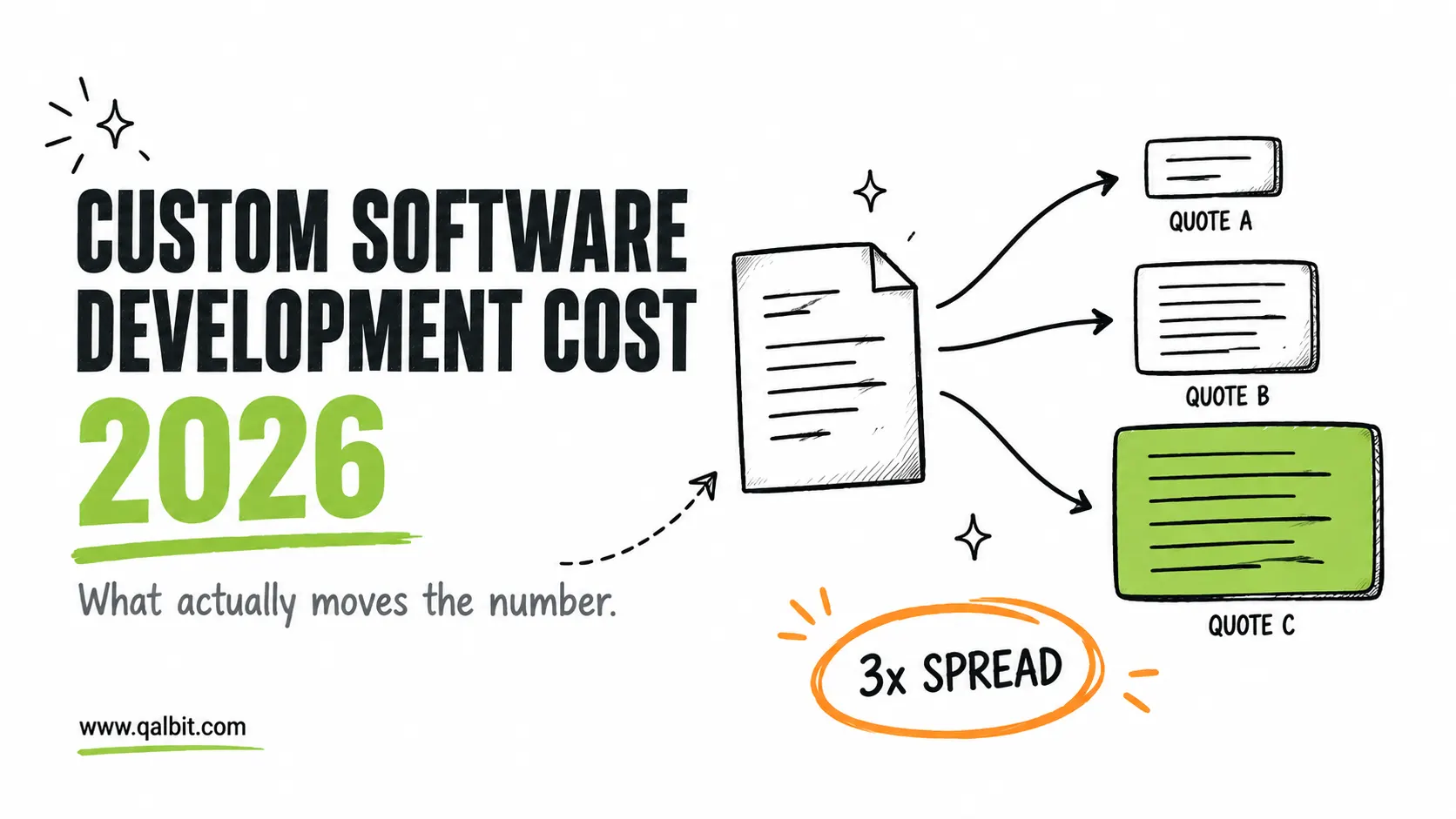
What Custom Software Actually Costs, And What Moves the Number
Custom software costs from $6,500 for an MVP to $52,500 for an ERP phase one with our team. Here’s what moves the number, and why quotes differ by 3x.
 Web Development
Apr 24, 2025
How Startups Build Smarter in 2025: The Complete Guide to Custom Software Development
In 2025, custom software development gives startups a serious edge. This expert guide breaks down MVP planning, tech stack choices, UX design, team…