Key takeaways
- llms.txt is a markdown file at a site's root that gives AI agents a summary and a curated list of links; it is a proposal, not a standard.
- Google says Search, AI Overviews included, does not use llms.txt, and that keeping one neither helps nor harms rankings.
- In Ahrefs' May 2026 data, 97% of about 38,000 valid files got no requests, and AI search bots sent only 1.1% of the rest.
- robots.txt controls crawler access and a sitemap lists pages for search engines; llms.txt can neither grant nor block access.
- Documentation, API and developer-tool sites gain most from the file; small brochure sites and anyone chasing rankings can skip it.
- If you publish one, generate it from your content so it stays current, validate it, and read your logs to see who fetches it.
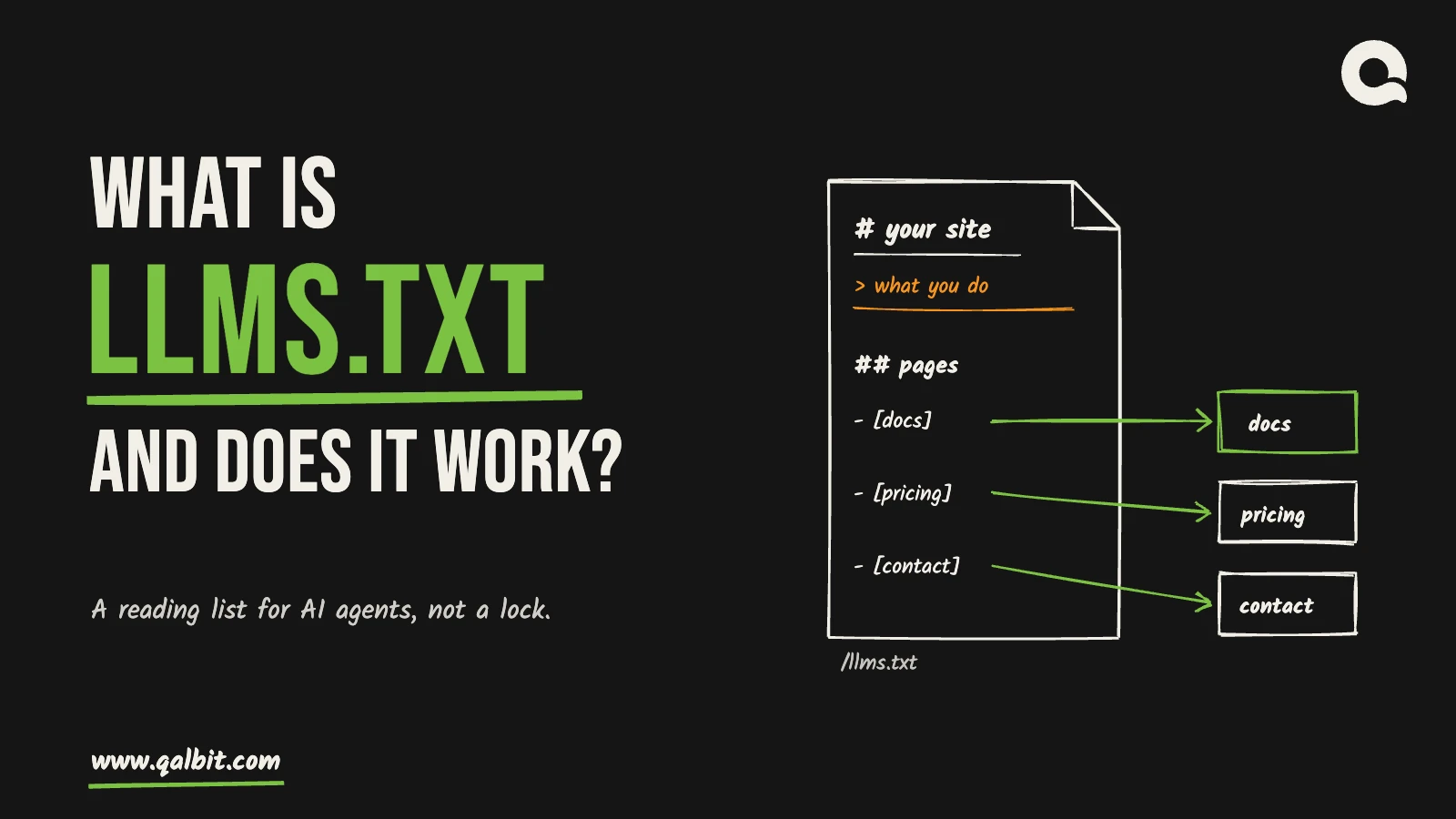
We publish one at qalbit.com/llms.txt, and we build an llms.txt generator and validator that anyone can use free, so we see the file from both ends. Below is what the proposal asks for, which crawlers request the file, what Google says on its own pages, and how llms.txt differs from robots.txt and a sitemap. We also say who should not spend time on it.
What is llms.txt, in plain terms
llms.txt is a proposal, not a standard. Jeremy Howard published it on llmstxt.org on 3 September 2024 and revised it as version 2 on 10 August 2026. It lives in a public GitHub repository open to comment, rather than coming from a body such as the IETF. The idea behind it is simple. Web pages are built for people, so an agent that wants facts about a site has to dig them out of menus, scripts and banners. An llms.txt file hands it a brief instead, in markdown, with links to the pages that hold the detail.
The format has one required part: an H1 with the name of the site. After it, in this order, come a blockquote with a short summary, any notes in plain markdown with no headings, and then H2 sections. Each H2 holds a list of links written as [name](url), and each link may be followed by a colon and a note. By convention, a section called Optional holds links an agent can skip when it is short of room.
A short llms.txt example from our own file
The quickest answer to what is llms.txt is to look at one. Here is our live file cut down to two sections, with the summary and the notes shortened. The full version has eight sections and 94 links.
# QalbIT Infotech Pvt Ltd

> QalbIT Infotech Pvt Ltd is a custom software development company in Ahmedabad, India.

Founded in 2018. Contact: business@qalbit.com

## Free Tools

- [AI crawler checker](https://qalbit.com/tools/ai-crawler-checker/): See which AI crawlers may fetch a URL.
- [llms.txt generator](https://qalbit.com/tools/llms-txt-generator/): Write the file, or check one line by line.

## Company

- [About QalbIT](https://qalbit.com/about-us/)
- [Contact](https://qalbit.com/contact-us/)
An agent that reads this learns in one line what the company does, and where the tool pages are, without parsing our navigation. That is the whole mechanism. Nothing is submitted or registered anywhere, and the file does nothing until something fetches it.
What changed in version 2
The August 2026 revision matters if you are reading an older guide. These are the changes on the proposal’s changes page that affect how you write the file:
- Files below the root. A file at
/docs/llms.txtcovers the pages under/docs/, and an agent should use the most specific file that applies. - Two forms of markdown copy. A page’s clean markdown version may sit at
page.html.mdor atpage.md. - Link relations. A page can point to its llms.txt with
rel="describedby", and to its markdown copy withrel="alternate"and the typetext/markdown, as HTML link elements or an HTTP Link header. - Optional loses its special meaning. The section is still allowed, but it is now only a convention, since the tooling that once acted on it is no longer part of the proposal.
Which AI crawlers request llms.txt today
No major AI company says its crawlers read the file. On 25 November 2026 we read the crawler pages of OpenAI, Anthropic, Perplexity and Google. All four describe their user agents and how robots.txt controls them. None of them says its crawlers read llms.txt. The file does appear on two of them, but only as a pointer: the OpenAI and Perplexity pages tell visiting agents where their own documentation index sits. The labs publish the file for their developer docs, and the proposal names OpenAI, Anthropic and Gemini. Publishing a file is a different thing from reading other people’s.
What the logs show
The largest measurement we found is an Ahrefs study published on 15 June 2026. Ahrefs looked at 137,210 domains that use its web analytics and examined their requests for May 2026. About 28% of them published an llms.txt file, roughly 38,000 valid files in all. Of those, 97% received no requests during the month. Ahrefs also notes that its customers are more technical than most site owners, so it treats the 28% as an upper bound for the wider web.
The other 3%, around 1,100 domains, took every request Ahrefs recorded. Bots sent 96% of those requests and people sent 4%. Named AI tools sent 19.5%. GPTBot sent the most of any AI tool. Claude Code, Anthropic’s coding agent, sent more than any AI search bot, assistant or training crawler other than GPTBot. Meanwhile the bots that fetch pages for AI search answers, such as OAI-SearchBot and PerplexityBot, sent only 1.1%. Chrome’s Lighthouse audit, which we come back to below, made 22 requests.
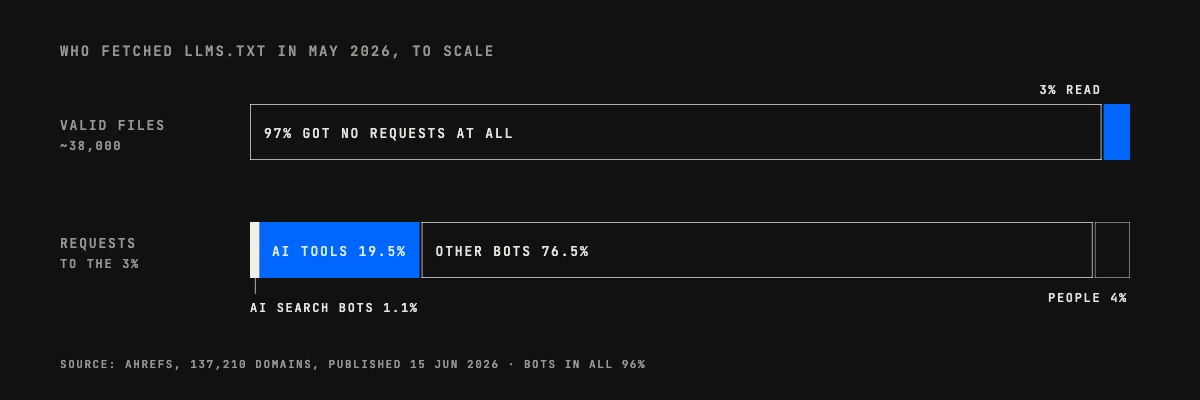
So the readers are real but few, and most of them are not AI at all. Among the AI tools, the agent category led: agents acting for a user, plus the tooling built for them. The bots that choose sources for AI answers barely showed up.
How to check your own logs
Your own logs are the only evidence that applies to your site. On a server that writes the standard combined log format, this counts requests for the file by user agent:
grep -F '"GET /llms.txt' access.log \
  | awk -F'"' '{print $6}' \
  | sort | uniq -c | sort -rn
Read the result with two cautions. First, a user agent is only a claim, and any script can call itself GPTBot. OpenAI and Perplexity publish their crawler IP ranges as JSON files, and Anthropic links a list from its crawler page, so check the address of any request you plan to act on. Second, if a CDN sits in front of your site, it may answer from its cache, and then the request never reaches your origin log. In that case, use the CDN’s own logs as well.
What Google says about llms.txt and AI Overviews
Google has put its answer in writing. Its guide, Optimizing your website for generative AI features on Google Search, was announced on 15 May 2026 and last updated on 10 July 2026. Its mythbusting section puts LLMS.txt files first on the list of things you can ignore for Google Search, and gives the reason in one line:
Google Search itself doesn’t use them.
The guide says you need no “new machine readable files, AI text files, markup, or Markdown” for Search or its AI features. It also says that keeping such a file for other services is fine, because doing so “will neither harm nor help” a site in Search, “as Google Search ignores them.” Google may still crawl the file, as it crawls many file types. However, the guide says that does not mean the file gets special treatment.
Google’s page on AI features and your website, last updated on 10 December 2025, says there are “no additional requirements to appear in AI Overviews or AI Mode”. A page needs what it always needed: to be indexed and eligible to show with a snippet. The newer guide adds one site-level condition. The site must be included in Search Console’s generative AI control, and every site is included unless an owner opts out. Neither condition involves llms.txt, so the file plays no part in AI Overviews.
Why Chrome checks for the file anyway
Chrome is a different product with a different job. Lighthouse has an llms.txt audit among its agentic browsing checks, and Chrome last updated its page on 5 May 2026. The audit flags a page when fetching the file returns a server error. A missing file, a 404, is marked not applicable, because the file is optional. So an llms.txt address that fails with a server error can earn you a Lighthouse flag, while having no file costs you nothing.
llms.txt vs robots.txt vs a sitemap
Much of the confusion over what is llms.txt comes from its name. All three files sit at the root of a site, so people mix them up. Yet they do different jobs, and none of them can stand in for another.
| robots.txt | Sitemap | llms.txt | |
|---|---|---|---|
| What it holds | Rules: which paths each crawler may fetch | A list of the URLs you want search engines to find | A brief for agents: what the site is and where to read |
| Who reads it | Search and AI crawlers, before they crawl | Search engines | Agents that choose to fetch it, when they need it |
| Status | IETF Standards Track, RFC 9309 (September 2022) | The Sitemaps XML format, set out at sitemaps.org | A proposal, version 2 (August 2026) |
| Does it block anything? | It asks crawlers to stay out; it cannot enforce | No | No |
| On qalbit.com, 25 November 2026 | A default group plus 15 for named AI bots and tokens | 368 URLs in 10 files | 94 links in 8 sections |
The practical rule is that robots.txt decides access, and llms.txt cannot override it. Listing a page in llms.txt does not let in a crawler that robots.txt shuts out. Equally, leaving a page out hides nothing. RFC 9309 itself says robots.txt rules “are not a form of access authorization”, so a page that must stay private belongs behind a login.
One site, two lists
Our own numbers show what curated means. On 25 November 2026 our sitemaps listed 368 URLs, and 192 of them were blog posts. By contrast, our llms.txt links 94 pages and names no post on its own, only the blog index. It is a reading list, not an inventory.
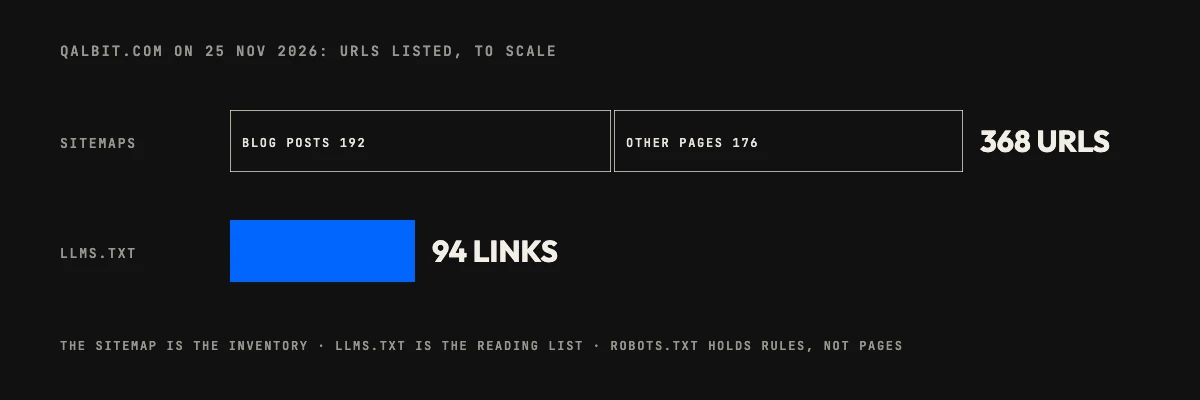
If you are auditing a site for search, the work that moves visibility is still the work in a complete SEO site audit: crawl errors, the sitemap, robots.txt rules and the quality of each page. An llms.txt file is not on that list.
Does llms.txt work for your site?
Once you know what is llms.txt, the useful question is who reads it on a site like yours. It works when the reader is an agent that already looks for it. That describes a narrow set of sites, and the proposal itself says documentation is where the files are used most.
Who it is for
- Documentation and API sites. Coding agents follow the file to API references and tutorials, and in the Ahrefs data Claude Code sent more requests than any AI search bot.
- Developer tools and technical products. If your buyers ask a coding assistant how to use what you sell, the file sends that assistant straight to your reference pages.
- Businesses whose policies agents get asked about. The proposal names a business setting out its structure and policies as a fit. Returns, terms and support pages are the obvious entries.
Who should not bother
- Anyone hoping for Google rankings or AI Overview citations. Google says Search ignores the file, so that time belongs to the pages themselves.
- Small brochure sites. With a dozen pages, an agent can read the site directly, and a summary adds little.
- Teams that will not keep it current. A stale file sends the few agents that read it to pages that have moved. Having no file is better than having a wrong one.
- Anyone being sold llms.txt as a paid AI visibility fix. On the evidence above, it is a small technical file, and its price should match.
How to generate and validate an llms.txt file
For most sites this is a short job, and the free tools cover each step.
- Pick the pages. List the ones an agent needs to answer questions about you: what you sell, prices, policies, documentation and contact. Then leave out the rest.
- Write the file. Our llms.txt generator takes a name, a summary and sections of links, then writes the file in the order the proposal sets out. It also turns any heading in the notes block into plain text, since the format does not allow headings there.
- Validate it. Paste the file, or fetch it from any live site, and the validator checks it line by line. Errors break the format, such as a missing H1 or a list item with no link. Warnings are advice, such as a missing summary. Each one comes with its line number.
- Publish it at the root, at
yoursite.com/llms.txt, served as plain text. After that, fetch it back from the live site to make sure the server returns the file and not an error page. - Check access. Run any page through the AI crawler checker. It reads your robots.txt, the page and your llms.txt, then shows which AI crawlers may fetch the page and whether the file is there. If robots.txt turns out to be the problem, the robots.txt generator writes a corrected one.
- Test it as the proposal suggests. Give an agent only your llms.txt and ask it questions about your business. A wrong answer shows which summary line or link needs work.
What our own file does, and what it skips
Ours is built from the same content model as the site at each build, and the builder drops any page marked noindex. As a result, the file cannot advertise a page that search engines are told to skip. On 25 November 2026 it passed our validator with no errors and no warnings: 17,902 bytes, eight sections and 94 links.
It does not yet do two things version 2 recommends. Its links point to HTML pages rather than markdown copies, and our pages do not carry the describedby link back to it. Given how few agents fetch the file at all, neither is urgent for a site like ours. The part we would not drop is the generation, because a hand-edited copy would drift from the site as pages change.


What is llms.txt? It is a markdown file, kept at the root of a site, that gives AI agents a summary of the site and a curated list of pages to read. Whether it works depends on who you hope will read it. Google says its Search, AI Overviews included, ignores the file. Coding agents do fetch it from documentation sites. For most business sites, though, almost nothing reads it: in an Ahrefs study of May 2026 traffic, 97% of the files measured got no requests at all.