India’s DPDP Act, in plain terms
India’s Digital Personal Data Protection Act, 2023 shapes what your contract must say. The parts that matter for a buyer:
- The business deciding why and how data is used (the data fiduciary) stays responsible even when a vendor does the processing. Section 8(1) says so “irrespective of any agreement to the contrary”, so a clause pushing all liability onto the vendor leaves the duty where it was.
- The fiduciary may engage a processor only under a valid contract (section 8(2)), and it must take reasonable security safeguards, including for what its processor does (section 8(5)). The maximum penalty for failing that duty is ₹250 crore.
- When consent is withdrawn or the purpose ends, the fiduciary must erase the data and make its processor erase it too (section 8(7)).
- The Central Government can restrict transfers to notified countries (section 16), which is a negative list, not a ban on sending data abroad.
The timing needs care. The Digital Personal Data Protection Rules, 2025 appeared in the Gazette on 13 November 2025 and switch on in stages: the Data Protection Board’s rules at once, consent-manager registration after a year, and most duties, including notice, security safeguards and breach reporting, after 18 months, on 13 May 2027. In January 2026 the ministry consulted industry on cutting that window to 12 months, at least for the largest data handlers, which would move the date to 13 November 2026. As of 11 October 2026 we had found no notification making that change. Dates like these move, so ask your lawyer which apply on the day you sign, and write the vendor’s obligations to the stricter standard now rather than when a rule bites.
If your customers are outside India
The Act covers processing outside India that serves people in India (section 3(b)). Section 17(1)(d) goes the other way: where an India-based business handles the personal data of people outside India under a contract with a party outside India, most of the Act’s obligations fall away, but sections 8(1) and 8(5), the responsibility and security duties, stay. That is useful for a buyer in the US or Europe, and it also means the rules that really bind you are your own.
For an EU or UK customer base, that means GDPR. Article 28 requires a contract under which the processor acts only on documented instructions from the controller, including on transfers to third countries, and does not bring in another processor without written authorisation. In practice, ask for the vendor’s list of sub-processors, which includes the model providers it calls, and a commitment to tell you before it changes.
Will your data train someone else’s model?
In an AI project your data usually passes through a third-party model provider, so the vendor’s promise is only as good as the provider’s terms. The defaults for the main API products, as read on 11 October 2026:
| Provider | What the terms say about API data and training | Source page date |
|---|---|---|
| OpenAI API | Data sent to the API is not used to train or improve models unless you opt in; abuse-monitoring logs are kept for up to 30 days by default | States “as of March 1, 2023” |
| Anthropic (API and other commercial products) | Inputs and outputs from commercial products are not used for training by default, unless you send feedback or opt in | Page dated August 18, 2026 |
| Google Gemini API, paid services | Prompts and responses are not used to improve Google’s products; unpaid services may be used, and human reviewers may read them | Terms updated April 28, 2026 |
Three practical points follow. The unpaid tier of a provider can have different terms from the paid one (Google applies its paid terms to everyone in the EEA, Switzerland and the UK), so find out which tier your data will touch, and never let a prototype run on a personal free key with real data. Defaults are not contracts: retention, region and training terms can change, so the agreement should name the provider terms in force and require notice of changes. And a vendor that runs models inside your own cloud account, or on open-weight models you host, can answer the training question by design rather than by policy.
Lock-in: model, provider and prompts
Models and prices change faster than a two-year contract. A vendor that threads one provider’s API through every file of the codebase has handed you a rewrite for later. Ask four things:
- Is there a provider abstraction? One internal layer should sit between your application and the model, so switching is a configuration change plus a re-run of the evaluation, not a code change in forty places.
- Is there a fallback? For anything business-critical, ask what happens when the provider has an outage or retires a model version, and whether an open-weight model can stand in at reduced quality.
- Are prompts and evaluation sets portable? Keep them in your repository as plain files, not inside a vendor’s tool that you cannot export from. The evaluation set is what makes a move to another model safe, because it tells you whether the new one is good enough.
- Who sees the cost per call? The provider bills model usage, and it rises with traffic, not with headcount. A proposal should size the expected per-call cost and show the working, and you should be able to see the provider’s invoice or dashboard directly.
Our written scopes name the model for each use case and the reason for it, and a swapped model is quoted and signed off in writing before work on it starts. Expect the same from any vendor.
Who owns what you pay for
“You own the code” is the answer everyone gives. In an AI project, code is the smallest part. Ask for ownership to be stated item by item:
- Application code, and the repository it lives in.
- Prompts, system instructions and any templates.
- The evaluation set and the labelled data behind it.
- Fine-tuned weights, if any, and the training data that produced them.
- Embeddings and vector indexes built from your documents, which are derived from your data and are expensive to rebuild.
- The cloud accounts and keys, registered to you before the first sprint.
Then there is what the vendor reuses. Reusable internal tooling is normal. Reusing your labelled data, or a model tuned on it, for another client is not, and the contract should say so in words.
Team, hours and how the work is run
Find out who will actually do the work, by name and seniority, and whether the person who scopes the project is the person who builds it. AI projects need someone who has shipped evaluation and guardrails before, not only someone who has called an API.
Time zone matters less than people assume, but it needs to be written down. With US Eastern clients our overlap is three to four live hours; with Gulf clients it is the whole working day. Any vendor should be able to give numbers that specific. The other half is how often you will see working software. We demo every two weeks and attach an evaluation report: the score against the fixed test set, response time, and what each call costs. Expect that rhythm from anyone.
The questions in one table
Take this to your calls. Listen above all for the red flags on the right.
| Topic | Ask | A good answer | Red flag |
|---|---|---|---|
| Evidence | Show me an evaluation you built. | A fixed test set, scores per version, failures listed | Case-study slides and a demo video only |
| Failure | What happens when the model is wrong? | A named human check, a visible fallback, errors logged as new tests | “Our accuracy is very high” |
| Regression | What runs when the prompt or model changes? | The full evaluation, automatically, before release | Manual spot-checks |
| Data | Where is it processed, stored and erased? | Regions named, retention stated, erasure at exit confirmed in writing | “Secure cloud” with no detail |
| Training | Can any provider train on our data? | The provider terms named by tier and date, with notice of changes | No idea which tier the prototype used |
| Sub-processors | Who else touches our data? | A list including model providers, with notice before changes | “Just us” |
| Lock-in | How hard is it to change model? | A provider layer, a re-run of the evaluation, a fallback | One provider’s SDK in every file |
| Ownership | Who owns prompts, weights, embeddings, eval data? | Each item listed, in your accounts | “You own the code” |
| Exit | What do we receive if we leave? | Repos, prompts, eval sets, documentation, notice period stated | Handover is “to be agreed” |
Contracts: tie acceptance to the evaluation
The contract is where these answers stop being promises. Three clauses carry most of the weight.
Acceptance criteria tied to scores. Instead of “the chatbot works”, write the score on the agreed evaluation set that counts as done, and who may add cases to it. Agree that any change to the set happens in writing, so nobody quietly drops a hard case to hit the number.
Service levels for what runs in production. Providers update and retire model versions, and their prices move. Agree who monitors accuracy and cost after launch, how fast a regression is fixed, and what that costs. Most of our clients retain a small team for this once the system is live; it should be optional, with a stated notice period. Ours is 30 days.
An exit clause that lists deliverables. The vendor hands over repositories, prompts, evaluation sets, architecture notes and cloud access within a set number of days. On fixed price versus time and materials, custom software development pricing models shows who carries the risk in each.
Walk-away signs when you choose an AI ML development company in India
You can hear most of these in the first call:
- The proposal commits to a model and a fixed price before anyone has asked what your data looks like.
- No one can say how success will be measured, or the measure is a general benchmark rather than your own cases.
- Data questions get a security certificate in reply instead of an answer about your data.
- Every answer is yes, including to things models cannot reliably do.
- The team that pitches is not the team that builds, and the builders cannot be named.
Nothing here is unique to India, which is the point. A good partner here answers as a good partner anywhere does, with evidence and in writing. Put the same questions to everyone, and keep talking to the vendor who is comfortable being asked. An AI ML development company in India that welcomes this scrutiny has usually done the work.

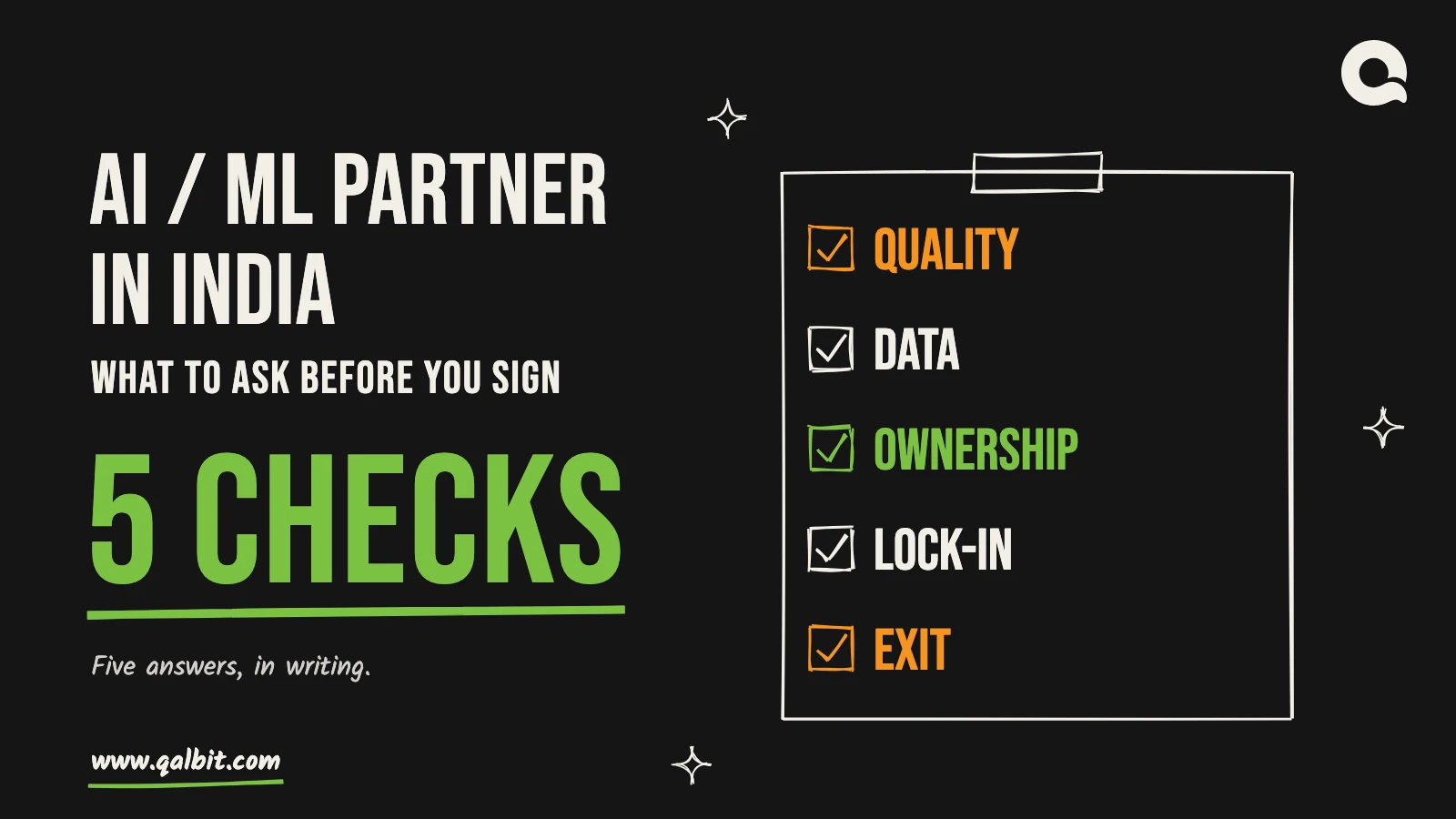
An AI ML development company in India should pass five checks, in writing, before you sign: quality, data, ownership, lock-in and the terms of exit. Shortlists and rankings cannot tell you any of that. Asking every candidate the same questions can, and the answers are easy to compare side by side.
Our team in Ahmedabad builds LLM apps, copilots and workflow automation. These are the questions we expect to be asked, and a few we raise ourselves before a client’s data moves. If you are still building a shortlist, our earlier post on the best artificial intelligence companies in India is the place for names. This one is for the conversation afterwards, and it applies to any AI development services provider, ours included.
What an AI ML development company in India should show you first
Start with something that was built, not something that was promised. A slide of logos proves a vendor has been in rooms. A working evaluation, with the cases it was tested on and the cases it got wrong, proves the team knows what good looks like for a model.
Two requests sort vendors quickly:
Everything below is a longer version of those two questions.
How a good AI ML development company in India measures quality
Models do not fail like ordinary software. Nothing crashes. The answer comes back fluent, confident and wrong, and nobody notices until a customer does. So the contract needs a way to measure wrongness before launch and after every change.
The evaluation set comes first. Find out how the team builds its test set, and whose data it comes from. Our rule of thumb is to start with a few dozen to a few hundred real cases from your own workflow, each with an answer your own staff agree is correct, and grow it from there. Some teams call this a golden set. Build it in the first weeks, before the prototype is polished, because you will judge every later decision about prompts, models and retrieval against it.
Then pin down what the score means in business terms. A claim like “87% accuracy” is meaningless until someone says what the other 13% looks like and what it costs. A refund-routing error and a mistyped greeting are not the same failure.
Regression runs on every change. A prompt edit, a model upgrade from the provider, a new document added to the knowledge base: any of them can quietly break something that worked. Ask whether the full evaluation runs automatically when any of those change, and who reads the result. If the answer is that the team spot-checks a few examples, you will learn about regressions from users.
Also ask about human review. For flows where a wrong answer is expensive, someone should read a sample of live outputs on a schedule, and the findings should flow back into the test set.
Where an AI ML development company in India puts your data
Data handling is where a thin proposal turns vague. Get these in writing: which data leaves your systems, where it is processed and stored, who can see it, whether it can be used to train anyone’s model, and how it is erased at the end.