2 pods available · start this month
Hiring MVP developers takes four months. Or two weeks.
Product-minded engineers who define the smallest version of your product that still delivers value, and ship it in six to ten weeks: interviewed by you, trialled on a real ticket, released with thirty days notice.
Runway burns while you recruit. That is the biggest number in this comparison.
48h
To real profiles
6–10 wks
To a first release
30 days
Notice to stop
0
Recruiter fees
Get your free estimate
Three quick questions: scope, approach and a price range back within 48 hours. No sales call required first.
Trusted by companies worldwide
- Bloomford
- Contractor Plus, Inc.
- Snappy Stats
- Ad Lunam
- Local Buzz
- CyberFind
- Hellory
- 5.0Clutch · 8 client reviews
- 4.9Google · 18 reviews
- Top ratedUpwork · 100+ reviews · 5K+ hours worked
- TopTracker7K+ hours tracked with clients
How hiring works
Weeks until the first release is being builtSeniority
- Hire an in-house teamThree roles, three searches, three notice periods16 wks
- Freelance marketplaceFast to start, nobody owns the whole product6 wks
- A QalbIT MVP podProfiles in 48 hours, paid trial sprint2 wks
Lean MVP pod
That is 14 weeks of runway you do not burn.
One senior full-stack engineer with a product lead over the top. For a single flow, a landing page and a way to sign up: the fastest route to a live test.
In-house timings from published hiring benchmarks · QalbIT timings from our own last twelve placements
MVP overview
When hiring MVP developers with QalbIT makes sense.
We work with founders and teams who want to validate an idea with real users, not a pitch deck, and need a partner who goes from concept to working MVP quickly and pragmatically. A first release you can describe in full is usually best run as the fixed-scope model, with the price and the date agreed before anyone writes code.
You have the idea and need the scope
A clear product vision that still has to become user flows, a feature list and a technical plan somebody can build.
You need proof before the full build
Demand and usability tested with real users before you commit runway to a large team or a big platform.
Runway is short and the v1 must stay small
Ruthless prioritisation so the first release is testable, maintainable and easy to pivot, not a bloated v1.

What our MVP developers deliver
MVP development capabilities from idea to first release.
Product discovery, UX and engineering combined to ship a version of your product that is small, focused and genuinely testable.
Product discovery & scope definition
Workshops and interviews that map users and journeys and decide what belongs in the first release.
MVP UX & interface design
Low- and high-fidelity flows for the critical paths, tuned for clarity and speed over polish.
Full-stack MVP implementation
End-to-end builds on React or Next.js with Node.js or Laravel APIs, and Flutter where mobile is part of the test.
Instrumentation & analytics
Events, funnels and a simple dashboard so you see how users actually behave.
Launch, feedback loops & iteration
Early adopters supported, feedback gathered and quick updates shipped in response.
Post-MVP roadmap
What to keep, drop or rebuild, written down, so v2 starts from evidence.
Want to see how these capabilities map to your idea? Share a brief or a deck and we will respond with a written scope.
Talk through your MVP idea →How it works
A practical MVP development process from idea to launch.
Focused on learning and speed, not on building every feature: the first release exists to answer a question.
Share the idea and the constraints
A short call on your users, success metrics, runway and the surfaces the first release actually needs.
48 hours
Meet the pod
Two or three profiles with real product history. You interview them yourself, no bench-warming.
Within a week
Paid scoping sprint
The pod scopes the smallest valuable version, designs the critical flows and sets up the repo. If the fit is wrong, you stop and pay only for that sprint.
Two weeks
Build, launch, decide
Six to ten weeks to a live release with analytics, then a written recommendation: scale, pivot or pause.
Ongoing
Our clients · reviews
Teams who trusted QalbIT
Short feedback from clients and products we work on across web, mobile, SaaS and internal tools.
- Testimonials from long-term custom software development and SaaS product clients.
- Covers ERP systems, B2B marketplaces, booking platforms, and web & mobile app development projects.
- Real text and video reviews from founders, CTOs, and product teams who partnered with QalbIT for delivery.
Video review
Rated 5 out of 5.“Working with QalbIT was an absolute pleasure. They understood our brand vision, delivered a WordPress site that is easy to navigate, and kept communication smooth throughout. I would absolutely recommend them to anybody.”
Imdad Ali KadiwalaFounder, Netzur Written review
Rated 5 out of 5.“QalbIT is a fantastic dev partner. They provide quality work, good communication and go above and beyond. Fantastic work delivered by QalbIT and his team. Can’t give enough credits with regards to how they work and at which speed they do it. Top team.”
Joost HesselberthFounder of Ad Lunam Investments PTY LTD
Written review
Rated 5 out of 5.“I would recommend QalbIT to everybody. QalbIT has been developing all my front-end & backend systems complete to my requirements. They have excellent technical knowledge and listen very well to the needs of their customers. And above all, they are great people.”
Wouter SantensExecutive Search Consultant at Bloomford Written review
Rated 5 out of 5.“They listened to my ideas and came up with a plan for development then executed that plan to completion. I liked their attention to detail and communication skills. Very responsive.”
Osmond MwanyikyCTO, Bocsit
Written review
Rated 5 out of 5.“QalbIT quickly integrated four platforms quickly. Square, Stripe, PayPal, and Coinbase were all successfully used. The vendor provided an active communication process, maintaining timely deadlines despite the research-heavy service. They also offered post-launch support.”
Roshan SethiaCTO, Contractor Plus, Inc.
Where MVPs fit best
MVP use cases we most often deliver.
We build MVPs where speed of learning matters more than having every feature on day one.
New SaaS & B2B product ideas
Simple but usable versions of SaaS products aimed at one workflow or niche.
Digitising manual workflows
Tools that replace the most painful spreadsheet or email process without rebuilding everything.
Marketplaces & two-sided platforms
Early versions that connect both sides of a market with minimal but working flows.
Mobile-first experiments
Lean Flutter apps that test whether a new channel or idea has legs.
Tech stack & platforms
The stack we typically use for MVP development.
Proven, flexible stacks that let you move quickly now and scale sensibly later.
Web front ends
- React and Next.js for responsive apps and dashboards
- Tailwind CSS for fast, consistent implementation
- Component-driven UI that can grow into a design system
- Landing pages and sign-up flows built for measurement
Backends & APIs
- Node.js with NestJS, or Laravel, for API-first MVPs
- Authentication, roles and billing done simply and correctly
- Webhooks and integrations with the tools you already use
- Admin tooling so you can operate the MVP yourself
Mobile & cross-platform
- Flutter for iOS and Android from one codebase
- Mobile companions to a web MVP where the test needs one
- Push notifications and deep links for activation
- Store submission handled end to end
Data, analytics & operations
- PostgreSQL or MySQL with clean migrations
- Event tracking, funnels and dashboards tied to MVP metrics
- CI/CD and basic monitoring from the first deploy
- Documentation so the next team can pick it up
The stack is chosen for your idea, timeline, budget and any existing systems, not for fashion. What we build is yours to keep building on.
How we work
A product engineering culture built on ownership and clarity.
The habits that decide whether software still works in year three. Here is the honest comparison: what most outsourced engagements look like, and what changes when you work with us.
| The question | The usual answer | At QalbIT |
|---|---|---|
| Who scopes it | A salesperson, then a handover doc | The founder and the engineer who will build it |
| Who writes the code | Whoever is on the bench that month | Named senior engineers, in our office, no subcontractors |
| What you see weekly | A status deck and a percentage | A working demo and the board it came from |
| When something breaks | A ticket queue and an account manager | The engineer who wrote it, in your timezone overlap |
| If you want to leave | A migration project and a licence conversation | Thirty days notice · repos and IP were always yours |
Principle 01
Ownership over ticket-taking
Engineers who ask why before they ask which framework. Scope questions come back before code goes out.
Principle 02
Written over remembered
Scope, estimates and architecture decisions are written down with the trade-off stated. Nobody relies on what was said on a call.
Principle 03
Small over staffed
Senior pods that hold the whole system in their heads beat large mixed teams that need a coordinator to function.
Engagement models
Three simple ways to work together.
Not sure which fits? Adding engineers to a team you already run is staff augmentation; handing a whole roadmap to a dedicated product team sits at the other end of the same scale. Tell us the roadmap and we will recommend one honestly, including when hiring in-house is the better answer.
Model 01
Dedicated developer
One or more engineers full-time on your product, managed by you day to day with QalbIT quality oversight.
Best for · ongoing roadmaps with a product owner
Most chosen
Dedicated squad
A cross-functional team, developers, QA and a technical lead, owning your delivery end to end.
Best for · products with no in-house engineering yet
Model 03
Fixed-scope pilot
A clearly bounded module or audit with agreed cost and timeline: the lowest-risk way to start.
Best for · testing us before a longer commitment
Built for reliability
Freelancer flexibility. Company-level accountability.
Every dedicated developer works inside QalbIT delivery: the same system behind our own SaaS products and 120+ client projects.
Tech-lead oversight
A senior technical lead reviews architecture and every pull request: quality never depends on one person.
ServiceReplacement guarantee
If a developer is not the right fit, we replace them quickly at no extra recruitment cost.
EngagementYour IP, your repos
Work happens in your repositories and cloud accounts under NDA: nothing is stranded with us when you leave.
SecurityTransparent delivery
Sprint demos and written updates so you know exactly what shipped, at what velocity, without chasing.
ProcessScale monthly
Add or drop developers when the roadmap changes: scale down with 30 days notice, no annual lock-in.
PricingQA & DevOps on top
Testing, CI/CD and infrastructure support are available where needed, without hiring two more specialists.
Service
More developer profiles
Pick the expertise your roadmap needs.
Every hire is a senior, product-minded engineer backed by our delivery team, not a solo contractor. Start with one developer or assemble a full squad.
Hire Laravel Developers
Dedicated Laravel and PHP engineers who build secure, maintainable business applications, SaaS platforms and internal tools.
Hire Node.js Developers
Dedicated Node.js and TypeScript engineers for API-first, real-time and event-driven backends that stay observable in production.
Hire Next.js Developers
Dedicated Next.js engineers for SEO-friendly, fast product surfaces on the App Router: SaaS front ends, marketing sites and content hubs in one codebase.
Hire React.js Developers
Dedicated React.js engineers who design, build and optimise dashboards, portals and SaaS interfaces on top of your APIs.
Hire Flutter Developers
Dedicated Flutter engineers shipping iOS and Android from one codebase, with clean architecture, offline behaviour and release cycles you can plan around.
Hire PHP Developers
Dedicated PHP engineers who extend and modernise established business systems on PHP 8 without a rewrite.
Hire Full-Stack JavaScript Developers
Engineers who own both the React or Next.js front end and the Node.js backend, so one hire ships a whole feature.
Keep exploring
- All dedicated developer profilesExplore more profiles
- Hire full-stack JavaScript developersExplore more profiles
- Hire Flutter developersExplore more profiles
- Start-up MVP developmentPlan your project
- Software development cost calculatorPlan your project
- Our delivery processPlan your project
- See CyberFind, our MVP-to-launch case studyPlan your project
- MVP DevelopmentServices this role delivers
- SaaS Product DevelopmentServices this role delivers
- Next.jsTechnologies
- Node.jsTechnologies
- FlutterTechnologies
FAQs · hiring MVP developers
Frequently asked questions about hiring MVP developers
These are the questions founders and product leaders usually ask when they consider hiring an MVP team to validate a new product idea with QalbIT.
Ask us directly →Next step
Let’s turn your idea into a testable MVP.
Share your idea, target users and runway. We will propose a practical MVP scope, a lean stack and a roadmap that maximises what you learn from the first release.
Further reading
 Startup MVP
Oct 19, 2026
Questions to Ask MVP Developers Before Signing
Twelve questions to put to an MVP team before you sign, from what gets cut and who owns the code to how changes are priced and how the work ends.
 Web Development
May 15, 2025
Launch Fast, Scale Smart: The MVP to Full Product Playbook for Startups
Discover the ultimate playbook for MVP development for startups — from rapid idea validation to scaling a full SaaS product. Learn frameworks, avoid…
 Startup MVP
Jul 17, 2026
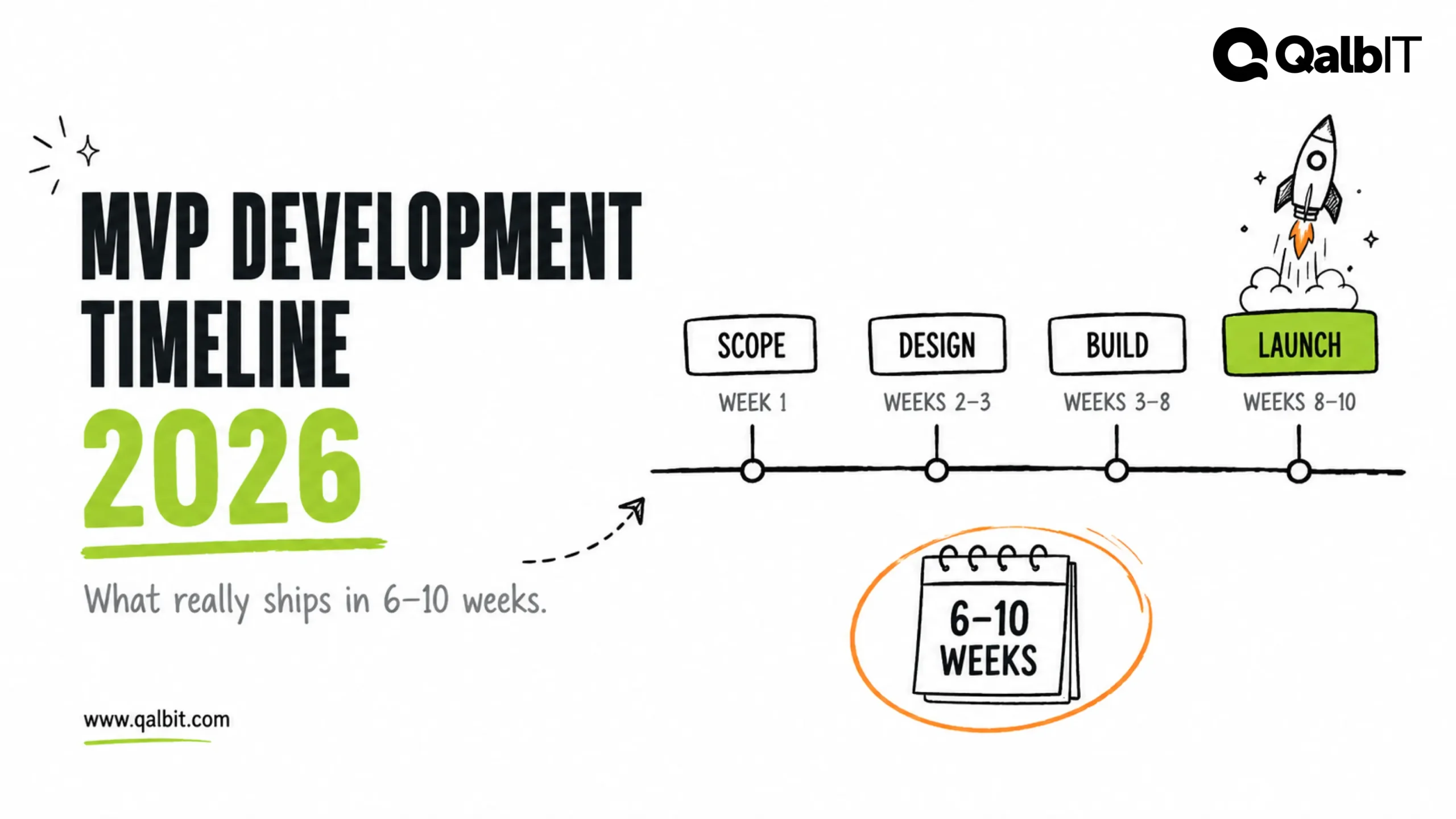
MVP Development Timeline: What You Can Really Ship in 6–10 Weeks
A lean MVP ships in 6–10 weeks; broader scopes run 3–4 months. Here’s the honest week-by-week timeline — and what actually causes delays.