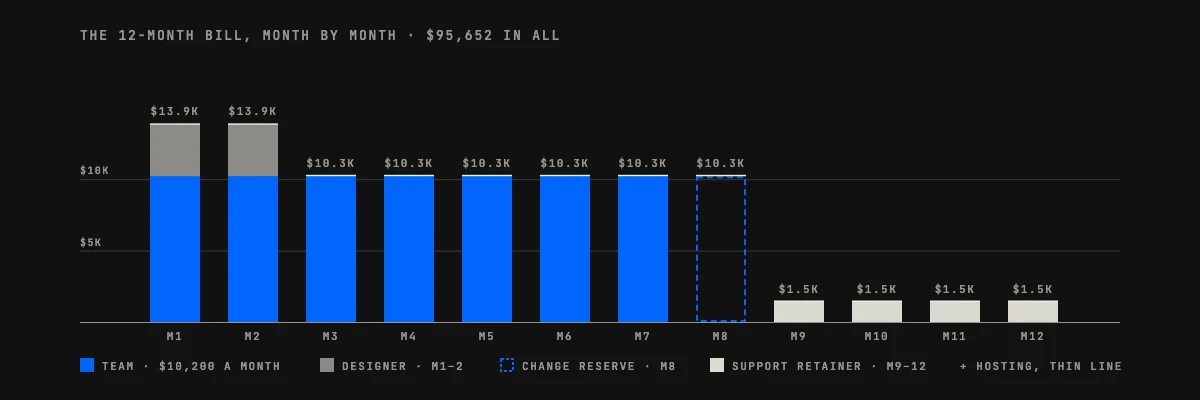
The team route lands at the top of the calculator’s band. You pay for the high end of the schedule whether or not the work needs all of it, and in return you can reprioritise every sprint. A fixed-scope build caps the number instead, and prices each change separately. Neither is wrong, but you need to know which one you are buying.
The 12-month bill
| Line | How it is worked out | Cost |
|---|---|---|
| Team, months 1 to 7 | $10,200 a month × 7 | $71,400 |
| Designer, months 1 and 2 | $3,600 × 2 | $7,200 |
| Change reserve, month 8 | One more team month | $10,200 |
| Hosting and monitoring, all 12 months | Two environments plus error tracking, at list prices | $1,252 |
| Support retainer, months 9 to 12 | $1,400 a month × 4, the published starting block | $5,600 |
| Total | $95,652 |
It is not a quote. It leaves out an external penetration test, paid design assets, any licence beyond the tools above, and your own hours, which come next. Our pricing page lists the first three as quoted separately.
The same twelve months, month by month, show how front-loaded the bill is.
Management and code-review time
On our side, delivery management is inside the monthly rate, and so is review: a senior engineer reads every line before it merges. You are not billed for that time separately, and a quote that bills it as an extra is worth questioning.
On your side, someone has to own the product. They answer questions, decide between two options, sit in the demo and test what the team built. The table assumes one product owner on a 28-week build. These hours are our assumption, so replace them with your own.
| What your product owner does | Assumed hours a week |
|---|---|
| Daily stand-up, 15 minutes | 1.25 |
| Answering questions and making decisions | 3 |
| Backlog and planning | 1.5 |
| Fortnightly demo, one hour | 0.5 |
| Testing finished work | 2 |
| Total | 8.25, or 231 hours over 28 weeks |
Nothing on the invoice shows these 231 hours, but you pay for them all the same, through a salary. Multiply them by whatever an hour of that person costs you and add the result to the total above. If the owner cannot give the time, the schedule slips, and the team months you bought wait for answers.
Time-zone overlap and handover cost
Any team that is not in your room has a handover cost, whether it works across a city or an ocean. People take leave, move to another project or leave the company, and each of those events leaves a gap the written record has to fill.
For us the arithmetic is simple. At 9:00 in New York it is 18:30 in Ahmedabad during US daylight time, 19:30 once the clocks go back. For clients on US Eastern time we keep a window of three to four hours of live conversation each morning, and a written handover goes out before our day ends. A question raised after the overlap closes waits until the next morning for an answer.
The way to keep that wait cheap is to save the decisions that block work for the live window and write the rest down. Your 231 hours include the question-answering time, so it is the same time spent differently, not extra.
Change requests move the total cost of a software build most
Most budgets break at this line. On a fixed-scope build, we price each change in writing before work starts. On a dedicated team, the rate does not move, so a change displaces something else in the sprint or pushes the end date out.
The calculator model shows how large a change is. Add real-time features, such as chat or live updates, to the example, and the band moves from $26,000 to $79,500 up to $28,500 to $87,000, and the schedule from 17 to 28 weeks up to 19 to 30. The long end of the schedule rises by two weeks, and 30 weeks fills the seventh month almost exactly. Any change after that spills into month eight, and that is the reserve in the table: one more team month, $10,200.
We call it a reserve, not a contingency, because it has a job. If the scope holds, the team rolls off after month seven, the thirty days of included support cover month eight, and the $10,200 stays in your budget. For how each model prices change, our pricing models post lays fixed scope, hourly work and dedicated teams next to each other.
Tooling, licences and hosting
This line is small at the start and easy to forget, because the invoices go to you rather than to us. Our pricing page says we pass any licence or cloud bill we pay for you through at cost. For a first release, two environments, staging and production, with error tracking, cost little. We priced them at list prices on 11 October 2026:
- DigitalOcean’s 4 GiB, 2 vCPU Droplet is $24 a month, and a managed PostgreSQL database with 1 vCPU and 1 GiB starts at $15.15, so one environment is $39.15 and two are $78.30.
- Sentry’s Team plan for error tracking is $26 a month when billed annually.
Over twelve months that comes to $1,252. These are starting prices for small workloads, so treat them as a floor. Traffic, storage, email, maps and payment fees all grow with use, and a product with real customers will outgrow this line. In this example it is 1.3% of the total. For what these services cost once customers arrive, our post on what an average cost figure hides has the longer list.
The year-one support retainer
Thirty days of post-launch support sit inside every build price. After that, support moves to a retainer: the published starting block is $1,400 a month, we agree response times up front, and hours you did not use carry into the next month. In the example the first release lands at about month seven and the reserve month follows it, so the retainer covers months nine to twelve, four months at $5,600.
If the roadmap keeps going, you keep the team and skip the retainer, and the retainer line becomes another team month. Dedicated teams end on thirty days’ notice with no exit fee, so you choose which of the two you need while you can see the product.
Contract and ownership terms that change the bill
Two clauses decide whether you can stop paying without losing the product. The first is who owns the code. With us the code is yours from day one, and the work happens inside accounts and repositories that carry your name, under NDA. Where the code sits decides who can reach it; the contract decides who owns it. If you hire a contractor whose repository is theirs, they have to hand it over at the end, and the handover is a cost.
The second is how the ownership is written down. The US Copyright Office explains in its Circular 30 (revised August 2024) that a commissioned work qualifies as made for hire only when it falls into one of nine listed categories and all parties sign a written agreement that expressly calls it made for hire. Software is not named among the nine. A contract that only says “work for hire” may not give you what you think it does, and a signed assignment clause is the line to ask your lawyer about. Have them read the contract before you pay for the first month.
Finally, check the notice period, because it sets how much of the year you have committed to. Ours is thirty days, with no exit fee, and we bill the team a month in advance, so you can see the cost of stopping before you decide.
What to ask a custom software development company before month one
Whoever builds it, the same questions expose the lines above:
- Is the quote in whole team months, and how are partial months handled?
- Is management and code review inside the rate?
- How many live hours do we share, and what happens outside them?
- How is a change priced, and who approves it first?
- Which bills will arrive in our name, not yours?
- What does support cost in month nine, and is it a retainer or a new quote?
- Who owns the code, and where is that written?
Our answers to most of these are on the pricing page.
Work out the total cost of a software build for your project
Start with the range for your project type and shape, and work out the weeks. Turn the weeks into whole months, price the roles from the card, add a month of reserve, then the hosting you can name and the retainer from the month after launch. Last, write your own hours beside the total.
Run your project’s shape through the calculator first. Then give us two lines on what you want built: we come back with questions on day one, and with a written scope and a firm price range within 48 hours.
The total cost of a software build over 12 months came to $95,652 in our example below, and the planned build was only 82% of that, not the whole bill. Everything else was a change reserve, hosting and a support retainer. Those lines sit outside most quotes, and they decide whether a budget holds after the first invoice.
We are a senior team in Ahmedabad, working for clients in America, Britain and the Gulf, and the example uses only our own published prices. The shape of the project comes from our software development cost calculator, the team costs from our pricing page, and every outside number has a date and a link. Nothing here depends on where the builders sit: any team bills for people, review time, changes, hosting and support. Not yet sure who should build it? Our guide to software outsourcing models covers the options first.
What the total cost of a software build is made of
A quote usually prices the first item and leaves the rest to arrive later. Eight things add up to a year of building, and the sections below price each one:
Only some of these are lines on an invoice. The others are hours your own people spend, which is why a comparison of two quotes can look close and still end far apart. Our guide answers how much does custom software cost for the build itself; this post prices the year around it.
The total cost of a software build, worked for one SaaS product
Take a SaaS product with sign-in, roles, payments, dashboards and integrations. In the cost calculator that is a SaaS product, web only, complex in size, with clean standard design and three add-ons: payments, dashboards and third-party integrations. The calculator’s model prices it at $26,000 to $79,500 and 17 to 28 weeks to a first release. It works like this: the model multiplies the SaaS range of $13,500 to $41,000 by 1.45 for a complex build and by 1.34 for the add-ons (12%, 10% and 12% added together), then rounds each end to the nearest $500. The weeks follow the same logic, with add-ons counted at 60% of their weight.
That is a fixed-scope price for a first release. Here we buy the same work another way, as a dedicated team, because it makes every month visible. The rest of this post follows that team through twelve months.
Sizing the team in whole months
We price dedicated teams per engineer per month and invoice each month in advance, so a month started is a month paid. Twenty-eight weeks is 6.5 months, so we book the team for seven. We assume a senior engineer at $4,400, a mid-level engineer at $3,200 and a QA engineer at $2,600, all from the published card, so the team costs $10,200 a month. A product designer joins for the first two months at $3,600.