| Line item | Why it goes missing | In our quotes |
|---|---|---|
| 1. Written scope and exclusions | Treated as sales work, then billed as “discovery” | A written scope before you sign; the detailed scope is the first milestone |
| 2. Interface design | Assumed to come from you | Included, with a design system you keep |
| 3. Testing | Squeezed when the build runs late | Included, with automated tests on business-critical paths |
| 4. Delivery management | Hidden in the rate, or billed hourly on top | Included: planning, fortnightly demos, written reports |
| 5. Environments and release pipeline | Seen as “infrastructure”, not development | Included: CI/CD, staged releases, monitoring |
| 6. Hosting and third-party services | They are your bills, not the vendor’s | Accounts in your name; anything we pay on your behalf is billed at cost |
| 7. Data migration | Invisible until someone opens the old data | Priced in the scope whenever there is a legacy system |
| 8. External security testing | Done by a separate firm | Quoted separately, only if you need one |
| 9. Support after launch, and changes | Starts after the contract ends | Thirty days included; changes quoted in writing first |
The first five are effort the vendor either includes or charges for. The last four are where most surprises come from, because they depend on your systems, your customers and your plans after launch.
Hosting and the services you rent
Cloud hosting, email delivery, maps, payments and every other service a product rents are billed to you every month, for as long as the software runs. They are easy to underestimate and easy to overspend: in Flexera’s 2026 State of the Cloud survey of more than 750 cloud decision-makers and users, wasted cloud spend rose to 29%. Ask the vendor for a monthly estimate at your expected usage, and make sure every account is in your company’s name. A mobile app adds two more: the Apple Developer Program costs $99 a year and Google Play charges a one-time $25 registration fee.
Data migration
Moving records out of an old system is a project of its own, and it is often discovered halfway through a build. The cost guide covers why in detail. The practical step is to hand every vendor a sample export of your real data before they quote, and to see who asks hard questions about it.
Security testing by an outside firm
A good vendor tests its own code, but enterprise customers, insurers and regulators often want an independent penetration test. That is a separate contract with a security firm, and benchmarks published by one such firm, DeepStrike, put a web application test at $5,000 to $30,000 or more. If your first customers will ask for a report, budget for it before launch, not after the first security questionnaire.
Support after launch, and changes
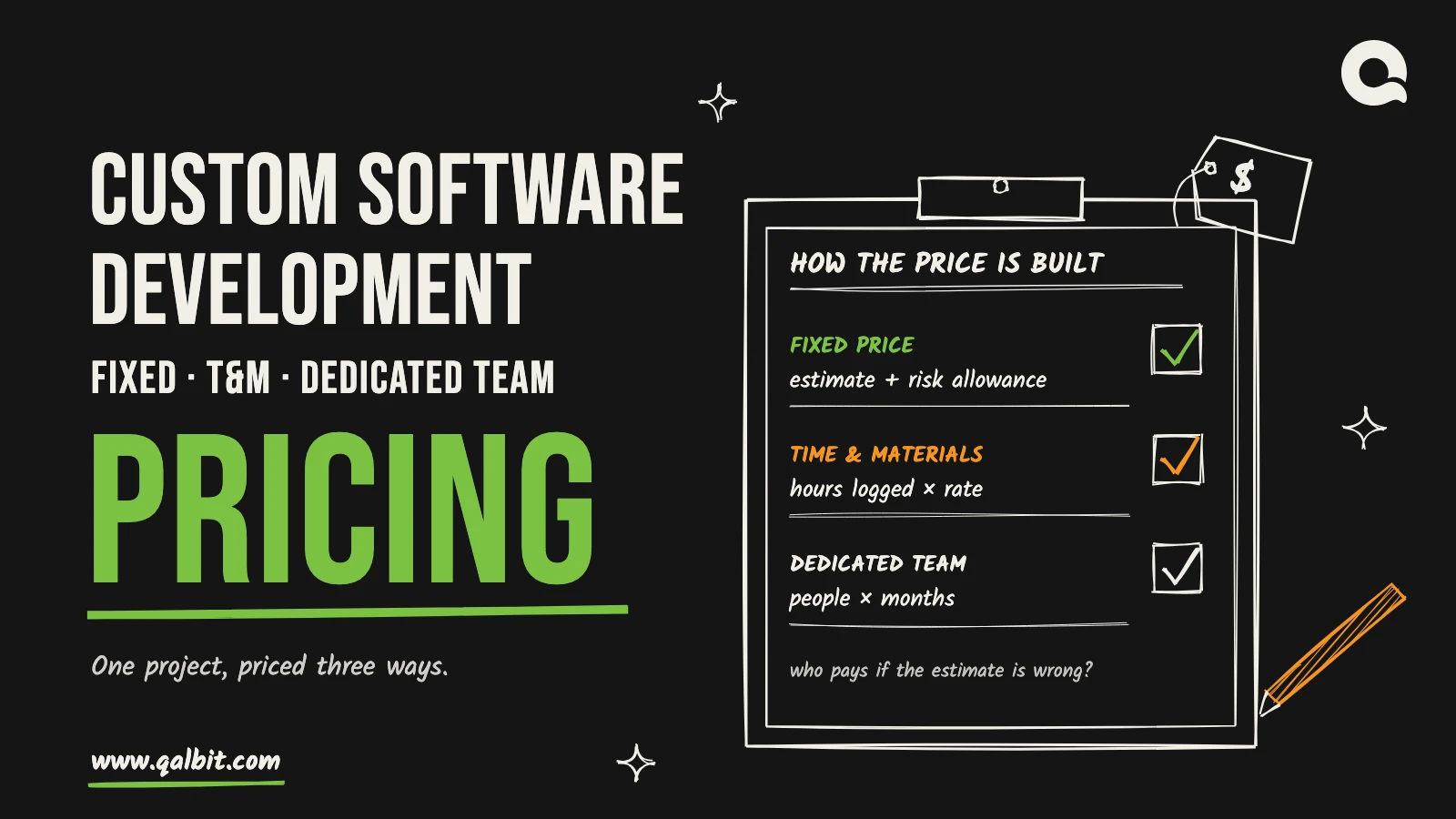
Software needs fixes, updates and small changes after it goes live. Our engagements include thirty days of support after release; after that, our support retainer starts from $1,400 a month, and unused hours roll one month forward. Changes during the build are a separate question. On a fixed price, every change is quoted in writing before anyone builds it, so ask how a vendor prices them and how quickly you get the number. Our guide to fixed price, time and materials and dedicated teams shows how each model handles change.
From a custom software quote to a first-year cost
To see how far the full cost can sit from the quote, take a piece of custom business software quoted at $20,000, near the middle of our range for that type. Here is a first-year budget built around it: the build, then its first twelve months in use. The build is an example from our range; the other figures are ours or a named source, except the two marked as assumptions, which you should replace with your own.
| Line | First year | Basis |
|---|---|---|
| The build | $20,000 | The quote |
| Changes during the build | $2,000 | Assumption: 10% of the quote |
| Hosting and services | $3,600 | Assumption: $300 a month |
| External security test | $5,000 | Low end of DeepStrike’s benchmark |
| Support after the first 30 days | $15,400 | Our retainer floor, $1,400 × 11 months |
| First-year total | $46,000 | 2.3 times the quote |
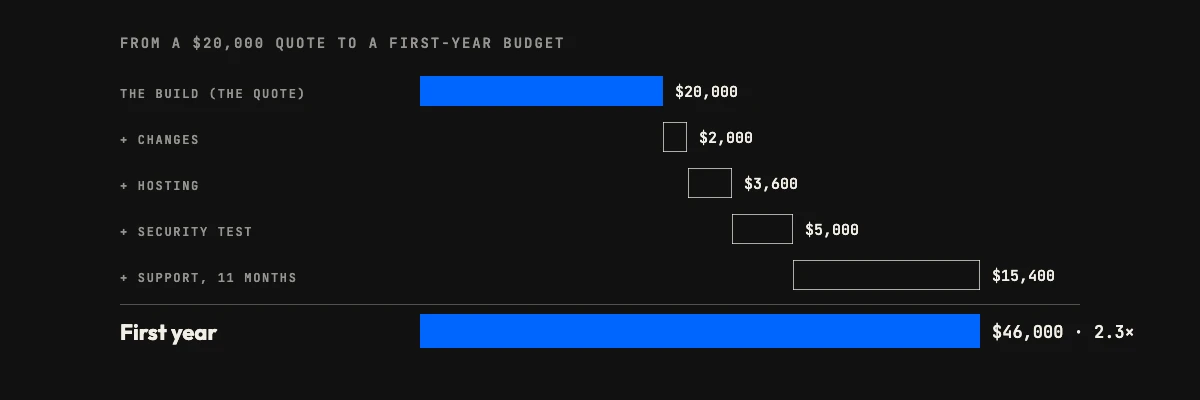
Not every project needs every line. A tool used by ten people inside your company may never need an external security test, and a stable product may need far less support than a retainer buys. Decide each line before the invoice decides it for you. A quote is the price of building the software; the first-year budget is the price of owning it.
How to compare two quotes on the same terms
Send every vendor the nine line items and ask them to mark each one as included, quoted separately or excluded, with an estimate for anything outside their price. Then, before you compare totals, add the estimates to each quote. A quote that looks cheaper often stops looking cheaper once its missing lines are filled in.
Three answers are worth reading closely. The first is how a vendor treats data migration: a fixed number before anyone has seen your data is a guess. The second is what happens on day thirty-one: a vendor with no support offer is leaving you to find another team. The third is how changes are priced: “we’ll discuss it” is not a process.
When an average is still useful
The average cost of custom software development is a sanity check, not a budget. Before you lean on one, check what it describes: the year it was collected, the currency, and whether it counts agencies, freelancers or both, because each of those measures a different market. If a quote falls well below the published range for its project type, find out which of the nine lines it leaves out. If it sits well above, ask what it includes that the others don’t; sometimes that is the better quote. For anything firmer, the calculator gives a range for your own project shape, and a written scope gives you a number you can hold a vendor to.
The average cost of custom software development is $132,480 in Clutch’s data, but the most common band among reviewed projects is $10,000 to $49,000. Measured against our own published pricing, a first release runs from $6,500 for a startup MVP to $52,500 for the first phase of an ERP. Neither figure tells you what your project will cost, or what a quote at that price leaves out.
We are a senior engineering team in Ahmedabad that has built software for clients in the US, the UK and the Gulf since 2018, and we publish our prices. If you want a number for your own project before you talk to anyone, our software development cost calculator gives a range in about a minute. For the full set of drivers behind any estimate, read what custom software actually costs, and what moves the number. This post is narrower: what an average hides, and the line items to check before you compare one quote with another.
Why the average cost of custom software development misleads
Clutch’s figure comes from verified client reviews on its platform, updated in September 2026. Clutch calls it an average and does not say how it is worked out; read as a mean, it is pulled upwards by a handful of very large projects. When the most common band is $10,000 to $49,000 and the average lands at more than twice the top of that band, the few expensive projects are doing the lifting. The typical project costs far less than the average one.
A simple example shows how much one large project can move a mean. If nine projects cost $30,000 each and a tenth costs $1 million, the average is $127,000, yet nine out of ten cost less than a quarter of that. That is why a published average can look high next to the quotes you actually receive.
Two more things make any published average a weak guide. It mixes a five-screen internal tool with a multi-year platform, because both are “software development projects”. And it says nothing about what each price included. One review’s $40,000 might cover design, testing, hosting setup and three months of support. Another’s might cover the code and nothing else.
Average cost of custom software development, by project type: our ranges
A range for the kind of project you have is more useful than one number for all of them. These are our published ranges for a first release, assuming one platform, standard interface patterns and up to two integrations:
A third system to connect, a legacy dataset to migrate or a second platform moves a project up its range. A narrower first release moves it down.
Nine line items behind the average software cost
Two quotes for the same total can buy very different things. The difference usually sits in a short list of items that one vendor prices in, another prices separately, and a third never mentions until the invoice arrives. Here are the nine we would check, and where each one sits in our own quotes: