The trade is flexibility for a total you can’t know in advance: the final figure is unknown until the work is done, and the risk of a slow estimate sits with you.
Dedicated team: people, by the month
You pay for a team’s full working month, per person, whatever the month is spent on. Ours bills in advance, you interview every engineer before they join, and thirty days’ notice scales the team down or ends it. There is no scope document at all; the team works through your backlog in your tools.
What you buy is capacity and retained context. A team that has been on your product for six months knows why the code looks the way it does, and that knowledge is the part a new vendor would charge you to relearn.
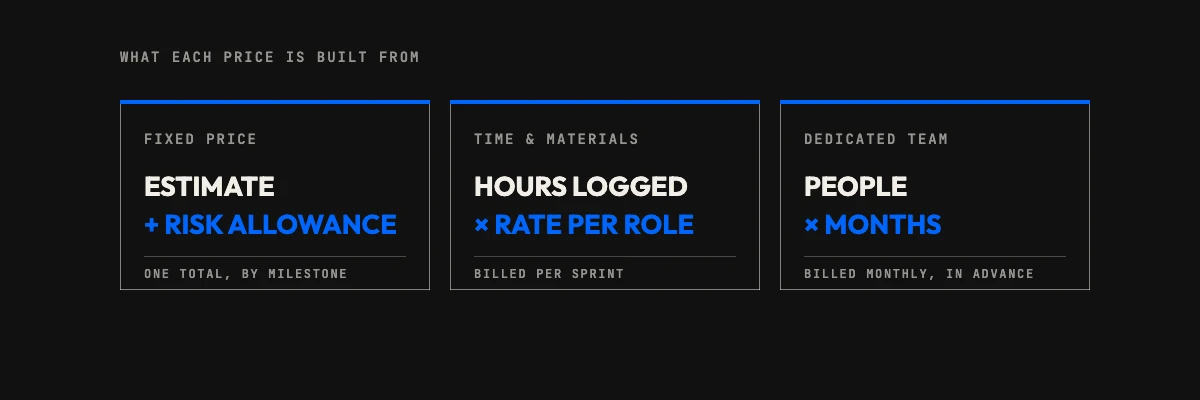
| The question | Fixed-price quote | Time and materials | Dedicated team |
|---|---|---|---|
| The price is built from | Estimate plus a risk allowance | Hours logged × rate per role | People × months |
| The final total is known | Before work starts | When the work ends | Month by month |
| A low estimate costs | The vendor | You | You, in extra months |
| Extra scope costs | You, as a priced change | You, in extra hours | You, in extra months |
| Billing rhythm | By milestone | By sprint | Monthly, in advance |
| Waiting on your decisions costs | You: client-side delays sit outside the fixed price | Less, if the vendor can move people meanwhile | You: the month is already paid |
The last row is the one buyers forget. You pay a dedicated team for its month whether or not your side kept the backlog full. If decisions stall for a week waiting on a stakeholder, a team still costs a week. Under time and materials the vendor can often move people to other work and stop logging hours, though you lose some context when they come back.
One project, priced three ways
Comparisons of custom software development pricing usually stop at “it depends”. The dependency is easier to see with numbers, so here is a single project run through all three.
The team is the same four people we used in our guide to converting software rates into one unit: one senior engineer, two mid-level engineers and a QA engineer. On our rate card that team costs $13,400 a month, which is $20.94 an hour across 640 working hours. To isolate the model, every column below uses that same hourly figure, including time and materials; a real time-and-materials quote states its own rate for each role. The estimate is 1,920 hours: twelve weeks, or three full months, of the whole team.
For the fixed price we assume a 20% risk allowance on top of the estimate, so the quote is $48,240. That percentage is illustrative. Vendors rarely state theirs, and asking what it is should be one of your first questions.
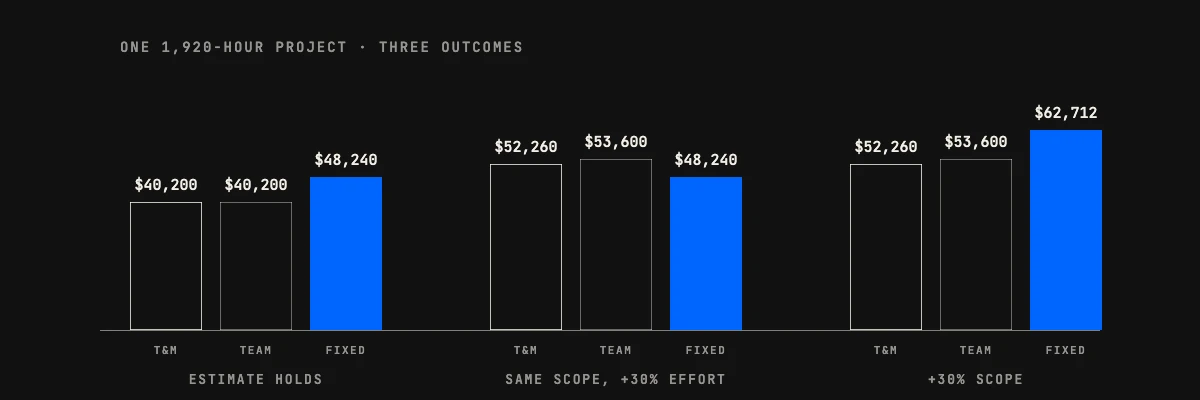
| What happens | Hours worked | Time and materials | Dedicated team | Fixed price |
|---|---|---|---|---|
| The estimate holds | 1,920 | $40,200 | $40,200 | $48,240 |
| Same scope, 30% more effort | 2,496 | $52,260 | $53,600 | $48,240 |
| You add 30% more scope | 2,496 | $52,260 | $53,600 | $62,712 |
When the estimate holds
The fixed price is the most expensive option by $8,040, the full risk allowance. You paid for insurance and didn’t claim on it. Time and materials and the dedicated team cost the same here because they are the same people at the same rate for the same three months.
When the same scope takes 30% longer
Now the fixed price wins. The work needed 576 more hours than planned, and the vendor carries all of them. Under time and materials, those hours land on your invoice: another $12,060, for a total of $52,260 against the fixed $48,240. The dedicated team costs a little more again, $53,600, because it bills whole months in advance: the extra hours need most of a fourth month, and you pay for all of it. The spare capacity isn’t lost, since the team moves on to the next items in your backlog, but it is spent.
When you add 30% more scope
Here the fixed price is the most expensive option by a distance. The extra 576 hours are new work, so they arrive as a change request. If the vendor prices it the way it priced the original quote, allowance included, as many do, that adds $14,472 to $48,240. Time and materials absorbs the same new work for $12,060, because there is no allowance to pay on it.
The break-even rule
A fixed price at a 20% allowance only beats time and materials if the work would have overrun by more than 20% on the same scope. Below that line, you are paying for cover you didn’t need. And a fixed price protects you from a bad estimate, never from your own changes of mind. If you expect the scope to grow, you may well pay the allowance on the growth as well.
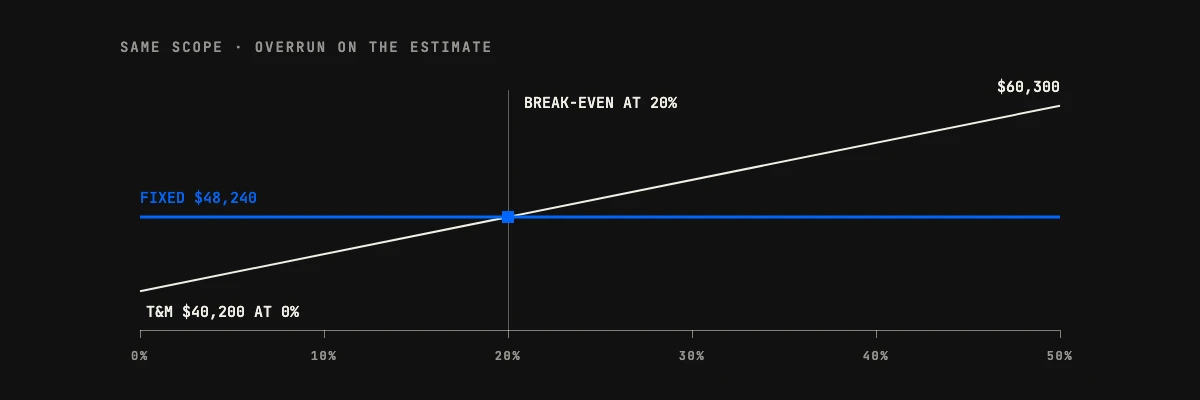
So the real question is which risk you are more exposed to. Overruns on agreed scope are common enough that the insurance is often worth buying. Summarising earlier survey work, Magne Jørgensen of Simula Research Laboratory put the average software project cost overrun at about 30% in a 2006 paper on software bidding, comfortably past a 20% line. Scope growth is the other risk, and it is the one buyers control. PMI’s 2018 Pulse of the Profession found that 52% of projects experienced scope creep, up from 43% five years earlier.
What changes custom software pricing after you sign
Most budget overruns happen after the quote is signed. What protects you is how each model handles change.
Change requests on a fixed price
On our fixed-scope work, you raise a change with a message, and we quote it in writing within 48 hours: the cost, the effect on the delivery date, and what it displaces if the date has to hold. We build nothing until you approve it in writing. Ask any vendor for the same three things. A change process that only states a cost hides the effect on the date.
Caps and sprint boundaries on time and materials
The protection on time and materials is visibility. You see the hours every sprint, so a drifting feature shows up after two weeks, not after two months. A monthly cap turns the open-ended total into a ceiling, and the sprint boundary gives you a clean point to stop, pause or redirect.
Scaling a dedicated team up or down
A team’s price only changes when its size does. Our dedicated teams start with a two-week paid trial, and thirty days’ notice removes a role or ends the arrangement, with no annual contract and no exit fee. Adding a role is how the price goes up, and it should be your decision, made at a monthly review, rather than something the vendor proposes mid-sprint.
When you pay: custom software pricing and cash flow
Custom software development pricing also shapes your cash flow. The same project produces very different invoices along the way, and that affects your leverage as well as your bank balance. Here is how we would invoice the example above if the estimate held, with the milestone split of our twelve-week template.
| Model | Invoicing | Invoices for the example |
|---|---|---|
| Fixed price | Five milestones: 20%, 20%, 25%, 20%, 15% | $9,648, $9,648, $12,060, $9,648, $7,236 |
| Time and materials | Per two-week sprint, on hours logged | Six sprints of $6,700 |
| Dedicated team | Per month, in advance | $13,400 at the start of each of three months |
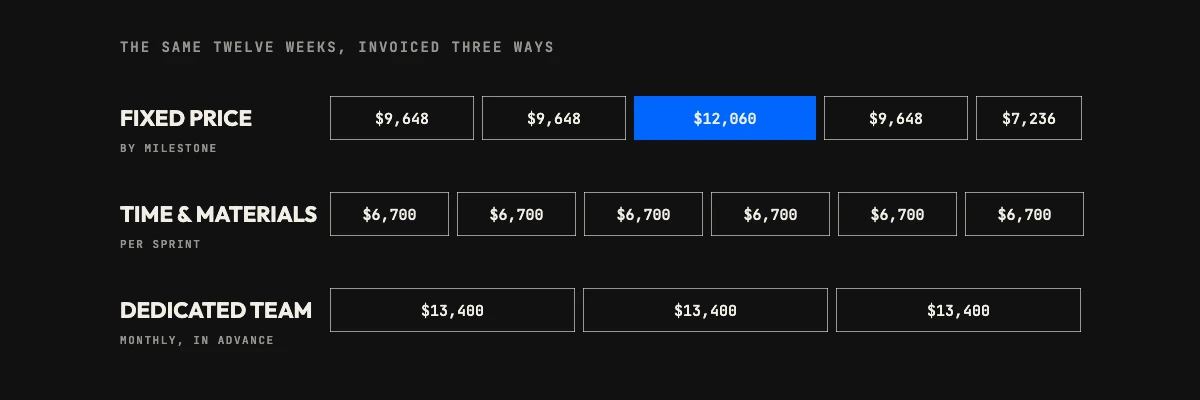
Milestone billing keeps your leverage until the end: the final payment is the smallest, and by the time it is due you already hold the code, the repositories and the documentation. Paying in advance for a team asks for more trust up front, which is why the trial period and the right to interview each engineer exist.
Which custom software pricing model fits your project
Start from how much of the work you can write down today, not from which model sounds safest.
- Choose a fixed price when you can describe what done looks like and are willing to freeze it: a first release, a bounded module, or a budget your board must approve as one number.
- Choose time and materials when you know the direction but expect real users to change the details, and someone on your side can set priorities every sprint.
- Choose a dedicated team when the roadmap has no end date and you have no engineering team of your own to hold it.

The models are not exclusive. A common path for our clients is a fixed-price first release, then a monthly team once the product is live and the backlog keeps growing. We agree that switch at a milestone, so neither side is mid-sprint when the terms change. If you want to know what moves the total within any of these models, our guide to what custom software actually costs covers the scope decisions that matter more than the rate.
Five pricing questions to ask a custom software vendor
- What risk allowance is inside this fixed price, and what is it for?
- How is a change request priced, and how quickly do I get the written quote?
- Can I put a monthly cap on time and materials, and what happens when it is reached?
- On a dedicated team, what do I pay for the weeks when my side is slow?
- Can we switch models at a milestone, and on what notice?
Get all five answers in writing before you sign. If you would like our answers for your own project, send us two lines about it at business@qalbit.com; you will get a recommended model and a written price range within 48 hours.
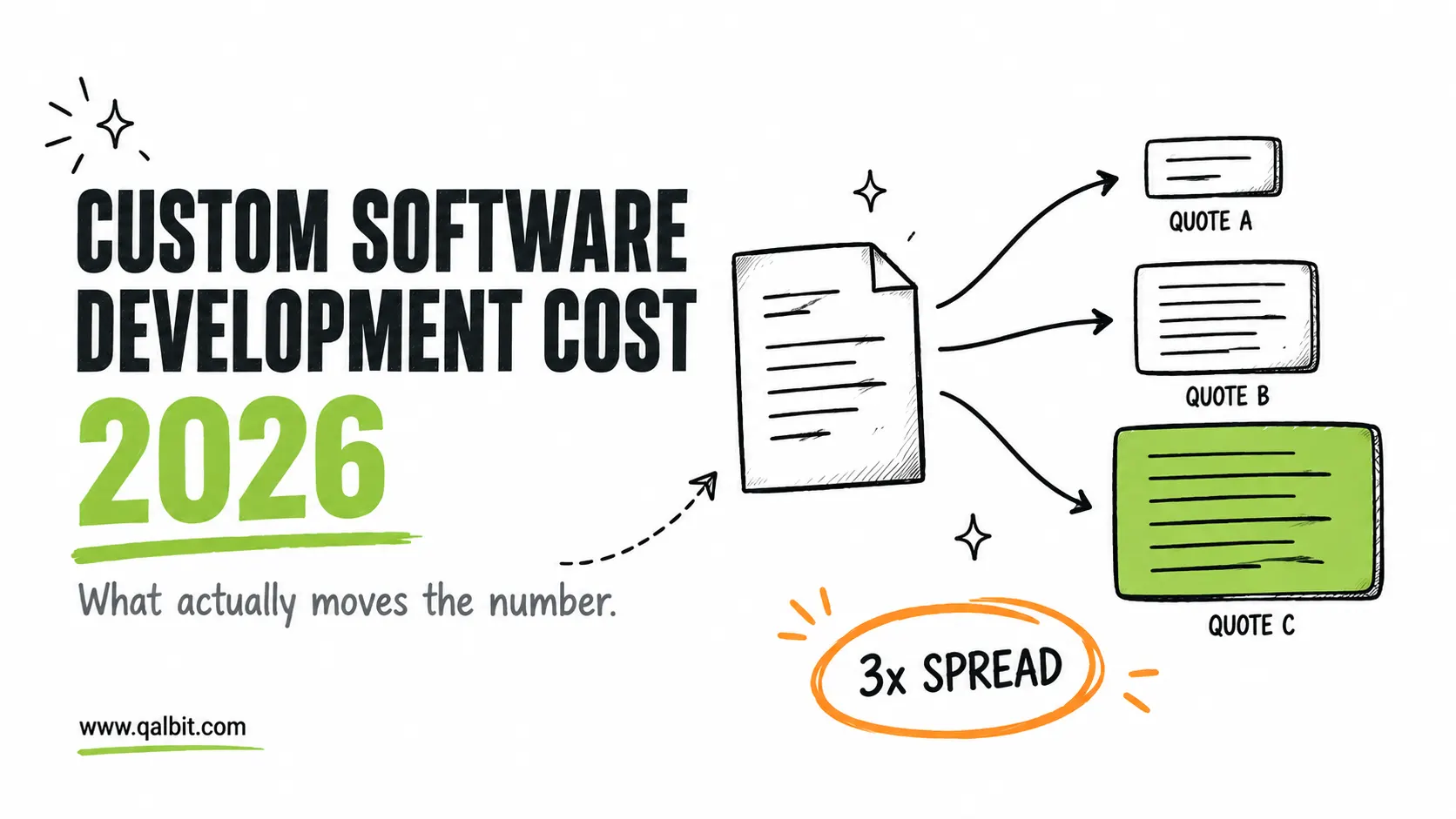
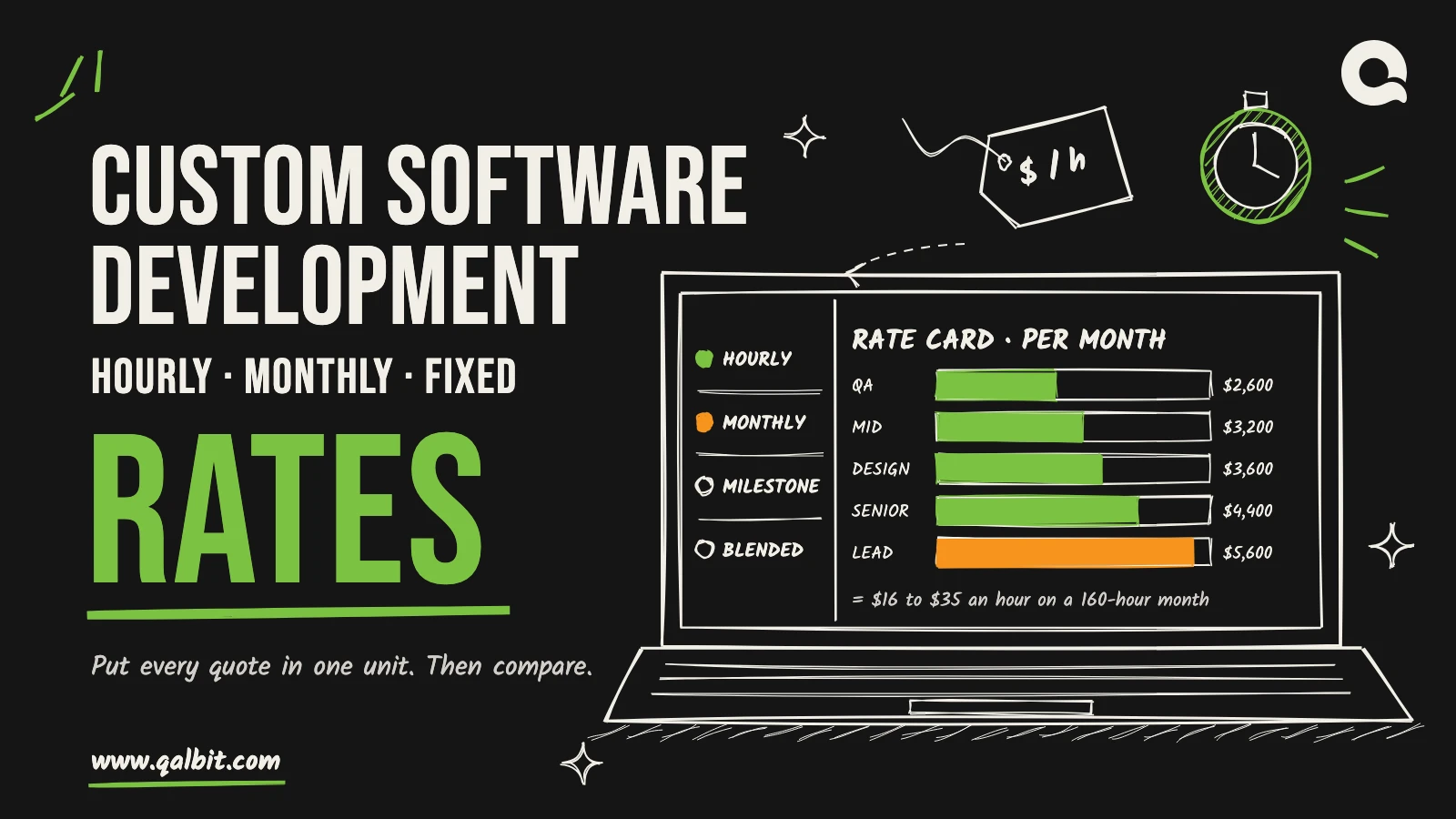

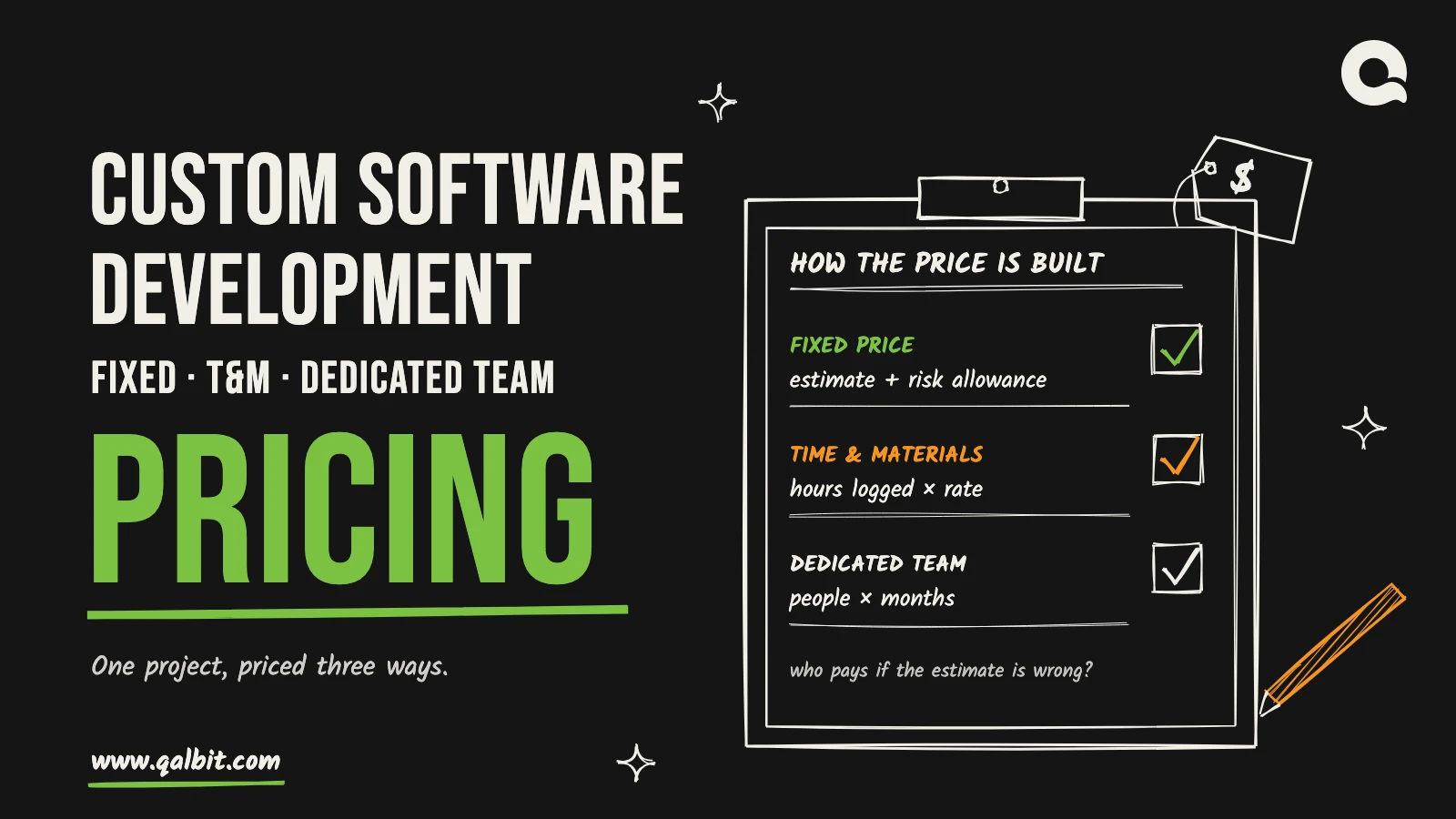
Custom software development pricing comes in three models: a fixed price from $6,500, hourly time and materials, or a team at $3,200 an engineer a month. Those are the floors on our published pricing. The model you choose matters more than the rate: it decides who pays when the estimate turns out wrong, and who pays when you change your mind halfway through.
We are a senior engineering team in Ahmedabad, building software for clients in the US, the UK and the Gulf since 2018, and we sell all three, so we have seen each model go well and go badly. If you want the short version of how ours work, one page sets our three pricing models for software projects side by side, and another publishes our rates and project ranges. This guide shows the arithmetic behind custom software development pricing, with one project priced three ways.
Back in 2022 we compared fixed price and hourly rates for web projects. This is the fuller version: it adds the dedicated team, and it puts real numbers on what each model costs when things go to plan and when they don’t.
How custom software development pricing works
Each model prices something different: a scope, the hours worked, or a team’s months. Most of what separates them follows from that.
Fixed price: a number for a defined scope
The vendor estimates the work, adds an allowance for the risk of being wrong, and commits to one total for a scope that both sides sign. You pay in instalments as each part is delivered. Ours runs to five milestones on a typical twelve-week build, split 20%, 20%, 25%, 20% and 15%, and each one ends in something you can open: a scope document, a clickable prototype, working software on staging, a tested build, then the release.
What you buy is certainty about the total for that scope. If the work takes longer than the vendor estimated, that is the vendor’s problem. If you add to the scope, it is not: the vendor quotes new work separately.
Time and materials: the hours that were worked
You pay for the hours logged against your project, at an agreed rate for each role. We bill it per fortnightly sprint, share the timesheets, and put a monthly cap on it when a client wants one. Scope stays open, so you can change direction between sprints without renegotiating a contract.