Software development company · Arizona
Software development company in Arizona.
QalbIT is a software development company working for Arizona businesses from Ahmedabad, India: suppliers to the semiconductor and advanced-manufacturing cluster around Chandler and the East Valley, aerospace and defence contractors in Mesa and Tucson, healthcare groups across Maricopa and Pima counties, the finance and insurance back offices that Phoenix hosts for the rest of the country, home builders and brokerages, and the freight forwarders working the Nogales and San Luis crossings. There is no QalbIT office in Arizona, and this page sets out exactly what that changes.
Two things make Arizona unusual for a remote partner, and both are on this page: the state keeps the same clock all year, which fixes our overlap, and some of its best-known work sits under export-control and criminal-justice rules that a supplier outside the country cannot take on.
2018
Building software since
50+
Clients served remotely
3 hours
Live with Phoenix, fixed all year
5.0
Clutch rating, 8 reviews
Get your free estimate
Three quick questions: scope, approach and a price range back within 48 hours. No sales call required first.
Definition
What a software development company in Arizona does for you when it is not in Arizona
A software development company in Arizona designs, builds and runs software shaped to one organisation’s work: a traceability system for a Chandler supplier, a servicing portal for a Phoenix lender, a scheduling tool for a Tucson clinic group. QalbIT does that work as a remote engineering partner from Ahmedabad, India, on a Phoenix morning that never changes, under an Arizona-law contract and with no office in the state.
The code is the same wherever the engineers sit. The clock, the contract and the eligibility rules are not.
A firm in Tempe or on Camelback Road is inside your jurisdiction. Someone can drive to your site, the invoice is domestic, and procurement recognises the supplier. A partner outside the country has to earn the same confidence on paper. That is what custom software development includes from us before a line of code: a written scope with the exclusions named, an architecture your technical lead can challenge, a data-handling position your compliance function has seen, and a working window that starts when your day does.
None of that is unusual, and all of it is easier to settle before a contract than after a security review.
We are the remote option. We would rather argue the case here than have it surface in month four.
At a glance
What we build
Quality and traceability systems, servicing and broker portals, SaaS products, offline-first mobile apps, integrations
Engagement shapes
A first release · a rebuild of an ageing tool · modules over an ERP or MES · a standing engineering pod
Hours
Remote from Ahmedabad, live 08:00 to 11:00 Arizona time Monday to Friday, the same in every month
Presence in Arizona
None. No office, no staff, no United States entity. Your MSA, Arizona law
Not eligible for
ITAR-controlled technical data, CJIS-covered systems, contracts requiring US-performed work
Definition
Arizona agency, contract staffing firm, remote engineering partner
Three purchases that get compared on price when they are not the same purchase.
Arizona agency
Registered in the state, on Phoenix time all day, able to put people in your building. You are buying proximity, a domestic contract and eligibility for work that has to be performed in the United States. The right answer when the work is stakeholder-heavy, needs hands on a floor, or sits under ITAR or CJIS.
Contract staffing firm
Engineers billed by the hour into a process you already run. You are buying capacity, and architecture, review, testing and release stay with your own lead. The right answer when you have an engineering manager with room to direct more people.
Remote engineering partner
A small senior team that owns a defined build, works your morning from outside the country, and hands over the repository at the end. There is no local entity, so contract, tax form and questionnaire are dealt with at the start. The right answer when you know what the system must do and want it built properly the first time.
We are the third. When one of the other two fits you better, you hear it on the first call rather than after a deposit.
Fit
When an Arizona company should hire a remote software development company, and when it should not
Both lists, in the open. A page arguing only one side is not helping you decide.
Hire a remote partner when
- Somebody on your side can describe the process and decide about it without convening a committee.
- The engagement has edges: a first release, a rebuild, a set of modules, not an open-ended programme with a rotating sponsor.
- Three live hours every morning cover what needs a conversation, and the rest of your day can run on a written handover.
- You want the source, the pipeline and the documentation in your own accounts when the work is finished.
- The data is regulated in the ordinary way, health, financial or card data, and your compliance function will set the rules and check our evidence against them.
Hire in Arizona instead when
- The system touches ITAR-controlled technical data or CJIS criminal-justice information. A supplier outside the United States is the wrong answer, and we will say so immediately.
- A procurement rule, a grant condition or a customer flow-down requires a supplier incorporated in the United States or work performed on US soil.
- People have to be physically present: a fab-floor integration, a jobsite rollout, hardware in a rack, a clinic go-live.
- Your security policy bars production access from outside the United States and the work cannot proceed on masked data.
- The real need is extra hands under your own architect, in which case a staffing firm will cost you less management overhead than we would.
What that looks like for an Arizona buyer
Arizona’s marquee employers, the fabs, the defence primes and the national back offices, run vendor-risk programmes of long standing, and their suppliers in the East Valley have learned to answer the same questionnaires. The distinctive part of the state is how much work sits under export control or criminal-justice rules, where the question is not how good a foreign supplier is but whether one is permitted at all. We put that question first, on the scoping call, so that the rest of the conversation, access, logging, change control, backups, is only had about work we are actually eligible to do. We turn down Arizona projects on the second list, and the ITAR and CJIS rows are not negotiable. A remote build where a Phoenix firm was the right answer costs far more than the fee.
Next step
Not sure which list you are on?
Send us what the system has to do, what data it holds and whether any of it is export-controlled. You will get a straight answer, including “hire someone in Phoenix” when that is the honest one.
Comparison
Remote software development company vs an Arizona agency vs a staffing firm
Every row is a real difference, including the ones that go against us. There is no rate row because we have no sourced figure for what Arizona firms charge, and inventing one would be worse than leaving it blank. We will run this table against your real scope, your data and your procurement rules, not the generic case.
| Arizona agency | Contract staffing firm | QalbIT (remote partner) | |
|---|---|---|---|
| Can be in your building | Yes | Often | No |
| Live hours on Arizona time | All day | All day, in most cases | 08:00 to 11:00, fixed year-round, then a written handover |
| Architecture is owned by | The agency | Your lead | Us, reviewed with your technical lead |
| Testing and release are owned by | The agency | Your lead | Us, with your sign-off as the gate |
| Contract and governing law | Domestic | Domestic | Your MSA, Arizona law, invoiced in US dollars |
| Source code and IP | Depends on the contract | Yours | Yours, assigned as each piece is written |
| ITAR technical data, CJIS systems | Eligible, with the right controls | Eligible, with screened staff | Not eligible |
| US-only work-location clauses | Eligible | Usually eligible | Not eligible |
| Team continuity | Shifts with agency workload | Turns over with the contract | Small, senior, named in the proposal, unchanged |
01
Start with the rows we lose.
A table where one column wins everything is a brochure. Four rows above are reasons to hire somebody else, and it is better to find them here than in month four of a contract you cannot exit cleanly.
02
ITAR and CJIS are eligibility questions, not quality questions.
Export-controlled technical data cannot be shared with foreign persons without authorisation, and criminal-justice information carries its own personnel rules. However good the engineering, a supplier outside the country is generally not the right one for that work.
03
Where the code runs and where the engineers sit are different questions.
Your platform can live in a US cloud region, in your own account, while the people writing it sit elsewhere. Most vendor-risk conversations resolve once that distinction is on the table.
04
Staffing adds hands; it does not add a system.
Contract engineers are capacity for a process you already run. If nobody on your side holds architecture, review and release quality, that capacity produces code faster than it produces working software.
What we build
Software development services we deliver for Arizona companies
Systems that share one record, so a lot, a loan, a load or a patient moves through operations, finance and compliance without being retyped at each desk.
Manufacturing
Quality, traceability and scheduling systems
Lot genealogy, non-conformance handling, calibration records and shop-floor scheduling for the suppliers feeding the Chandler fabs and the aerospace plants in Mesa and Tucson, where the customer audit is the real acceptance test.
Portals
Servicing, broker, patient and supplier portals
A portal over the system you already own, with role-scoped access, document handling and an audit trail that survives a review. The fastest way to take volume off a Phoenix service desk that handles work for the whole country.
SaaS
SaaS products and first releases
Multi-tenant products with billing, roles and usage limits for a Tempe or Scottsdale founding team, or for a company productising something it already runs for itself.
Mobile
Offline-first apps for crews and drivers
One Flutter codebase for iOS and Android, capturing on a jobsite, on I-10 or inside a plant with no coverage and syncing when it returns. Hellory, a reminder app we built the same way, creates a reminder in under fifteen seconds and syncs on reconnect.
Integrations
ERP, MES, EHR and broker-system integration
Queues, retries and a reconciliation screen between your system of record and the tools around it, so a failed message is seen by a person rather than lost in a log.
Cloud
Cloud environments and release pipelines
AWS accounts in your name, in the US region you choose, defined as code and released in stages with monitoring and the change history a security questionnaire asks you to show.
Cost
How much does a software development company in Arizona charge?
Custom software for an Arizona company is priced on the scope of the first release, the number and age of the systems it connects to, and the evidence it has to produce for customers and auditors, not on headcount. At QalbIT, fixed-scope projects start from $6,500 and a scoped first version typically from $5,000. A written scope with the exclusions named comes back within 48 hours of the first call, and a first release usually ships 6 to 14 weeks after that scope is signed.
Those are our own floors and the only cost figures on this page. Search the question and you will find ranges a factor of ten apart, published with nothing behind them. We are not adding to that.
We do not quote what a Phoenix or Tucson agency charges either, because we have no figure we could attribute to anyone. Send one written scope to three Arizona firms and you will know more than any page can tell you.
What we do is scope first: a discovery call, a written scope with the exclusions listed, and a fixed price for phase one before you commit beyond discovery. The drivers below are what move the number, so you can test any quote, ours included.
Try the software development cost calculatorWhat moves the number
What the first release has to do
The largest driver and the most common mistake. One workflow built properly beats four built thinly, and a first release that does one job well is the easiest thing to fund a second phase from.
The systems it connects to
A documented REST API with OAuth is quick. An MES that exports a flat file nightly, or a broker system with no API at all, needs a middleware layer and a reconciliation view of its own.
Evidence for customers and auditors
Traceability records, access reviews, breach-scoping logs and retention rules are engineering work. Designed in from the first sprint they are modest; retrofitted after a customer audit they are a project.
Roles and approval chains
Two user types is a data model. Eight, with delegated authority, segregation of duties and a maker-checker step on payments, is a system in itself.
Platforms and the offline case
Web only, web plus one mobile platform, or web plus iOS and Android with offline sync. Each step adds build and test work, and offline adds conflict handling that must be designed rather than assumed.
How much history moves
Master records and open items are routine. Years of lots, loans or loads, reconciled against the old system and signed off by finance, is a workstream with its own estimate.
How we work with Arizona teams
A software development process for Arizona, on a clock that never changes
Arizona keeps Mountain Standard Time all year and India keeps IST all year, so the twelve-and-a-half-hour offset between Phoenix and Ahmedabad is the same in January and July. We plan around it rather than pretend it away. Here is how a project runs from scoping call to release for an Arizona team.
Discovery and written scope
One call about how the work moves, who touches it and where it breaks, and whether any of the data is export-controlled. Then a written scope with the exclusions named. The document is yours regardless.
A scope, a first-phase price range, an eligibility answer and the name of the engineer who would lead it.
48 hours
Prototype and architecture
Clickable screens in week one so your quality manager or servicing lead argues with something real. Alongside them: data model, access control, the US hosting region and the rollback path, agreed in writing before an editor is opened.
Approved screens, an architecture your technical lead has challenged, a data-handling position your compliance team has seen.
1 to 2 weeks
Build in two-week slices
Working software demonstrated every fortnight at 08:00 Phoenix time, on your real records. Each slice is checked against the scope with you on the call, so progress is watched rather than reported.
Working modules proven against real scenarios, and a backlog you shaped along the way.
6 to 14 weeks, by scope
Harden, then release
Permissions, load behaviour, backups, monitoring and a rehearsed rollback signed off before an Arizona user logs in. Where traceability or access-review evidence is required, it is produced here rather than promised.
A release your security reviewer can sign off, evidence included.
2 to 3 weeks
Run and extend
Monitoring, a support window on Arizona hours, a critical fix within 48 hours, and the next feature chosen from what your people actually use.
A platform that keeps earning its place, and a team that hands it to yours whenever you ask.
Monthly, 30 days notice
Phoenix is twelve and a half hours behind Ahmedabad, in every month of the year, because neither Arizona nor India observes daylight saving. Our live window is 08:00 to 11:00 Arizona time, which is 20:30 to 23:30 IST. Stand-ups, demos and decisions sit inside it, and a written handover goes out before we close, so your afternoon never waits on us. The Navajo Nation, which does observe daylight saving, is the one exception in the state.
Book a scoping callWhere we fit
Arizona projects that work well from a distance
These are the engagements a remote team does well. The ones that need bodies on site or a US-only supplier are listed higher up, and we mean that list.
First build
Replacing the spreadsheet that runs the plant or the desk
A quality lab, a servicing team or a dispatch office held together by workbooks, email and one person who knows the exceptions, rebuilt as a system with roles, approvals and a history of who did what. For operations, quality and finance teams at growing companies.
Rebuild
Retiring a tool the vendor no longer supports
An old desktop application or an early web tool rebuilt as a maintainable platform without losing years of records or retraining a plant over a weekend. For companies whose core tool has outlived its maker.
Customer audit
Getting ready for the customer that audits its suppliers
Adding lot traceability, access reviews, an audit trail that cannot be edited and retention rules to a platform built before a fab or a prime started asking for them. A supplier questionnaire is usually the trigger. For suppliers facing a customer audit or a framework alignment.
Extension
Building around the system of record
Portals, dashboards and custom modules over an ERP, an MES or an EHR, so the core stays put and the rekeying around it disappears. It is the shape of a vendor decision platform for CISOs we have run in production for four years: one system of record, a comparison engine over it, no rewrite since launch. For companies extending rather than replacing a core system.
Industries
Industries a software development company serves in Arizona
Operational software takes the shape of its industry. These are the Arizona sectors where our process knowledge carries over and the compliance questions are ones we have met before.
Semiconductor and advanced-manufacturing suppliers
Traceability, non-conformance, calibration and scheduling systems for the machine shops, chemical and gas suppliers, cleanroom contractors and logistics firms feeding the fabs around Chandler and the East Valley. The customer audit is the acceptance test, so the evidence is designed in.
Aerospace and defence, where we are eligible
Non-controlled work for contractors in Mesa and Tucson: supplier portals, quality systems, training and certification tracking, internal tooling. Where a programme carries ITAR-controlled technical data, we are not the supplier, and the scoping call says so.
Healthcare across the Valley and Tucson
Scheduling, referral, intake and care-coordination tooling around an existing EHR for clinic groups, behavioural-health providers and the specialist practices that serve a retiree population. Where protected health information is in scope we build to the HIPAA Security Rule safeguards.
Financial services back offices in Phoenix
Servicing portals, operations workbenches, document handling and reporting for the lenders, insurers and card operations that run national volume from Maricopa County. Maker-checker rules, segregation of duties and a complete audit trail shape the build.
Real estate, home building and construction
Lot and phase tracking, warranty and punch-list systems, subcontractor portals and buyer-facing status tools for the builders and brokerages growing with the Valley, with the offline case built in for people on a jobsite.
Cross-border logistics through Nogales
Load tracking, customs-document handling, warehouse and yard tools and proof of delivery for the freight forwarders and produce distributors moving goods through the Arizona-Sonora crossings, where one shipment has to stay in one state across three systems.
If your sector is missing, the first question is the same: what does a day of this work look like, and where does it break?
Next step
The packaged product bends until it breaks. Then it is a custom build.
Describe the process the vendor tool cannot follow and we will tell you whether it justifies a build, or whether configuring what you already own would do.
Arizona compliance
Building software in Arizona: breach duties, sector rules and the controlled-data line
The rules below shape how software gets built for an Arizona company and set the questions a supplier outside the country has to answer before a signature. We are engineers rather than lawyers: this section describes what we build, and your counsel decides what applies to you.
Breach notification under A.R.S. 18-551 and 18-552
Arizona requires a person or business that owns or licenses unencrypted computerised personal information about Arizona residents to notify affected individuals when a security incident results in unauthorised acquisition of that information, and to notify the Attorney General and the consumer reporting agencies where a large number of residents is affected. The statute sets a time limit and a threshold for those notices, which we deliberately do not restate here. The engineering consequence is that you cannot notify accurately unless you can answer which records were reached and by whom. Retained access logs, an audit trail that cannot be edited, alerting on unusual access and a rehearsed procedure for reconstructing an incident are part of the build, and encryption at rest is designed in rather than added later. Deciding whether, when and how to notify is for your counsel and your incident response plan. Our part is to make sure the facts are available fast and can be trusted. Sources: Arizona Revised Statutes 18-551 and 18-552, notification of security system breaches · Arizona Attorney General.
Incident duty
ITAR and CJIS: the line we do not cross
The International Traffic in Arms Regulations restrict access to controlled technical data by foreign persons, and the FBI’s CJIS Security Policy imposes personnel and access rules on systems holding criminal-justice information. A supplier outside the United States is, in the ordinary case, not permitted to receive the first and not able to satisfy the second. We do not hold any certification under either, and we do not describe our controls as compliant with them. What we can do is build the parts of a programme that sit outside the controlled boundary, supplier portals, quality systems, training records, internal tooling, and align their access and logging controls to the same expectations, so your compliance function is not managing two standards. Where the controlled boundary is unclear, we ask before scoping rather than after. Whether a given dataset is controlled is a question for your export-control or compliance officer. Tell us on the first call and the eligibility answer comes back the same day. Sources: International Traffic in Arms Regulations, 22 CFR Parts 120 to 130 · US Department of State, Directorate of Defense Trade Controls · FBI CJIS Security Policy.
Controlled data
HIPAA safeguards for protected health information
Where a system for an Arizona provider touches protected health information we build to the HIPAA Security Rule technical safeguards: unique user identification, automatic logoff, role-scoped access, encryption in transit and at rest, integrity controls, and an audit trail that records who read a record as well as who changed it. Minimum necessary is a data-model decision, made at design time. Whether a business associate agreement is required, and what it must say, is decided by your privacy officer and counsel. We build to the safeguards, work under your compliance team’s rules and hand them the evidence to sign off. Sources: HIPAA Security Rule, 45 CFR Part 164 Subpart C · US Department of Health and Human Services, Office for Civil Rights.
Health data
GLBA safeguards for financial data
For a Phoenix lender, servicer or insurer handling non-public personal information, the Gramm-Leach-Bliley Safeguards Rule expects a written information security programme with access controls, encryption, multi-factor authentication, monitoring and oversight of service providers. We build the controls the programme names and give your qualified individual the evidence that they operate, including evidence about us as a supplier. Scope and the content of your programme are for your compliance officer. We are one of the service providers your programme oversees, and we expect to be asked to prove it. Sources: Gramm-Leach-Bliley Act Safeguards Rule, 16 CFR Part 314 · Federal Trade Commission.
Financial data
PCI DSS, kept out of your codebase
The simplest way to handle card data is never to hold it. We tokenise at the processor, so the card number is captured by the processor’s hosted field or SDK and your platform stores a token, the last four digits and a brand. Your application never sees a primary account number, which keeps most of PCI DSS scope out of the code we write. The PCI obligation remains yours, and which self-assessment questionnaire applies depends on how you accept payments. Our job is to keep the scope narrow and to warn you when a feature request would widen it. Sources: PCI DSS v4.0.1 · PCI Security Standards Council.
Payments
SOC 2 questionnaires, from your customers and from you to us
A supplier to a fab, a prime or a national lender will be sent a security questionnaire mapped to the Trust Services Criteria before a contract is signed, and the engineers complete ours rather than a sales team. The answers describe what we operate: least-privilege access, review-gated change management, environment separation, logging and retention, tested restores, staged releases, incident handling and offboarding when an engineer rolls off. When the honest answer is no, we write no and put the compensating control next to it. Padding a questionnaire is how a supplier gets dropped from a shortlist at the last stage. Where your policy calls for the supplier’s own attestation report, raise it on the first call. You will get our current position in plain words, including where we fall short of the bar. Sources: AICPA Trust Services Criteria for Security, Availability, Processing Integrity, Confidentiality and Privacy.
Vendor risk
Arizona has no comprehensive consumer privacy statute of the kind some other states have enacted, so the rules above are the ones that bind most Arizona builds. They are re-verified before each publish, and if the legislature enacts one this page gets a row for it. Where a customer audit or a deadline drives your timeline, that date is where we plan backwards from.
Working with us
Contracting a supplier outside the United States from Arizona
Legal, finance, security and, in this state, export control each have a short list of questions about a vendor outside the country. Most vendor sites leave the list off. Here is ours with the answers.
The contract
Your master services agreement, under Arizona law, with the venue, liability and termination clauses your counsel asks for. We never ask an Arizona buyer to sign under Indian law, and we never run a project on an exchange of emails in place of a contract.
Governing law
Tax form and invoicing
Because we are not a US entity, a completed Form W-8BEN-E goes to your accounts payable team before any invoice is raised. Invoicing is in US dollars, against the milestones or the monthly rate the contract names, with your purchase order reference on every invoice.
W-8BEN-E
Export-control screening
We ask on the first call whether any data in scope is ITAR-controlled or otherwise export-restricted, and we expect your export-control officer to confirm. If it is, we decline that part of the work. If your policy requires a written statement of foreign-person status for your records, we provide one.
Before scoping
Intellectual property
Everything produced for you, code, designs, documentation, infrastructure definitions, is assigned to you at the moment it is created rather than when the last invoice clears. Repositories, cloud accounts and domains are yours from the first commit, and each engineer on the account has signed the same assignment and confidentiality terms.
Assignment
Confidentiality
Before anything sensitive changes hands there is a mutual NDA, on your template or ours. Your name, your product and your project are never used as a reference without your written consent.
NDA
Insurance, questionnaires and background checks
Certificates of insurance on request. Security questionnaires completed by the engineers who would do the work. Background checks on named engineers arranged through your process where your policy requires them, raised at contract stage because they add time before anyone can start.
Vendor risk
What the lack of a local entity rules out
There is no QalbIT entity in the United States, no Arizona office and nobody we can send to Chandler or Tucson on a Thursday. If a procurement rule, a grant condition, a customer flow-down or an export-control boundary requires a domestic supplier or US-performed work, we are simply not eligible, and we say so on the first call instead of discovering it after a proposal.
The limit
None of this is a reason to avoid a remote partner. It is a reason to do the paperwork properly at the start, and we raise it before the estimate rather than after the contract.
Tech stack
Technology behind the software we build for Arizona
A quality system or a servicing portal stays in service for years after it is written, so we choose tools a new hire can read in an afternoon and a future internal team can maintain without us.
Backend and business rules
- Laravel on PHP 8 for modular business systems with a complete audit trail.
- Node.js and NestJS where integrations and event-driven flows dominate.
- Queues, schedulers and retries for syncs, alerts and end-of-day reports.
Interface
- React and Next.js, rendered on the server where search traffic counts.
- Keyboard-first data entry for quality, servicing and dispatch screens.
- Flutter for a single iOS and Android codebase that works offline first.
Data and integration
- PostgreSQL and MySQL with constraints that protect record integrity.
- Append-only audit trails and versioned records where evidence is demanded.
- REST and GraphQL connections to ERPs, MES, EHRs and processors.
Security and delivery
- AWS in your name and your chosen US region, defined in Terraform.
- Logged least-privilege access, with any break-glass use reviewed after the fact.
- GitHub Actions pipelines with staged, reversible releases.
Already on an ERP, an MES or a records platform nobody wants to replace? We build around it and write down, before the first sprint, which parts stay exactly where they are.
Outcomes
What the software should change for an Arizona company
These are not projections. They are the operational changes the build exists to make, paired with the measure that shows whether it made them.
| What changes | How you would know |
|---|---|
| One record of the truth across plants, offices and systems | Gap between the system and a physical or manual count |
| Lots, loans and loads move without being rekeyed | Hand-offs where someone still copies a value by hand |
| Approvals are enforced by the system rather than remembered | Proportion of transactions carrying a complete approval trail |
| A customer audit is answered from the system | Hours to produce a traceability, access or audit response |
| An incident can be scoped to the records actually reached | Time to identify the records reached and the accounts that reached them |
| Managers see the position without asking anyone | Minutes from question to answer |
A note on sourcing
A note on sourcing
You will not find market statistics here: nothing about Arizona wages, nothing about what Valley agencies bill, none of the project-failure percentages that circulate without a primary source. Every number on the page is either ours or a case-study outcome, and each one says where it came from. If one of them matters to your decision, ask for the source; we will send it or take the claim down.
Why QalbIT
Why Arizona companies keep working with a software development company they have never visited
The figures we can evidence
Since 2018: 120+ engagements delivered, 50+ clients, a Clutch rating of 5.0 from 8 reviews, a Google rating of 4.9 from 18 reviews and 100% job success on Upwork. Those are the figures with a public source behind them, and they are the only ones we use.
An overlap you never have to re-learn
Three hours every working day, 08:00 to 11:00 Arizona time, which is 20:30 to 23:30 for us in every month of the year. Calls, demos and decisions happen inside it, and a written handover goes out before we close.
We say what we are not
No Arizona office, no Arizona staff, no United States entity, no ITAR or CJIS eligibility, and no implied presence anywhere on this site. The compliance and contract sections above exist because we would rather lose a deal at the scoping call than at the vendor review.
The proposal names the people who build it
No part of the work goes to a subcontractor, and nobody is rotated off your project to cover another one. The people you interviewed are the people on the commits, and you can reach the founder directly rather than through an account manager.
Proof from production, not projections
The CyberFind vendor decision platform has run in production for four years, with 500+ verified CISOs and 2,000+ peer reviews on it and no rewrite since launch. Hellory, an offline-first Flutter app, creates a reminder in under fifteen seconds from one codebase on both stores. Snappy Stats cut a shooting academy’s double bookings by 80%. The write-ups are on this site, including what we got wrong first.
QalbIT did a great job turning my idea into a real product. What I really appreciate is how well they understand my requirements, even when I'm not fully sure how to explain or finalize things. They listen patiently, guide me when I'm stuck, and always try to find the right solution. I really enjoy working with their team and I'm definitely looking forward to continuing our work together in the future.
FAQs · Software development company in Arizona
Questions Arizona companies ask a software development company
The fixed overlap, export control, budgets, contracts and who owns the code, answered the way we would on a call.
Talk to the teamNext step
Let us scope the first release.
Tell us how the work moves today, where it stalls and which date is fixed. We will map the process, name the system that earns its place first and put an honest range against a phased plan. When an Arizona firm is the better fit, the reply says so. Within 48 hours: a written scope, exclusions named, yours whether or not you proceed.
Further reading
 Business and Industry
Feb 16, 2025
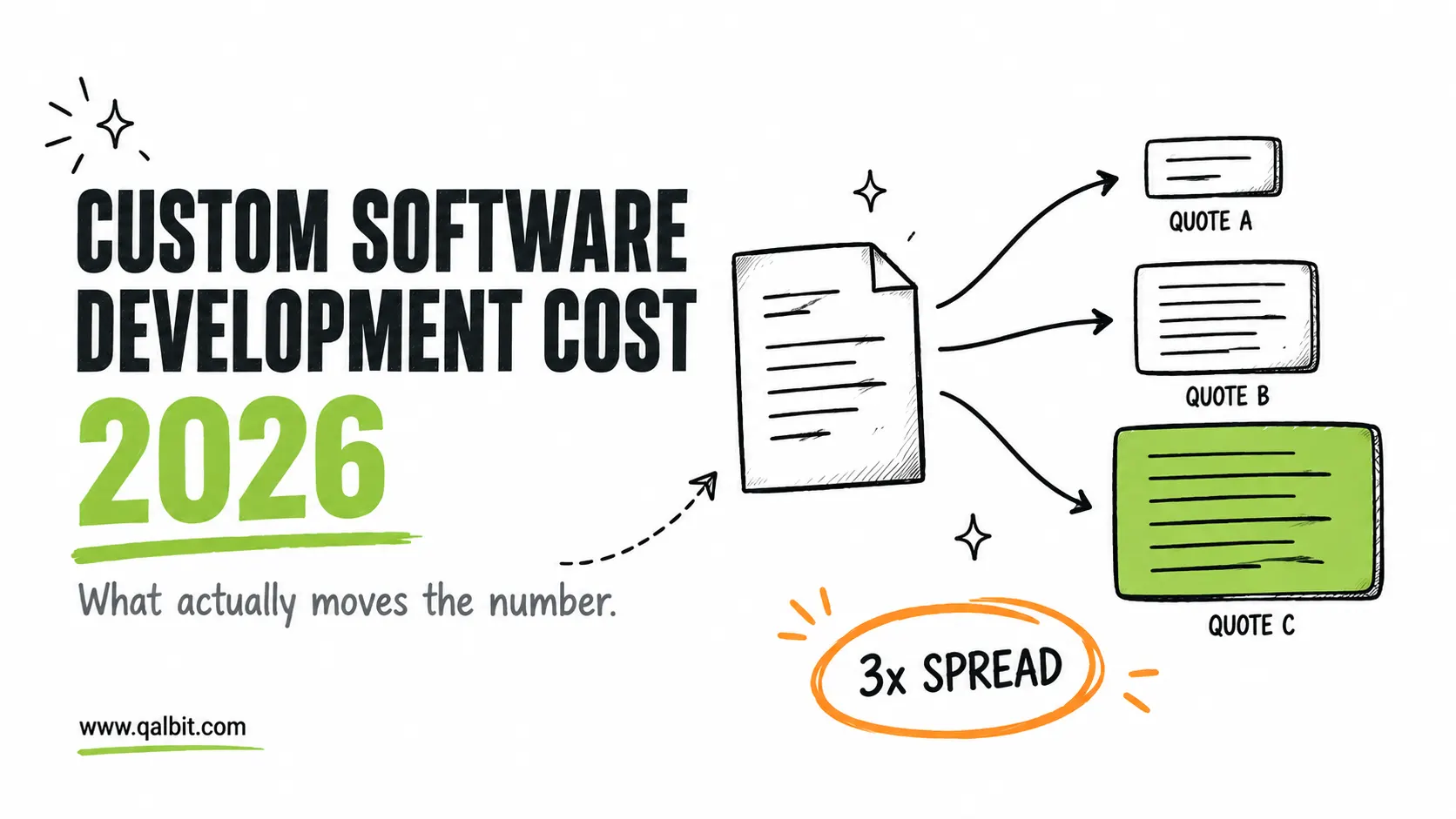
What Custom Software Actually Costs, And What Moves the Number
Custom software costs from $6,500 for an MVP to $52,500 for an ERP phase one with our team. Here’s what moves the number, and why quotes differ by 3x.
 Web Development
Apr 24, 2025
How Startups Build Smarter in 2025: The Complete Guide to Custom Software Development
In 2025, custom software development gives startups a serious edge. This expert guide breaks down MVP planning, tech stack choices, UX design, team…