Written scope within 48 hours
Mobile apps that stay fast after the launch week.
We build native and cross-platform mobile apps for product teams who need store-ready releases, solid backends and a team that still answers after launch.
Nobody budgets for the hours already being lost. Tell us the outcome: you get a written scope within 48 hours.
48h
To a written scope
Week 1
Clickable prototype
6–14 wks
To first release
100%
Code and IP yours
Get your free estimate
Three quick questions: scope, approach and a price range back within 48 hours. No sales call required first.
Trusted by companies worldwide
- Bloomford
- Contractor Plus, Inc.
- Snappy Stats
- Ad Lunam
- Local Buzz
- CyberFind
- Hellory
- 5.0Clutch · 8 client reviews
- 4.9Google · 18 reviews
- Top ratedUpwork · 100+ reviews · 5K+ hours worked
- TopTracker7K+ hours tracked with clients
Why teams call us
Three reasons a team calls us about a mobile app.
Almost every mobile app engagement we take on starts from one of these three situations. Recognise yours and the rest of this page gets more useful.
You need iOS and Android, not just one
Two native codebases means two teams, two release schedules and every feature built twice. Most products cannot afford that from day one.
One Flutter codebase, native performance on both stores.
A previous app shipped, then stalled
The app is in the stores but the person who built it is gone. It still works, mostly, until the next OS update or store policy change breaks it.
Audit, stabilise on current SDKs, then keep shipping.
The app needs a real backend behind it
Push notifications, sync, payments and accounts all need a server the app can trust, not just local storage and hope.
API, auth and backend built alongside the app, not bolted on after.

What you actually get
What a mobile build actually hands you.
Six artefacts a mobile engagement produces, not a slide about frameworks.
Clickable screens before a build decision
A tappable prototype on your own phone in week one, so stakeholders react to something real instead of a deck.
A store-ready build, not just a demo
Signing, provisioning, and the App Store and Play Store listings handled as part of the build, not left for you to work out at launch.
A release every two weeks you can install
A TestFlight or internal track build after every sprint, with a written note of what changed and what is next.
Code and store accounts in your name from day one
Your Apple Developer account, your Google Play console and your repos, with access from the first sprint.
Tests on the flows that cost you a bad review
Automated and device coverage on sign-up, payments and anything that crashes the app, not a coverage number for its own sake.
Documentation and a handover
Architecture notes, a release checklist and a walkthrough so your team can ship updates without us.
What it costs
Three ways to start, priced honestly.
Ranges, not single numbers, because the real figure depends on integrations and migration scope. You get the exact number in writing after one call.
Launch
One core journey, production-ready.
Investment
From mid four figures USD
Timeline
6–8 weeks
- Discovery and written scope
- Clickable prototype before build
- Core journey in production
- Auth, roles and admin basics
- Your repos and cloud accounts
- 30 days post-launch support
For founders validating a product with real users.
Start with LaunchMost chosen
Scale
A full product with the integrations that matter.
Investment
From low five figures USD
Timeline
10–14 weeks
- Everything in Launch
- Two to four external integrations
- Payments, billing or subscriptions
- Reporting and analytics
- Automated tests on critical paths
- Fortnightly demos and reports
For teams replacing a manual process or an outgrown tool.
Start with ScalePlatform
A standing team that keeps shipping.
Investment
Retainer or dedicated pod
Timeline
Ongoing
- Everything in Scale
- Named technical lead
- Multi-tenant or multi-entity architecture
- Performance and cost optimisation
- Monitoring, uptime targets, on-call
- Roadmap planned quarter by quarter
For products where the roadmap does not end at launch.
Start with Platform
Ranges reflect projects delivered in 2025–26 and move with integrations, data migration and compliance scope. Every engagement starts with a written scope listing exactly what is included and what is not.
Our clients · reviews
Teams who trusted QalbIT
Short feedback from clients and products we work on across web, mobile, SaaS and internal tools.
- Testimonials from long-term custom software development and SaaS product clients.
- Covers ERP systems, B2B marketplaces, booking platforms, and web & mobile app development projects.
- Real text and video reviews from founders, CTOs, and product teams who partnered with QalbIT for delivery.
Video review
Rated 5 out of 5.“Working with QalbIT was an absolute pleasure. They understood our brand vision, delivered a WordPress site that is easy to navigate, and kept communication smooth throughout. I would absolutely recommend them to anybody.”
Imdad Ali KadiwalaFounder, Netzur Written review
Rated 5 out of 5.“QalbIT is a fantastic dev partner. They provide quality work, good communication and go above and beyond. Fantastic work delivered by QalbIT and his team. Can’t give enough credits with regards to how they work and at which speed they do it. Top team.”
Joost HesselberthFounder of Ad Lunam Investments PTY LTD
Written review
Rated 5 out of 5.“I would recommend QalbIT to everybody. QalbIT has been developing all my front-end & backend systems complete to my requirements. They have excellent technical knowledge and listen very well to the needs of their customers. And above all, they are great people.”
Wouter SantensExecutive Search Consultant at Bloomford Written review
Rated 5 out of 5.“They listened to my ideas and came up with a plan for development then executed that plan to completion. I liked their attention to detail and communication skills. Very responsive.”
Osmond MwanyikyCTO, Bocsit
Written review
Rated 5 out of 5.“QalbIT quickly integrated four platforms quickly. Square, Stripe, PayPal, and Coinbase were all successfully used. The vendor provided an active communication process, maintaining timely deadlines despite the research-heavy service. They also offered post-launch support.”
Roshan SethiaCTO, Contractor Plus, Inc.
How it runs
From first call to running software in four moves.
The same process on every engagement, whichever package you start from.
Scoping call
A working call about the outcome and the constraints. Not a pitch.
Day 1–3
Written scope & price
Architecture options, timeline and a price range you can take to your board.
Within 48 hours
Prototype & build
Clickable prototype, then working software in fortnightly sprints.
Week 1 onward
Launch & operate
Deployment to your cloud, monitoring in place, then the next slice.
Launch week
Proof
Mobile app development engagements we scoped, built and still support.
Different sectors, same process, and in each case the client owns the code.
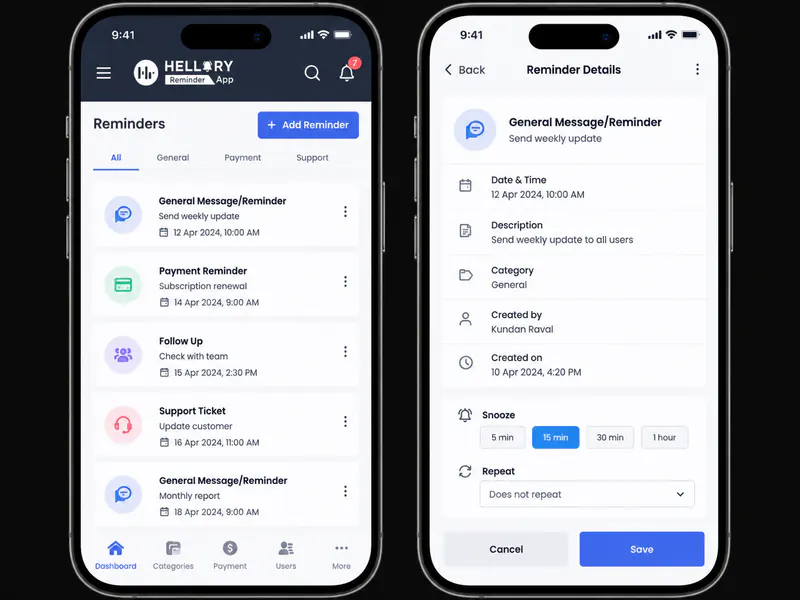
Consumer apps / productivity
Hellory · smart reminder app
A cross-platform reminder app with recurring schedules and secure sharing.
Flutter · iOS & Android · Node.js APILive And still evolving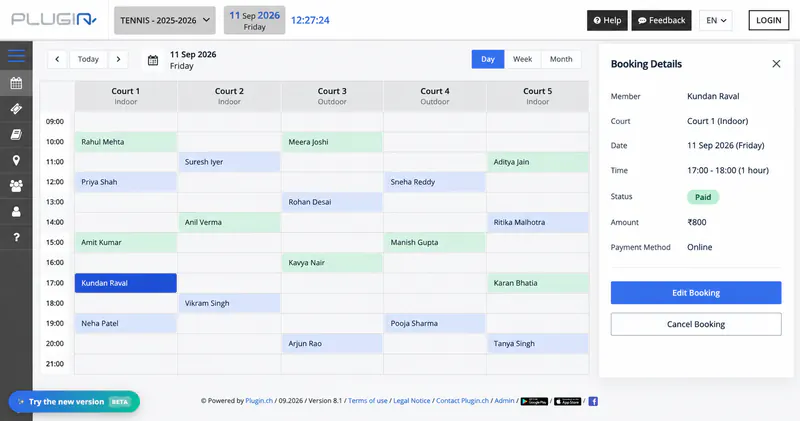
Sports / club management
Plugin · club management platform
Court scheduling, memberships, variable pricing and online payments in one system replacing manual admin.
CodeIgniter · MySQL · StripeFewer Double-booked courts
How we work
A product engineering culture built on ownership and clarity.
The habits that decide whether software still works in year three. Here is the honest comparison: what most outsourced engagements look like, and what changes when you work with us.
| The question | The usual answer | At QalbIT |
|---|---|---|
| Who scopes it | A salesperson, then a handover doc | The founder and the engineer who will build it |
| Who writes the code | Whoever is on the bench that month | Named senior engineers, in our office, no subcontractors |
| What you see weekly | A status deck and a percentage | A working demo and the board it came from |
| When something breaks | A ticket queue and an account manager | The engineer who wrote it, in your timezone overlap |
| If you want to leave | A migration project and a licence conversation | Thirty days notice · repos and IP were always yours |
Principle 01
Ownership over ticket-taking
Engineers who ask why before they ask which framework. Scope questions come back before code goes out.
Principle 02
Written over remembered
Scope, estimates and architecture decisions are written down with the trade-off stated. Nobody relies on what was said on a call.
Principle 03
Small over staffed
Senior pods that hold the whole system in their heads beat large mixed teams that need a coordinator to function.
Engagement models
Flexible engagement models.
Choose how you want to work with us based on where your product is today. We help you validate, ship and then scale without forcing you into a one-size-fits-all model, and how we price projects follows the model you pick.
Best for defined scope
Fixed-scope projects
Best when requirements are clear and we can estimate precisely.
- Clearly defined scope, milestones and deliverables.
- Predictable budget with upfront estimates.
- Ideal for MVPs and discrete feature releases.
Works well with good documentation or a short discovery
Most chosen
Dedicated product squad
A cross-functional team that behaves like your in-house product team.
- Stable team for long-term ownership and roadmaps.
- Capacity planned monthly with clear velocity.
- Founder involvement on architecture and key decisions.
When software is core to your business
Best for ongoing work
Time & material / Agile
Ideal for ongoing iterations, R&D and integrations.
- Pay for actual engineering and design time used.
- Flexible backlog and scope, prioritised every sprint.
- Perfect for experiments and proof-of-concepts.
When agility matters more than fixed scope
What protects you
Five commitments that make the first engagement low risk.
The objections worth raising before you sign anything, answered up front rather than buried in a contract.
Free written scope
Scope, timeline and price range within 48 hours, yours to keep whether or not you hire us.
IP and repos yours, day one
Code, repositories and cloud accounts in your name under NDA, with commit access from week one.
Changes quoted in writing
Added scope is priced and approved before it is built. The number never moves quietly.
Replacement guarantee
If an engineer is not the right fit we replace them at no recruitment cost, with handover before they leave.
30 days notice
Monthly engagements end or scale down with 30 days notice. No annual lock-in.
Industries we build this for
Tailored software solutions built for your industry's success.
We bring patterns from multiple domains, but always adapt them to your specific context, constraints and users, never a template dropped on your business.
Food & delivery
Food and delivery software: ordering, kitchen display and zone-based dispatch systems for restaurants and delivery operators.
Healthcare
Healthcare software for clinics, wellness and care teams: workflows that respect privacy, scheduling and real operational load.
Social networking
Social and community products: feeds, messaging and moderation with architecture that survives growth.
Travel
Travel and hospitality software: channel sync, direct booking engines and itineraries that hold up across OTAs, phone desks and your own site.
More services
Software development services at a glance.
From MVPs to long-term platforms, combine our core and specialised services to design, build and grow products that match how your business really works.
Backend Development
Backend development covering REST APIs, integrations, auth and microservices for web and mobile applications.
MVP Development
MVP development for startups: scope, design and launch a working product in 6–10 weeks, validate with real users and scale what works.
UX Design Services
User-centric UI/UX and product design for SaaS, web applications and mobile experiences.
FAQs · Mobile App Development
Frequently asked questions
Cost, timelines, store accounts and what happens after the next OS update.
Ask us directly →Next step
Get the number before you commit.
Send the problem in two lines. You get a written scope, timeline and price range within 48 hours, free, and yours to keep either way.
Keep exploring
- Hire Flutter DevelopersHire developers for this
- FlutterBuilt with
- React NativeBuilt with
- AndroidBuilt with
- Node.jsBuilt with
- Fixed-Scope ProjectsHow we would run it
- Dedicated TeamHow we would run it
- PocketGSTProducts we run on it
- AhmedabadMarkets we serve
- SheffieldMarkets we serve
- BristolMarkets we serve
- ManchesterMarkets we serve
- AmsterdamMarkets we serve