- Where the interview has to be virtual, require video, with the background unobscured.
- Ask the person to wave a hand in front of their face, which can make AI-generated video glitch, and to point the camera out of a window and answer questions about where they are.
- Cross-check the ID’s photo and contact details against the person’s social profiles, portfolio and payment accounts, and save images to compare at later meetings, because sometimes one person passes the interview and another does the job.
- Ship equipment to the address on the person’s identification, or to another address only with documents that prove it.
- Grant no access to any system until the background check is complete.
The 2026 alert adds warning signs for anyone hiring: photo IDs that don’t match the person on the call, video that looks manipulated or artificially generated, refusal to join video calls, offers to work at rates lower than the general market rate, and requests to be paid in cryptocurrency. One of those is a reason to slow down. Two is a reason to stop.
2. Test the work they would actually do
Puzzle-style coding tests measure how someone performs under a timer, not how they build software. A better test is close to the real job: review a pull request from a codebase like yours and explain what you would change, or build a small, paid task in your stack. Ask them to walk you through code they have written before, and why they made the choices they did. People who wrote the code can explain the trade-offs; people who copied it usually can’t.
3. Test how they write
Remote work runs on writing: pull request descriptions, status updates, questions asked at the end of someone else’s day. In Stack Overflow’s 2025 Developer Survey, 32.4% of respondents described their current work situation as remote rather than hybrid or in-person, and for that kind of team written communication is most of the communication. Ask candidates to write a short design note, or the description for the pull request they just built. One honest paragraph tells you more than an hour of interview answers.
4. Check references you found yourself
A reference supplied by the candidate is a contact the candidate chose. Where you can, find a former manager or client independently, through the company itself, and ask one specific question: would you hire this person again for the same kind of work? Then ask what they worked on, for how long, and how much of it they did without supervision. Vague answers to specific questions tell you something too.
5. Agree the overlap hours in writing
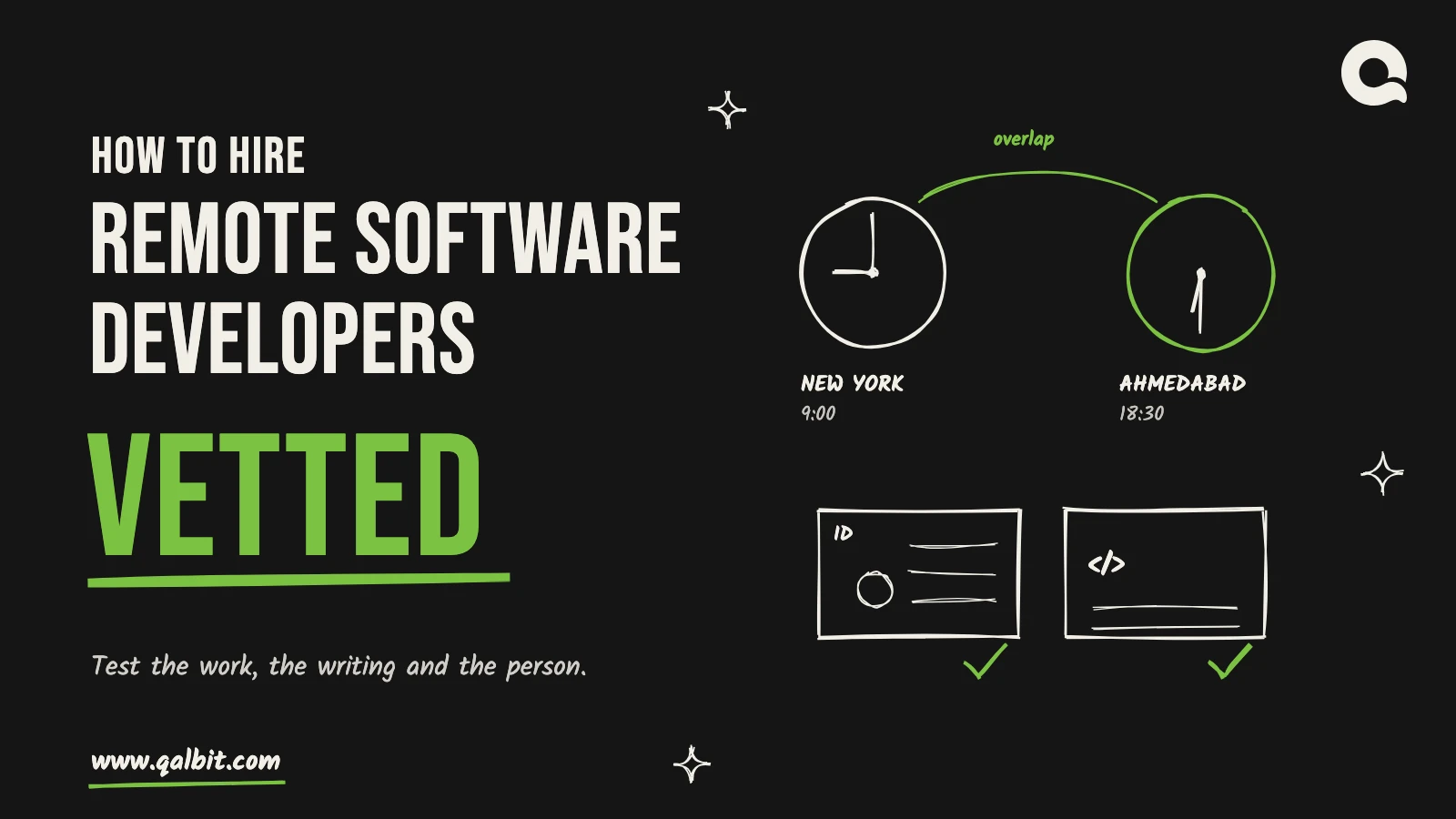
Overlap is the window when both sides are working and can talk. During US daylight time, 9:00 in New York is 18:30 in Ahmedabad (19:30 from November to March), so a team in India working into its evening gives a US company a shared morning. For US Eastern clients we keep three to four live hours every morning, four on request, and the whole working day for clients in the Gulf. Whoever you hire, write the overlap into the contract, and add a response time for messages sent outside it.
6. Pay for a trial on real work
A trial on real work shows more than any interview. Two weeks on a real ticket from your backlog shows the code, the communication and the pace before either side commits further. Give the trial the limited access that one ticket needs, such as the repository and a staging environment, and pay for it properly. An unpaid trial filters for people with time to spare, not for the people you want.
7. Grant full access, and keep ownership
Once the trial ends well, widen access to what the work needs, nothing more, and keep every account in your company’s name. Sign the NDA and an intellectual property assignment before the trial starts. Plan the exit at the beginning: who revokes access, who collects the laptop, and how the code and documentation stay with you if the engagement ends.
Red flags when you hire remote developers
- The camera “doesn’t work” for every call, or the person on the video doesn’t match the ID.
- A request to send equipment somewhere other than a documented address.
- Pressure to be paid in cryptocurrency, or through an account in someone else’s name.
- An unprompted offer to work well below the market rate for the experience the person claims.
- Code samples they can’t explain, or a portfolio nobody at the listed companies remembers.
- Reluctance to sign an IP assignment or to work in your repositories.
The first two weeks
Plan the first two weeks before you hire remote software developers. Left unplanned, they can undo even a careful choice. These steps keep the start predictable:
- Day one: access to what the first task needs. A staging environment, the repository and the board. Production access can wait until there is a reason for it.
- A small first ticket. Something that touches the real codebase and can ship within days, so both sides see the whole cycle from branch to release early.
- A named person to ask. One engineer on your side who answers questions inside the overlap hours. In our experience, remote developers stall more often on unanswered questions than on hard problems.
- Expectations in writing. How work is reviewed, when updates are due, what “done” means. A one-page note prevents most of the friction that otherwise surfaces in week three.
- A review at the end of the trial. Look at the code that shipped, the questions asked and the updates written, then decide together whether to continue.
None of this is specific to remote work, but remote work exposes the gap faster. In an office, a confused new hire is visible by lunchtime. On a distributed team, the same confusion can sit unnoticed for a week.
Hire remote software developers through a vendor
A vendor should take on part of this work, but ask exactly which part. Five questions sort the careful ones from the rest:
- How do you check identity and background before an engineer joins?
- Are the engineers your employees, or do you subcontract them?
- Can I interview each engineer myself and decide who joins?
- What happens if an engineer is not the right fit?
- How much notice ends the engagement, and what do I keep?
Our answers, for comparison. Every hire passes background checks and signs confidentiality terms, and the engineers are our own team, with no subcontractors. You review profiles and code samples and interview each engineer yourself, and a two-week paid pilot comes before any longer commitment. A senior technical lead reviews every pull request, a developer who isn’t the right fit is replaced at no extra recruitment cost, and thirty days’ notice ends the engagement. The work happens in your repositories and cloud accounts under NDA from the first sprint, there are no recruitment fees, and the first commit usually lands about two weeks after the first call.
Whichever route you take to hire remote software developers, the order matters: verify the person, test the work and the writing, check references, agree the hours, trial it on real work, and only then widen access.



To hire remote software developers safely, check four things before anyone gets access: their identity, their work, their writing and their hours. Verifying the person first is the newest part. A joint alert published on July 31, 2026 warns that North Korean IT workers use false identities to win remote jobs, and in June 2025 the Justice Department announced coordinated actions against schemes that had placed such workers in more than 100 US companies.
We place senior engineers from our Ahmedabad office with US, UK and Gulf companies, so we see this process from both ends: our clients interview our people, and every engineer we place has already passed our background checks. If you want engineers who come checked, you can hire dedicated developers who work your hours through us. If you are still deciding whether remote is right at all, we weigh remote against in-house and hybrid teams in a separate post. This post assumes you have decided, and covers how to hire well.
Choose how you will hire remote developers
The route you choose decides who checks identity, who supplies equipment and who carries the employment risk. There are three common ones:
If you hire contractors directly, classification matters. The IRS weighs whether someone is a contractor or an employee using three categories of facts: behavioural control, financial control and the type of relationship. The Department of Labor and some states, California among them, apply tests of their own. A “contractor” who works fixed hours, uses your equipment and takes daily direction from your team starts to look like an employee. Working remotely does not change the answer: the IRS says a remote worker is your employee under the common-law rules if you can control what will be done and how. That is a question for your accountant or lawyer, so ask it before the first contract, not after the first audit.
A vetting checklist for remote software developers
Run these in order whenever you hire remote software developers, and apply every check to every candidate, wherever they are based. The early checks are cheap and fast, and they stop a bad hire before it costs a sprint.
1. Verify the person before the skills
Identity is now the first check, not the last. Gartner forecast in July 2025 that a quarter of all candidate profiles, worldwide, would be fake by 2028. In its survey of 3,000 job candidates, 6% owned up to interview fraud: posing as someone else, or having someone pose as them. The FBI’s July 2025 advice to US businesses is specific, and most of it applies to any remote hire: