The team side deserves a line too. A remote team outside the storm’s path can keep deploying, watching alerts and answering a ticket while your own office has no power. It cannot fix your guests’ connectivity. The runbook still needs a named person on your side who can approve a change at two in the morning. Our guide to outsourcing models for startups compares the ways an outside team can be set up.
The 30-day clock behind custom software in Florida
Section 501.171, the Florida Information Protection Act, is the law most likely to touch a Florida business with a database. It applies to any business that acquires, keeps or uses personal information, and the definition is wider than people expect. The list runs from a name together with a Social Security or driver licence number, a financial account number with the code that opens it, medical or health insurance details, biometric data or geolocation data. A username or email address with the password or security answer to an online account counts on its own.
That second branch catches ordinary products. A portal with logins holds regulated data on day one, and so does a booking app that stores a guest’s location next to their name.
The statute asks for three things that touch the build:
- Reasonable measures. Anyone holding the data, vendors included, must take reasonable measures to protect it. The statute gives no checklist for the phrase, so a vendor’s answer is evidence. Ask how data is encrypted, who can read production and where access is logged.
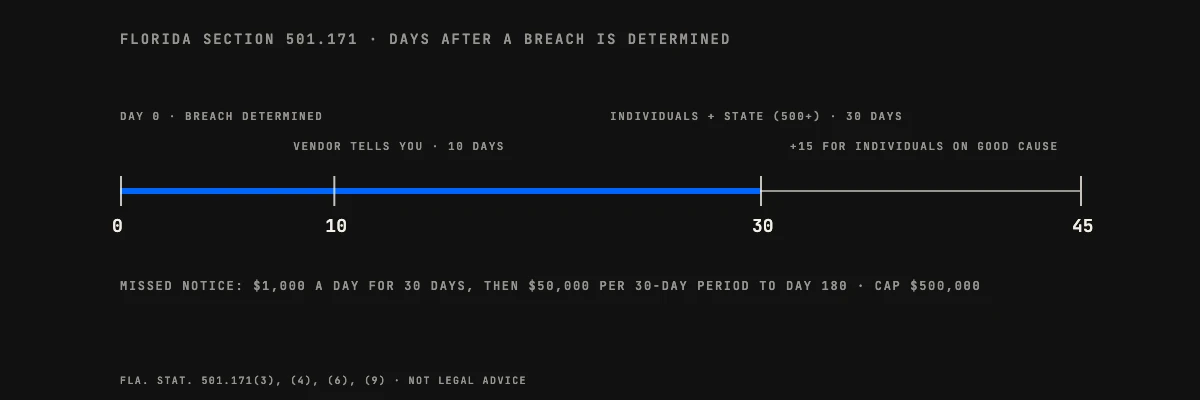
- Notice within 30 days. You must tell affected individuals within 30 days of the day you determine a breach, or have reason to believe one occurred. If the breach reaches 500 or more people in Florida, you must also tell the Department of Legal Affairs within 30 days. Good cause for delay, put to the Department in writing inside those 30 days, can buy 15 more days for the notices to individuals.
- A shorter clock for vendors. A third party that stores or processes the data for you must tell you no later than 10 days after it determines a breach.
What a missed deadline costs
Missing either notice deadline carries a civil penalty of $1,000 a day for each of the first 30 days. After that it is $50,000 for each further 30-day period or part of one, for up to 180 days. A failure that runs past 180 days can cost up to $500,000, which is also the ceiling for the whole penalty. It counts per breach, not per person affected. The statute creates no private cause of action. Enforcement belongs to the Department of Legal Affairs, which can sue under section 501.207 and treat a violation as a deceptive or unfair trade practice.
What that means for the contract and the code
Thirty days sounds long until you try to work out whose records the intruder reached. Notice needs logs that show which records were read, by whom, and when. Build that audit trail from the first sprint, because rebuilding it after an incident is guesswork. Keep less data too: a record you never stored cannot leak.
In the contract, copy the statute’s shape. The vendor reports a suspected breach to you within a stated number of days, shorter than 10 so you keep room. It also hands over what you need to write the notice. Settle who pays for investigation and notification before anything goes wrong.
Florida’s privacy bill of rights covers fewer buyers than you think
The headlines about the Florida Digital Bill of Rights suggest a consumer-privacy law like California’s. For most buyers it is not one. Its core duties fall on a “controller”, and the definition requires more than $1 billion in global gross annual revenues, plus at least one of three conditions: half of revenue from online advertising, a consumer smart speaker with a voice assistant, or an app store offering at least 250,000 apps. A hotel group, a clinic network or a logistics firm will not usually meet that.
One rule reaches further. Section 501.715 applies to any for-profit business that conducts business in Florida and collects personal data, with no revenue test. It bars the sale of sensitive personal data without consent, and a business that does sell it must display the notice “This website may sell your sensitive personal data.” If your product sells nothing, this costs you little. Even so, ask the vendor for a written list of every third party the build sends personal data to, so your counsel can judge whether any of it counts as a sale.
Custom software in Florida and the sales-tax line
Florida’s rule on computer software, Rule 12A-1.032 of the Administrative Code (last amended with effect from August 15, 2021), says the charge for a customized software package is construed to be a service and is not subject to tax. Retail sales of prepackaged software in tangible form, usable without modification, are taxable. The rule adds a middle case: when a vendor modifies a prepackaged program to the customer’s specification and charges for it as a single transaction, the charge counts as customized software.
The Department of Revenue’s advisement TAA 14A-001, dated January 31, 2014, dealt with delivery. It found that a hosted product the customer reached only over the internet, with no software or other tangible property handed over, was not subject to Florida sales and use tax. It also noted that software sold together with tangible property, such as hardware, can become taxable as part of that sale. An advisement binds the Department only on the facts of the taxpayer who asked. This one is also more than a decade old, so read it as an indication rather than a ruling on your deal.
Three drafting habits make your adviser’s review shorter:
- Describe the deliverable as software built to your specification, and say whether the vendor is modifying any existing product.
- Keep hardware, devices and physical media out of the build contract, or ask your adviser first how the state would tax a combined sale.
- Have the adviser read the statement of work before you sign it, not after the first invoice.
Eastern clocks and a Central corner
Most of Florida runs on Eastern time. The federal boundary in 49 CFR 71.5 follows the Apalachicola River and the west line of Gulf County, which leaves the western Panhandle, Pensacola included, on Central. That matters for a window agreed in Eastern hours. Our four live hours, 8 a.m. to noon Eastern, are 07:00 to 11:00 for a Pensacola team, so their first hour comes before many offices open.
On the Ahmedabad side the same window runs 17:30 to 21:30 in summer and 18:30 to 22:30 in winter. A written handover carries the work after it. If your staff are split across the zone line, say so at the start and agree the window by city, not by state.
What breaks first in four Florida sectors
| Sector | What usually breaks first | Design it in early |
|---|---|---|
| Hotels, resorts and attractions | Reservations spread across several systems, strained on a holiday weekend | One booking record, queued writes if a channel is down, a load test before peak |
| Healthcare and senior care | Record location and access rules | US or Canada storage for the primary and the failover copy, access logs a security office can read |
| Ports and logistics | Hand-keyed data between carriers, terminals and customers | Integrations that enter a shipment once and reconcile everywhere |
| Property management | Thousands of units tracked in one spreadsheet | Roles per property, an audit trail on money movements, imports that survive a messy sheet |
Each row describes the worst day rather than the average one, often a Saturday with every guest or tenant on the system at once. Write the scope for that day.
Working back from June 1 for custom software in Florida
If the system has to be live before the season, count backwards. The sequence below is illustrative guidance for a new build of moderate size; a larger scope starts earlier.
| When | What happens |
|---|---|
| January to February | Written scope; RTO and RPO set per system; data inventory against section 501.171 |
| March to April | First releases on staging; second region built; logging and access controls in place |
| May | Restore test, failover drill and a load test, with results written down |
| June 1 | Season opens: runbook, contacts and breach-notice template are on file |
Price the continuity work apart from the product. Our Florida page lists a fixed-scope build from $6,500, exclusions included, and dedicated engineers from $3,200 per engineer a month. The second region, the drills and the audit logging come on top. Seeing them as separate lines tells you what resilience is costing. Our comparison of custom software pricing models explains how each way of paying absorbs a change of scope.
Then put the season into the contract: recovery targets per system, the date of the restore test and the vendor’s breach-reporting deadline, all agreed before work starts. A bidder who will not commit to those in writing before June is showing you how the first storm will go.
Plans for custom software in Florida start from a date no vendor can move: June 1, when the Atlantic hurricane season opens and runs to November 30. Underneath that sit two state rules that reach into the build itself: a 30-day deadline for telling people their data was breached, and a sales-tax rule that turns on how the contract describes the work. This post takes them in the order they land on a project.
Each legal or tax point below links the statute or rule it relies on and stops short of saying what applies to your business. That is a question for a Florida lawyer and tax adviser, and nothing here is legal or tax advice. QalbIT itself works from Ahmedabad and keeps no office or staff in Florida. How we cover the Eastern-time morning is on our page about custom software development in Florida, and nothing below depends on hiring us.
Hurricane season sets the schedule for custom software in Florida
The National Hurricane Center puts the Atlantic season at June 1 to November 30, with the peak on September 10 and most activity between mid-August and mid-October. Across those six months a data centre, the local grid or your own office can be out for days while customers still expect to book, pay and log in.
Two numbers turn that worry into something a vendor can build against:
Most proposals for custom software in Florida never state either one. Ask for both in writing, per system, because a booking engine and an internal reporting tool do not deserve the same answer. The table below is illustrative: its targets show how the options trade off, not figures to copy into a contract.
Each step down the table costs more to build and to run. Pick the tier per system and have the vendor price it as its own line.
Where the second region goes
“A second region” sounds like a free choice. For some Florida buyers it is not. Section 408.051(3), part of the Florida Electronic Health Records Exchange Act, covers health care providers using certified electronic health record technology. Patient information they store off-site, cloud services included, must be physically maintained in the continental United States or its territories or Canada. If that describes you, the failover copy has to sit inside those lines too. A proposal that puts it anywhere else has missed the brief.
Distance from the coast matters as well. Two regions that a single storm can reach are one region with extra steps, so ask where each is and what would take both down.
What a vendor should put in writing
A continuity clause is short. It names the RTO and RPO for each system, says who declares an outage and who tells your customers, and sets how often recovery is rehearsed. That last part is the one that gets dropped. A backup nobody has restored from is a hope, so ask for a restore test before June and a written result afterwards.