What to build first, in order
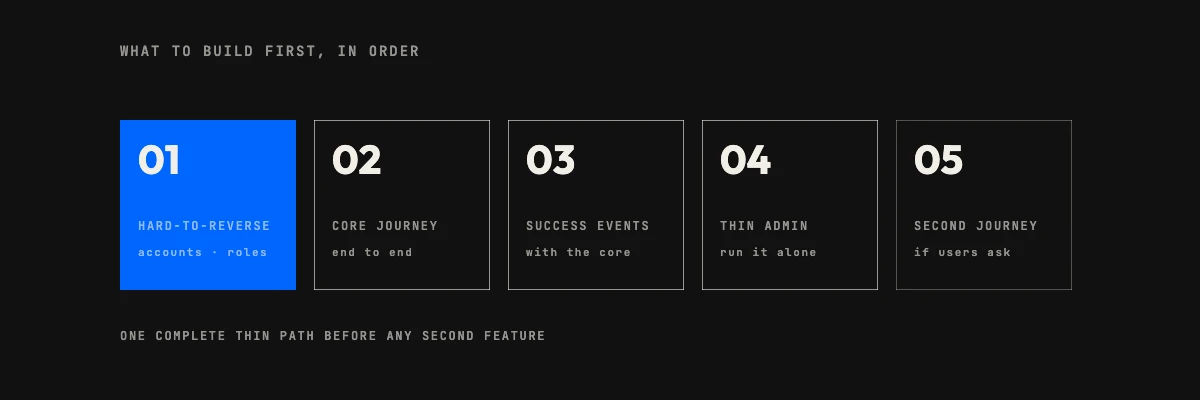
Once the core is clear, the order of work matters more than the feature list. We build in this sequence:
- The decisions that are expensive to reverse. Before any screen, settle whether an account is one person or a company with many users, how roles work, how money and currencies are stored, and how time zones are handled. Everything else sits on top of these, so changing one later touches most of the code.
- The core journey, end to end. One real user can sign up, do the main thing and get the result, even if the screens are plain. A complete thin path teaches you more than three polished half-paths.
- The events that tell you whether it worked. Pick the three or four numbers that would prove or kill the idea, and wire them in alongside the core journey so they count from the first real user. Without them, you can’t tell whether the launch worked.
- The thinnest admin that lets you run it. Enough to fix a user’s account or refund a payment without asking a developer.
- Only then, the second journey. And only if users of the first one are asking for it.
What to skip in the first release
Most software carries more features than anyone uses. Pendo’s 2019 Feature Adoption Report, built from its customers’ usage data, found that 80% of features in the average software product are rarely or never used. A first release is the cheapest place to stop building them. What founders ask us to cut usually falls into these groups, and most of them also appear on our list of things that push a quote up:
- A second platform. Launch on one platform first, the web or mobile. If mobile comes second, Flutter covers iOS and Android from one codebase, which is how our mobile range is priced.
- Bespoke components. Proven interface patterns test just as well with early users and cost far less than designing every element from scratch.
- Microservices. One well-structured application is faster to change while the product is still moving. Split it when a part genuinely needs to scale on its own.
- Every integration on the wish list. Our ranges assume up to two. Each extra system you connect adds testing, failure cases and cost.
- Fine-grained permissions. Start with two or three roles. A permissions matrix built before you have customers usually models the wrong organisation.
- Scale you don’t have yet. Build for the next hundred customers, on infrastructure that can grow, and leave the million-user design for when the users exist.
We write every cut item into the scope document as a named exclusion, so the conversation about release two starts from a list.
A worked example of custom software development for startups
Take a typical brief: a marketplace that books physiotherapists for home visits, from a founder who wants to launch in one city.
Build. The matching of therapists to visit slots by area and specialty, the booking and rescheduling rules, each therapist’s availability, and the visit notes. That is what patients and therapists would describe as the product, and it is the part that will change after the first month of real bookings.
Rent. Sign-in from an auth service. Payments with payouts to therapists from Stripe Connect, because splitting money between a platform and its providers is a solved problem with real compliance work behind it. Reminder texts from Twilio. Analytics from PostHog. The back office from a framework admin. Stripe Connect and Twilio are the two outside systems beyond the standard sign-in, billing and analytics, which is as far as our ranges go.
Visit notes are health data, and that narrows the list. Every service that touches them has to sign the agreement your market requires, such as a business associate agreement in the US or a data processing agreement in the UK, and store data in the right region. Check that before you choose, because switching later means moving patient records.
Skip. Native apps, since a responsive web app works on every phone the first patients own. In-app chat, because a phone call and a text cover it. Ratings, insurance claims and a second city. Each one goes into the scope document as a named exclusion.
What to measure, and where it lands
Measure. Bookings per therapist per week, how many patients book a second visit, and how many visits get cancelled. Those three numbers decide whether release two is more cities, more features or a different idea.
Scoped like this, the brief fits the startup MVP band on our pricing rather than the SaaS one. The same idea with native apps, chat and insurance claims in version one would climb into the higher bands of that page, and take months longer to learn the same three numbers.
When renting stops making sense
Renting is the right default early, and it stays right for most things. A few signals say it is time to price the build:
- The rented part has become the reason customers choose you, or the thing your roadmap keeps fighting against.
- The monthly bill for one service is heading past what an engineer costs. On our card a mid-level engineer is $3,200 a month, which is a useful line to compare against, though owning a component also means maintaining it.
- A customer or regulator needs the data held somewhere the service can’t offer.
- The provider’s outages have started to show up in your own support queue.
Even then, the module boundary from earlier is what keeps the switch to a contained job.
What custom software development costs for startups
Our published ranges for a first release assume one platform, standard interface patterns and up to two integrations:
| First release | Typical range | Timeline |
|---|---|---|
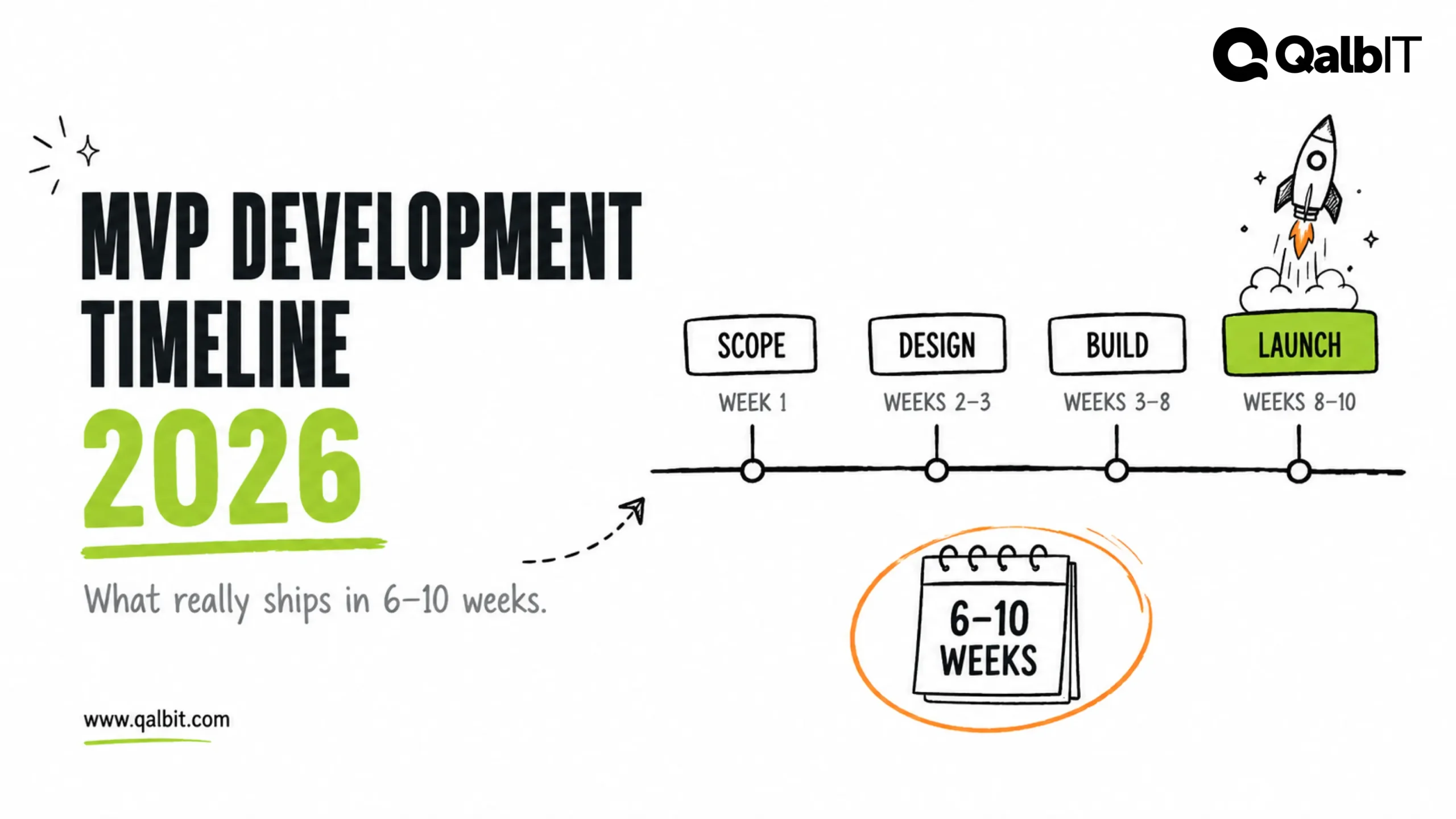
| Startup MVP | $6,500 – $16,500 | 6–10 weeks |
| Mobile app | $9,000 – $26,500 | 8–14 weeks |
| SaaS product | $13,500 – $41,000 | 10–16 weeks |
The rented services’ own subscriptions sit outside these ranges; like any licence or cloud bill, they are billed to you at cost. Where a project lands inside its range depends mostly on the decisions above: how much is custom, how many platforms, how many integrations.
Runway is the reason this matters. CB Insights’ 2026 study of 431 venture-backed shutdowns could identify the reasons for 385 of them; among those 385, running out of capital topped the list at 70%, and poor product-market fit was cited by 43%. A smaller first release spends less of the runway before the market answers. Our breakdown of what an MVP costs in 2026 walks through those decisions one at a time, and the MVP development timeline shows what fits into six to ten weeks.
Whichever way you build, the code, the repositories, the cloud accounts and every rented service account should be in your name from the first week. If you would like a written scope that marks what we would build, rent and skip for your idea, send two lines about it to business@qalbit.com.


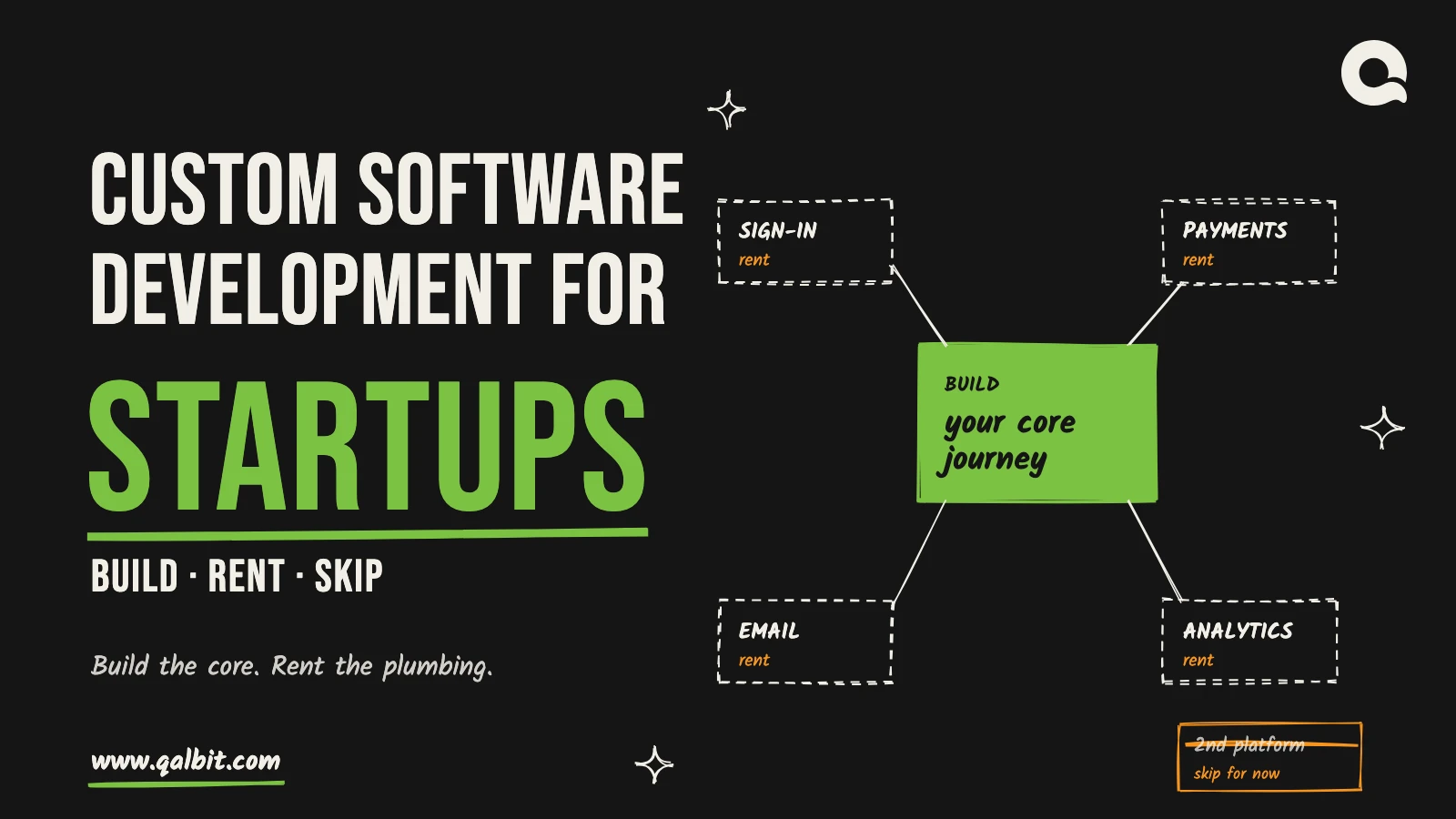
Custom software development for startups should cover the one journey that makes your product different, and rent almost everything that sits around it. Scoped that way, a startup MVP costs $6,500 to $16,500 on our published pricing and takes six to ten weeks. The hard part is deciding which pieces are which.
We are a senior engineering team in Ahmedabad working with founders in the US, the UK and the Gulf, and we build and run four SaaS products of our own, so we have made these calls with our own money as well as our clients’. Our startup MVP development work starts from the same rule every time: write down what the first release must prove, then refuse to custom-build anything that doesn’t help prove it.
If you are further along, our MVP to full product playbook covers what happens after launch. This piece is about the decisions before the first line of code.
What startups should build as custom software
Every product has a core: the thing a customer would describe if a friend asked why they use it. For a booking marketplace, it is how supply gets matched to demand. For a B2B tool, it is the workflow that replaces the spreadsheet. It is almost never the login screen, the invoice email or the settings page.
Three questions sort the core from everything else:
A yes to any of the three means build it. Three noes mean rent it, and spend the money on the core instead.
What to rent instead of building
Most of a startup’s first release is plumbing that thousands of products need in the same shape, and writing it by hand is the classic overspend in custom software development for startups. Mature services sell that plumbing for less than it costs to build, test and maintain yourself. We wire them in from the first week, which is why a first release on our pricing can include sign-up, roles, payments and analytics without blowing the budget.
The names are examples, not endorsements. Pick by price at your expected volume, by where the service stores data, and by how easily you can leave.
Rent behind your own interface
The bigger risk of renting is rarely the monthly bill. It is ending up with a vendor’s API calls scattered through two hundred files. Put each rented service behind a small module of your own, so the rest of the code talks to “send receipt” or “charge customer” and never to the vendor directly. Swapping a provider then touches one module. The habit costs almost nothing in week one and is very expensive to retrofit in year two.