From a fixed price to an implied rate
A fixed price hides its rate, but you can work it out. Ask the vendor for the effort estimate behind the quote, in person-weeks. A $26,000 quote built on 30 person-weeks, or 1,200 hours, implies about $21.67 an hour. The same $26,000 built on 20 person-weeks implies $32.50.
The totals match, yet the two plans tell very different stories. One vendor expects a lot of hours at a modest rate. The other expects fewer hours at a higher one, or has priced more contingency into the number. Neither is wrong by default. The question worth your time is which plan is realistic for the scope you described.
Our rate card, per month and per hour
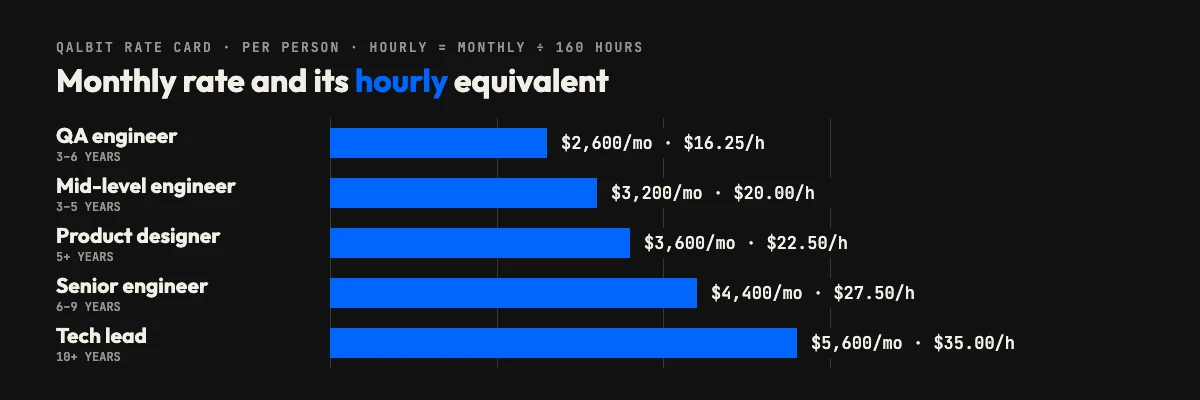
Below is the card we publish, along with the hourly figure on a 160-hour month, so you can set it against an hourly quote.
| Role | Experience | Per month | Per hour (160 hours) |
|---|---|---|---|
| QA engineer | 3–6 years | $2,600 | $16.25 |
| Mid-level engineer | 3–5 years | $3,200 | $20.00 |
| Product designer | 5+ years | $3,600 | $22.50 |
| Senior engineer | 6–9 years | $4,400 | $27.50 |
| Tech lead | 10+ years | $5,600 | $35.00 |
Each figure is per person, and we bill it monthly in advance. Thirty days’ notice ends an engagement, with no annual lock-in and no exit fee. Every engagement comes with QA on business-critical paths, delivery management, CI/CD and handover notes; a full-time QA engineer is a separate seat on the card. We pass third-party licences and cloud bills on at cost, and nothing outside the agreed price reaches an invoice without your written approval.
Where our software development rates sit in the market
Two recent surveys give a fair picture of agency pricing. Clutch’s pricing data, updated in September 2026, reports that most development companies charge between $25 and $49 an hour. Techreviewer surveyed 127 companies in January and February 2026: 37.8% of them charged $30 to $49 an hour, and 22% each charged $20 to $29 or $50 to $99.
A survey cannot tell you whether a particular team is good value. It can flag a quote as an outlier worth questioning, in either direction. We explain in what custom software actually costs why we don’t publish rate tables by country, and why those tables predict so little about a project.
Blended software development rates: what a whole team costs
Most projects need more than one role, so the number that matters is the blended rate: the team’s monthly total divided across its people, or across its hours. If a proposal doesn’t show it, ask for it.
A four-person product team
A senior engineer, two mid-level engineers and a QA engineer cost $13,400 a month on our card. That is a blended $3,350 per person, or $20.94 an hour. A ten-week first release is 2.5 of those 160-hour months, so the team comes to about $33,500, which sits inside the $13,500 to $41,000 range we publish for a SaaS platform.
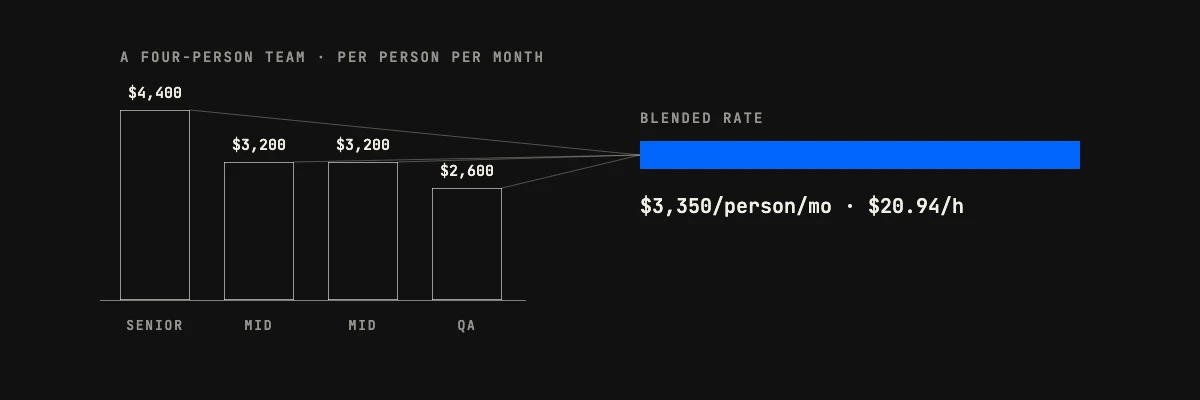
The QA seat pulls the blended rate down, which is a side effect rather than the reason it is there. Testing is part of building software, and a quote that leaves it out describes a smaller job, even if the scope document looks the same.
Why a lower rate can cost more per feature
Your bill is the rate multiplied by the hours. Most comparisons stop at the rate, because it is the number printed in bold. The hours depend on things a rate never shows:
- The seniority mix. A junior-heavy team bills less per hour and usually needs more hours per feature, plus more review and rework.
- How clear the scope is. In our experience, scope decides roughly 70% of any quote. A vague brief adds hours, whoever is billing for them.
- What the rate includes. If QA, project management or DevOps sit outside the rate, those hours come back later as separate invoices.
- How changes are handled. Whether a new request is priced and approved before work starts decides whether a budget drifts.
What usually sits behind a budget overrun
When a project ends up costing more than the quote it beat, the cause is rarely the hourly figure. It is usually a loose plan: nobody wrote down what “done” meant before the first sprint began, so each week brought a new set of hours. A slightly higher rate attached to a written scope tends to be the cheaper of the two by the end.
What to ask a vendor before you compare rates
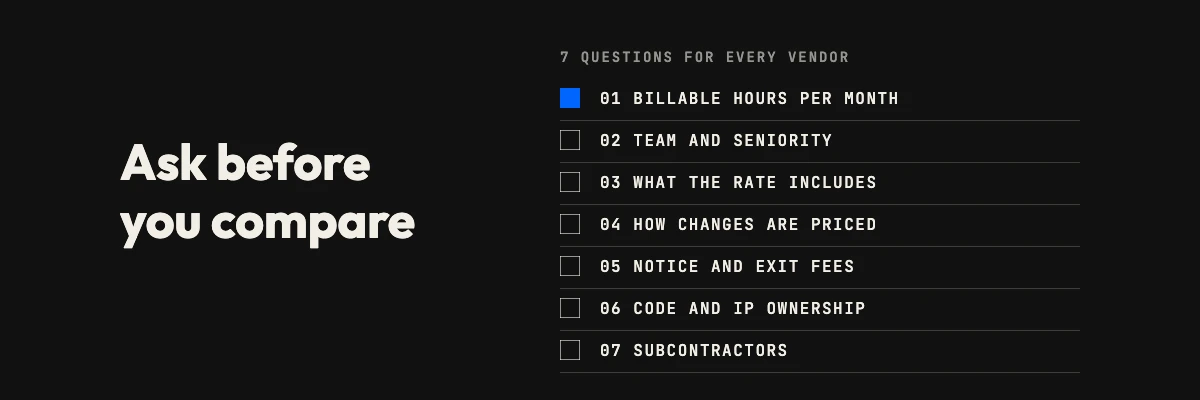
Before you weigh one vendor’s custom software development rates against another’s, send them all the same list, in writing. Their answers will tell you more than the headline numbers do:
- How many billable hours does your month assume?
- Who is on the team, at what seniority, and for what share of their time?
- What is inside the rate: QA, project management, DevOps, tooling, licences?
- How is a change request priced, and who approves it before work starts?
- What does it take to end the engagement, and is there a fee?
- Who owns the code and the repositories, and from what date?
- Will anyone outside your company work on the project?
Our own answers are on the record. On fixed-scope work, we quote any change in writing within 48 hours, and nothing starts until you approve it. Your repositories and IP are yours from the first day, and we use no subcontractors.
Hourly, monthly or fixed: which rate fits your project
Each pricing unit suits a different kind of work, and the right one depends on how settled your scope is.
| Model | You pay for | Best for | Who carries overrun risk |
|---|---|---|---|
| Fixed scope | Agreed scope, in milestones, from $6,500 | A first release with a clear spec | Us: the price holds |
| Time and materials | Hours worked, billed per sprint with shared timesheets and an optional monthly cap | Scope that will change as you learn | You |
| Dedicated team | A full month per person, $2,600 to $5,600 on our card | An ongoing product roadmap | Shared |
For many of our clients, the pattern that works is a fixed-scope first release, followed by a monthly team once the roadmap keeps going. Our engagement models page sets out the terms of each option, and if you are still at the idea stage, our guide to what an MVP costs to build covers the first step in more detail.

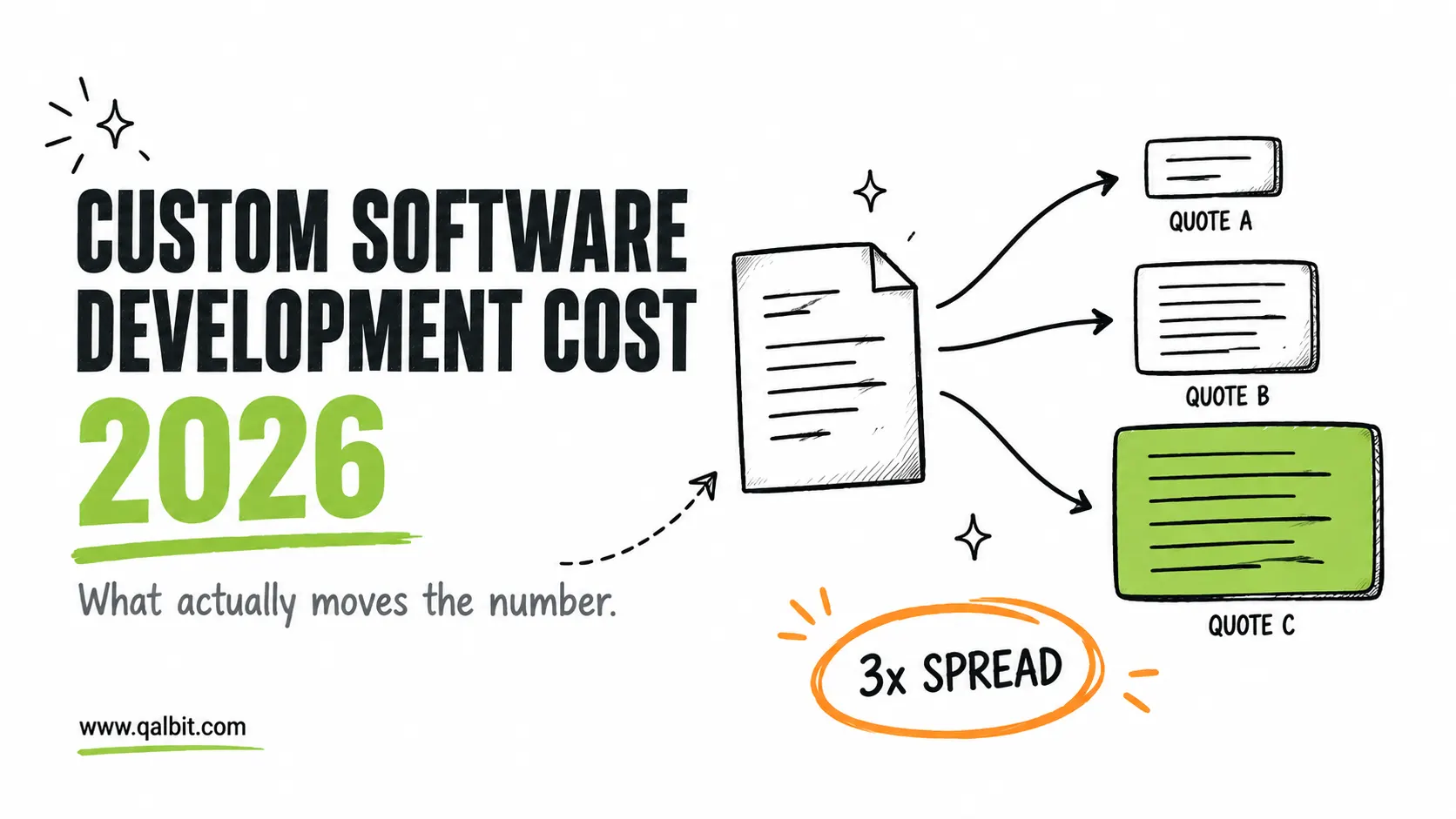
Custom software development rates on our published card run from $2,600 to $5,600 per engineer a month, which works out at roughly $16 to $35 an hour. Across agencies, Clutch puts most firms at $25 to $49 an hour. Both of our figures describe the same engineer and the same invoice, so the one a vendor chooses to quote tells you how they want to be compared, and very little about what your build will cost.
We are a senior engineering team in Ahmedabad, and we have been building software for clients in the US, the UK and the Gulf since 2018: more than 50 clients and over 120 engagements. We publish our rates by role and seniority on our pricing page, and the software development cost calculator turns a project shape into a cost range. This guide covers what sits behind those numbers: how rates are quoted, how to convert one kind into another, and what a rate leaves out.
What custom software development rates actually measure
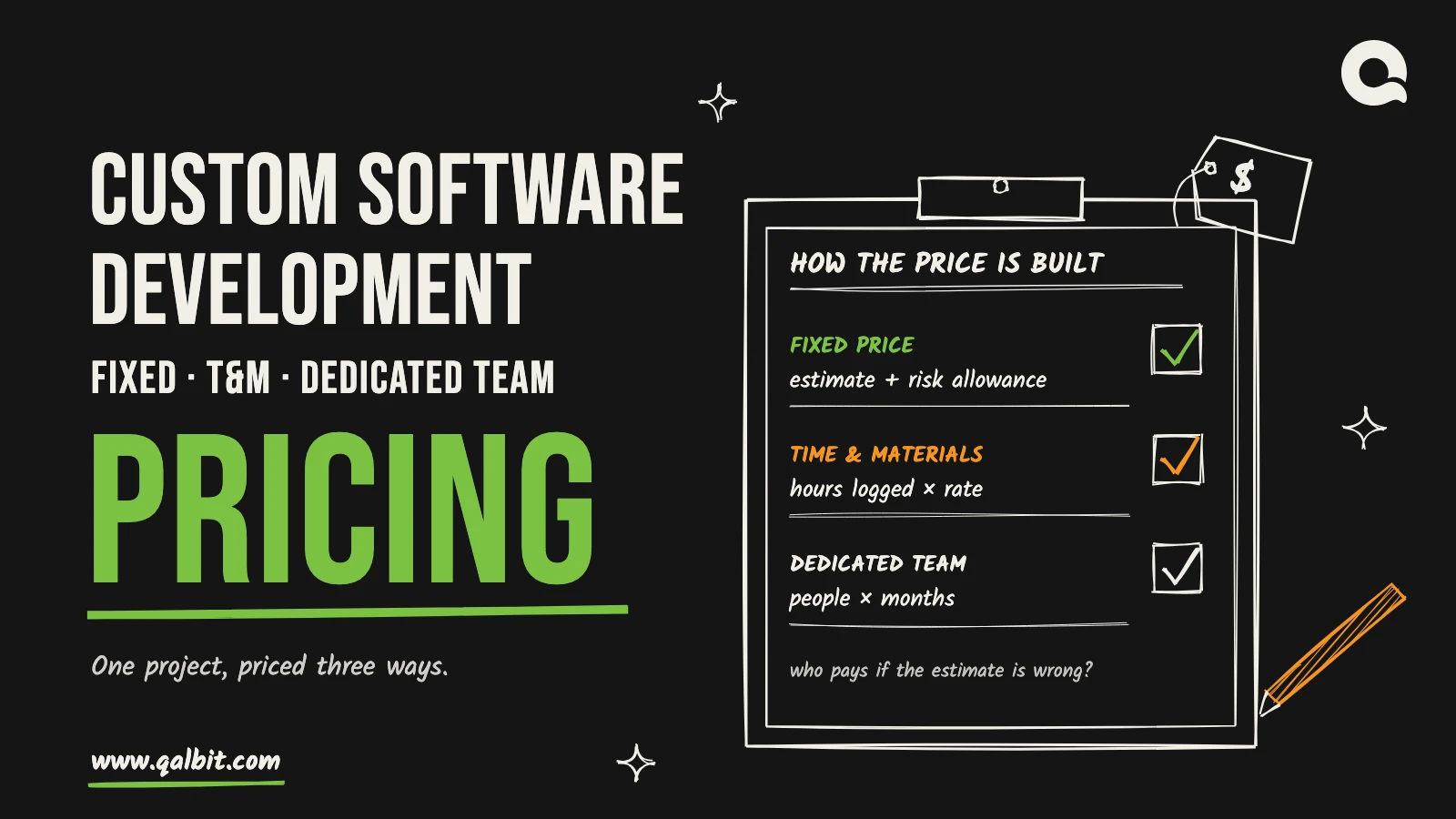
A rate is a price for a unit of something. In software, the unit is either someone’s time or a defined piece of scope, and you will meet three versions of it:
There is a fourth shape for software that is already live: a support retainer, which buys a monthly block of hours for fixes and small changes. Ours starts from $1,400 a month.
No unit is cheaper by nature. Each one moves risk between you and the vendor. On an hourly rate, you carry the risk that the work takes longer than planned. On a fixed price, the vendor carries it and prices it in. A monthly rate sits between the two: the cost of each month is certain, but how much gets built in that month depends on how well the work was planned.
How to convert hourly, monthly and fixed rates
Custom software development rates only become comparable once they are in the same unit. Rate cards, ours included, usually convert with a 160-hour month, which is four weeks of 40 hours. That is a sensible starting point, but it is a convention, and conventions differ between vendors.
From a monthly rate to an hourly one
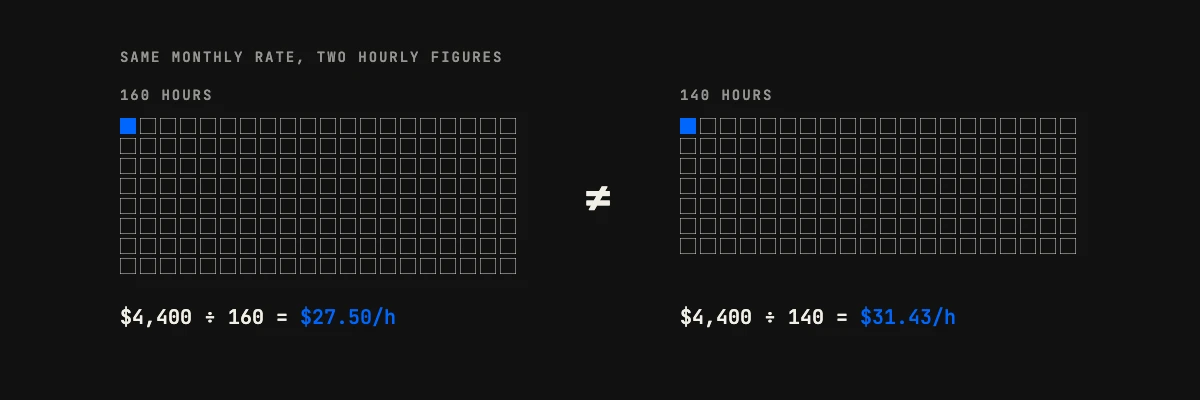
Divide the monthly rate by the hours the vendor assumes. A senior engineer on our card costs $4,400 a month, which is $27.50 an hour across 160 hours. If another vendor assumes 140 billable hours instead, to allow for holidays and internal meetings, the same $4,400 becomes $31.43 an hour. That is a 14% difference on paper, and it comes from an assumption that never appeared in the proposal.