
Ask where errors are caught in a service they built, and what becomes of a half-finished job when the process dies. Three answers are worth hearing. Request errors become responses in one place, not in every route. Queue workers get retries, a dead-letter queue and handlers that are safe to run twice. A global unhandledRejection handler exists to log and exit cleanly, never to keep a broken process alive. If the reply is “we wrap everything in try/catch”, the candidate has probably not run workers at scale.
Can they explain streams and backpressure?
Sooner or later, any service that moves files, exports or large API responses runs into streams. The backpressure guide describes the core problem: when the destination is slower than the source, data piles up in memory. write() returns false to signal a stop, and the 'drain' event says when to resume. The usual default buffer is 16 KB for byte streams and 16 objects in object mode.
A concrete test is an export endpoint that reads a large table and writes a CSV. The weak answer loads every row into an array first. The strong one streams the rows through pipeline(), which the same guide recommends because it forwards errors and cleans up every stream when one fails. Plain .pipe() does not destroy the others. Then ask what happens when the client disconnects half-way through the download.
TypeScript, and what recent Node versions do and do not do
Recent Node releases can run TypeScript files directly by stripping the types out. The TypeScript page marks type stripping stable from v25.2.0 and v24.12.0, and states plainly that no type checking is performed. A candidate who says Node “handles TypeScript now” has missed that last part. The compiler still has to run in CI, or the types are decoration.
Also ask which Node line they ship on. On the nodejs.org releases page as we write this, v24 (Krypton) and v22 (Jod) are LTS, v26 is Current and v20 is end-of-life. The project’s release schedule moves v26 to LTS on 28 October 2026 and ends support for v22 at the end of April 2027. Production code belongs on an LTS line, and a developer should know the date theirs stops receiving fixes.
Dependencies, input and secrets
A Node.js service runs on code other people wrote, pulled in through npm, and a lot of the risk sits there. In September 2025 CISA warned of a self-replicating worm in the npm ecosystem that had compromised over 500 packages. It stole developer credentials and used them to publish more infected versions. CISA’s advice was to review dependencies, check lockfiles, pin to releases from before 16 September 2025 and rotate credentials.
The Node.js security best practices turn that into habits you can ask about. Commit the lockfile and install with npm ci, which fails when the lockfile and package.json disagree. Run npm audit in CI. Consider --ignore-scripts so install scripts cannot run. Set a release-age cooldown with min-release-age (npm v11.10.0 or later) so a package published an hour ago never reaches your build. Beyond that, a reviewer should see the basics in every pull request. Input is validated at the edge, secrets come from the environment and are never committed, and there is a plan for rotating a key that leaks.
Time-zone overlap after hiring Node.js developers in India
India has one time zone, IST, which is UTC+5:30 all year with no daylight saving. Most of our clients’ clocks move twice a year and ours never do. The table converts a 9:00 start in each region into IST, for summer and for winter, next to the live hours we hold with you.
| Your region | 9:00 your time is, in IST | Live hours we hold with you |
|---|---|---|
| US Eastern | 18:30 in summer (EDT), 19:30 in winter (EST) | Four, across your morning, on request |
| US Pacific | 21:30 in summer (PDT), 22:30 in winter (PST) | Four, across your morning, on request |
| UK | 13:30 in summer (BST), 14:30 in winter (GMT) | Four, across your morning |
| Gulf (GST, UTC+4) | 10:30 all year | The whole working day |
The gap to Eastern is 9.5 hours in summer and 10.5 in winter. To Pacific it is 12.5 and 13.5, to the UK 4.5 and 5.5, and to the Gulf a constant 1.5. The IST time of your 9:00 call moves by an hour on the day your own clocks change. In the UK that is the last Sunday of October (25 October in 2026); in the US it is the first Sunday of November (1 November). If you have offices in both London and New York, expect a week each autumn when only one has moved. In March the mismatch lasts two or three weeks. Check the invites before a release lands in that window.
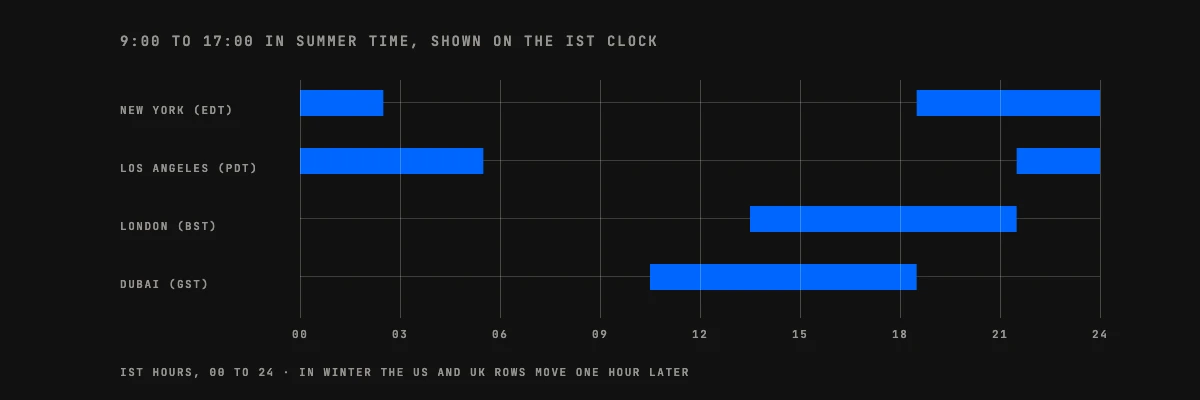
For US clients the day works as a handover. Your morning falls in our evening, so stand-ups, reviews and decisions happen live. A written note goes out before our day closes, so nothing waits overnight unanswered.
How much shared time a Node.js job needs
Not every Node.js job needs the same amount of shared time. A backend team behind a well-specified API uses the window for planning, code review and incident calls, and does the focused work outside it. Discovery on an unfamiliar codebase is different: it needs all four hours, plus someone on your side who can answer questions inside them.
Hiring Node.js developers in India by the month, the scope or the hour
How settled your scope is decides the model more than anything else, and we work all three ways. The engagement model page compares them side by side, and our post on pricing models for custom software prices one project each way.
| Model | How it is billed | Suits a Node.js job such as |
|---|---|---|
| Dedicated engineers | Per engineer per month, in advance; 30 days’ notice ends it | An API platform with a roadmap that keeps going after launch |
| Fixed scope | One agreed price paid by milestone, from $6,500; changes quoted in writing first | A bounded build: one integration, one service, one migration |
| Time and materials | Hours actually worked, billed per sprint; timesheets shared, optional monthly cap | Discovery, tracing a slow endpoint, work that cannot be fully specified yet |
For dedicated engineers, our published rate card lists a mid-level engineer (three to five years) at $3,200 a month. A senior (six to nine years) is $4,400, and a tech lead (ten years or more) is $5,600. Rates are billed in advance with no annual commitment, and you get a written rate for each named engineer before you commit. We do not publish an hourly rate for time and materials, so get one in writing before you choose that route. It also depends on a product owner who sets priorities every sprint; without one, a dedicated team or a fixed scope is the safer choice.
Whichever model you pick, ask the questions that sit underneath the invoice. Who owns the repositories and cloud accounts? (It should be you, from day one.) Are the engineers the vendor’s own employees or subcontractors? What happens when one of them leaves?
How we vet and trial Node.js developers
Two or three profiles with real project history arrive within 48 hours of the first call. You interview each person yourself, ideally with the five tests above. Our Node.js engineers write TypeScript by default, on NestJS, Express or Fastify, and are comfortable in a plain JavaScript codebase you already run.
The first two weeks are a paid trial sprint on a live ticket in your repository: an endpoint, a worker, a flaky queue. Two weeks of real work show you more than any interview can. If the fit is wrong, you stop there and pay only for that sprint. If it is right, you carry on under whichever model suits the work, add engineers as the roadmap grows and release them with 30 days’ notice. There are no recruiter fees.
If you take only one test into the interview, make it the pbkdf2Sync handler. Hiring Node.js developers in India or anywhere else comes down to the same signal. A candidate who spots the blocking call in under a minute, then asks how large the request body can get, has usually kept a Node.js service alive under real traffic. That experience is what you are paying for.



Hiring Node.js developers in India works best when you test five things yourself: the event loop, failure handling, streams, TypeScript and dependencies. Neither a CV nor a list of frameworks tells you much about any of them. From Ahmedabad we build Node.js backends for American, British and Gulf clients. This is the checklist we would hand a buyer’s interviewer to use on our own engineers.
It also answers the two practical questions that come with a team several time zones away: which hours you will actually share, and how the work is billed. If you already know you want vetted engineers, you can meet dedicated Node.js engineers from our team. If Node.js itself is still an open question for your product, our earlier post on why Node.js suits modern web applications makes that case. This one starts after the decision.
Hiring Node.js developers in India: five things to test
Most Node.js interviews drift into framework trivia: which ORM, which test runner, NestJS or Express. The production problems we find in inherited Node.js codebases rarely trace back to any of that. They come from a handful of habits, and each one can be checked in about fifteen minutes with real code on the screen.
Do they know what blocks the event loop?
Node runs your JavaScript on a single thread, so one slow request holds up every other user. The official guide on not blocking the event loop lists the usual culprits. They include regular expressions with nested quantifiers,
JSON.parseandJSON.stringifyon large input, and the synchronous versions of crypto, compression, file system and child-process calls. In its own benchmark, parsing a 50 MB JSON string takes 1.3 seconds.Show the candidate a handler like this and ask what goes wrong under load:
app.post('/login', (req, res) => {
  const hash = crypto.pbkdf2Sync(req.body.password, salt, 600000, 64, 'sha512')
  res.json({ ok: hash.equals(stored) })
})
When we ran that one call on a laptop under Node 22, it held the event loop for just over a second. Not a single timer fired until it finished.
A good answer names the synchronous call and explains that every other request queues behind it. The fix is the asynchronous
crypto.pbkdf2, which hands the hashing to Node’s worker pool. A senior candidate keeps going. They cap the size of incoming input, move CPU-heavy work to worker threads or a separate service, and measure event-loop delay in production rather than guessing. Some will also swaphash.equals()forcrypto.timingSafeEqual(), so the comparison does not leak timing. The guide’s own rule is the one to listen for: the event loop should orchestrate client requests, not fulfil them itself.How do they handle async errors and unhandled rejections?
Since Node 15, a promise rejection that nothing handles is raised as an uncaught exception by default, and an uncaught exception ends the process. Earlier versions only printed a warning; the CLI documentation records the change in the history of
--unhandled-rejections. So a missingawaitor a forgotten.catch()now shows up as a restart, usually in the middle of somebody’s request.