



You’ve got the idea. Maybe a deck. Maybe a lead investor who just asked the one question every founder dreads answering off the cuff: so what will it actually cost to build?
We field this question on scoping calls almost every week, and the honest reply is never a single figure. It’s a range that moves depending on a handful of choices you’re about to make. So instead of quoting you a number and hoping it sticks, let’s walk through what those choices are — the 2026 pricing, the mistakes that quietly drain a runway, and the scope decisions that end up mattering far more than whatever hourly rate you manage to negotiate.
The short answer: what an MVP costs in 2026
Here’s where the numbers land with a senior India-based team that leans on proven patterns and AI-assisted development rather than reinventing the wheel:
| MVP type | Cost | Timeline |
|---|---|---|
| Lean web MVP (one core journey) | $4,000 – $7,500 | 4–7 weeks |
| Standard web MVP (auth, billing, core workflow, admin) | $9,000 – $18,000 | 6–10 weeks |
| Marketplace / two-sided MVP | $14,000 – $28,000 | 8–14 weeks |
| Mobile MVP (Flutter, both stores) | $10,000 – $21,000 | 8–12 weeks |
| Web + mobile together | $15,000 – $33,000 | 10–16 weeks |
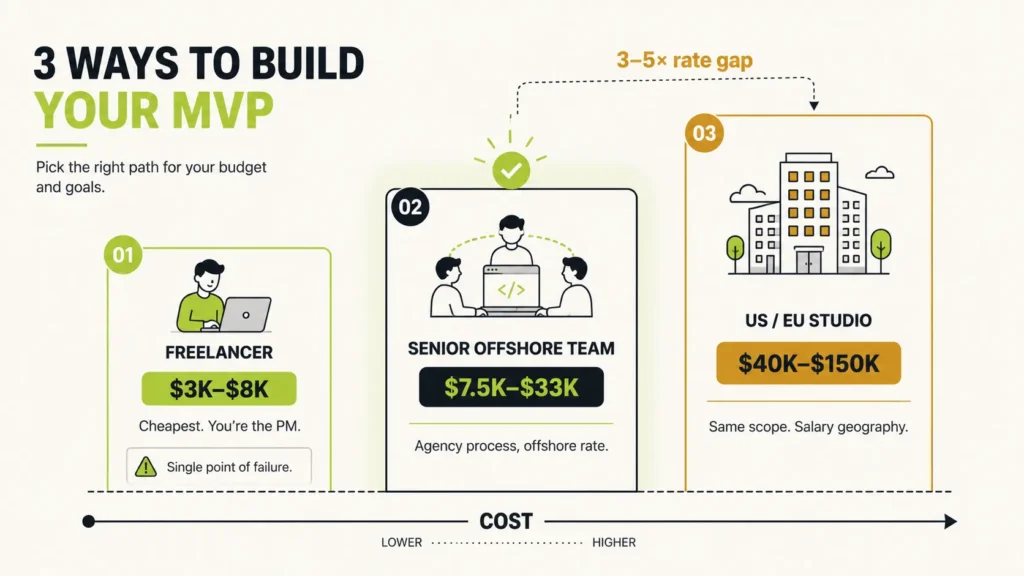
Take that same scope to a studio in the US or Western Europe and you’re looking at $40,000 to $150,000. We want to be clear about why: it isn’t that the work is better. It’s geography. A senior developer in India bills somewhere around $25–$50 an hour, while the equivalent in the US runs $100–$200. That three-to-five-times gap is the whole story, and it’s exactly why so many funded and bootstrapped founders build their first version offshore.
If you’d rather see a number tailored to your specific idea, our cost calculator will give you a range in about a minute.
Why building an MVP got cheaper this year
The low end of that table has crept down over the past eighteen months, and there are two reasons worth understanding before you sign anything.
The first is AI-assisted development. Tools like Cursor and GitHub Copilot are genuinely good at the grunt work that fills most of an MVP — the scaffolding, the CRUD screens, the login flows, the tests, the admin panel nobody enjoys building. That’s the stuff that used to swallow weeks. Pair a decent AI setup with a reusable component library and a senior team ships the same feature set noticeably faster and cheaper than they could a year or two ago.
The second is that the surrounding tooling has grown up. Managed hosting, one-click deployment pipelines, and solid framework starters mean a small senior team now delivers what used to take a much bigger one. Even when hourly rates hold steady, the cost per feature keeps sliding.
One important caveat, though: these savings only materialize when senior people are driving. Hand the same AI tools to a junior and you get code that technically runs but that any future CTO will take one look at and refuse to touch. Which brings us neatly to the trap we’ll cover shortly.
What that budget actually gets you
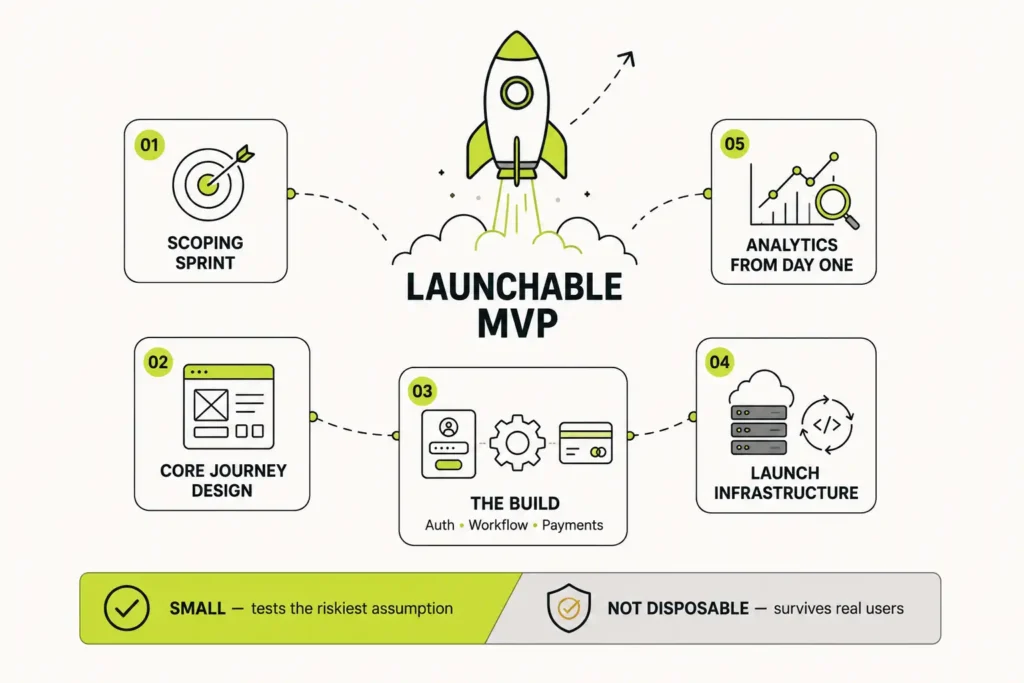
An MVP isn’t a weekend hackathon build with the corners sanded off. When we quote a standard web MVP in the $9K–$18K band, here’s what’s inside it:
- A scoping sprint. Before anyone writes code, we pin down the single riskiest assumption in your idea and cut everything that doesn’t test it. This is where most of the real savings live — not in the hourly rate.
- Design for the core journey. Polished where users actually judge you, deliberately plain everywhere else.
- The build itself. Authentication, the core workflow, payments if you’re charging from day one, and a functional admin panel.
- Launch infrastructure. Production and staging environments, CI/CD, error tracking — the unglamorous plumbing that keeps you from flying blind.
- Analytics from the first day. So your opening week produces actual evidence instead of a collection of hunches.
That last item is really the whole point. The reason to spend this money at all is to buy trustworthy answers to a single question: do people want this thing? Everything else is in service of that.
The five decisions that move your number
1. Web first or mobile first?
Web MVPs come in 30–40% cheaper, skip the app-store review gauntlet, and let you ship fixes the same day rather than waiting on a release cycle. Go mobile-first only if your idea genuinely lives on the phone — think camera, GPS, or a habit that’s driven by push notifications. Plenty of founders launch on web, validate, and only then add a Flutter app. And if you do need an app, one Flutter codebase covering both stores beats maintaining two separate native builds.
2. One core journey or three?
Every extra user journey adds real cost. A marketplace with buyers, sellers, and admins is effectively three products wearing a single trench coat — which is precisely why two-sided MVPs sit near the top of the pricing table. Our advice: seed the supply side by hand at first, and only build the second journey once the first one shows signs of life.
3. Custom design or proven patterns?
Nobody has ever funded a gradient. Investors fund traction. Sticking to familiar UI patterns saves you 10–15% (sometimes more) and, in our experience, tends to test better anyway because users already know how to work with something they’ve seen before. Save the bespoke visual identity for after you’ve proven anyone wants the product.
4. How many integrations at launch?
Stripe or Razorpay is table stakes — expected and quick. But each additional integration you bolt on at launch, whether it’s maps, KYC, messaging, or calendars, adds both cost and things that can break. If an integration doesn’t help test your core assumption, push it to phase two without guilt.
5. Who’s actually building it?
Realistically you’ve got three paths:
- A freelancer ($3K–$8K). Cheapest option, but you inherit a single point of failure and, functionally, the project-manager role.
- A local US or EU agency ($40K+). The most expensive route, and the premium is almost entirely about where they’re sitting.
- A senior offshore product team. The middle path most funded pre-seed founders take — agency-grade process and accountability without the local price tag.
The two ways founders quietly burn their runway
Overbuilding. We’ve all seen the $60K “MVP” stuffed with six features, a live chat widget, and an analytics dashboard — shipped only to discover users cared about exactly one of those things. The cure is unsentimental scoping: if a feature doesn’t test your riskiest assumption, it waits. That fight is worth having before a single line of code exists, which is the entire reason our scoping sprint comes first.
Underbuying. The flip side is the $3K prototype that buckles the moment real users show up. No error tracking, no analytics, and a codebase so tangled that the first serious engineer you hire refuses to work on it. Now you’re paying for a rebuild and you’ve burned the window when you should have been learning. An MVP needs to be small — it doesn’t need to be disposable.
The sweet spot buys you the smallest possible product that still produces evidence you can trust: a polished core journey, wired for measurement from day one, sitting on an architecture that won’t collapse if you actually succeed. For a week-by-week view of how that comes together, our MVP timeline guide walks through it.
Get your number
Two free ways to move forward. Run your idea through our software development cost calculator for an instant range, or book a scoping call with the QalbIT MVP team. We’ll help you find your riskiest assumption and hand you a fixed cost and a launch date — usually before the first call is over.
Frequently asked questions
Sometimes, yes. If the test you need to run is genuinely tiny — a landing page, a waitlist, and a concierge backend where you do the work manually behind the scenes — you can validate real demand for under $2,000, and that's frequently the smartest first move. But a working product with real auth and payments for under $5K almost always means corners that'll cost you more to un-cut later than you saved up front.
The same scope typically runs $40,000–$150,000 at a US or Western European studio versus roughly $7,500–$33,000 with a senior India-based team. Nearly all of that gap is hourly rate — about $100–$200 an hour in the US against $25–$50 in India. It's a difference in cost of living, not a difference in engineering quality.
Fixed, in almost every case. Your runway math needs a firm number to plan around, and fixing the scope forces the discipline that makes MVPs work in the first place. We give you a fixed cost and a launch date after one scoping call.
Two ongoing lines: hosting, which sits around $50–$300 a month at MVP scale, and iteration as feedback rolls in. A reasonable rule of thumb is to set aside 15–25% of your build cost per year for maintenance and improvements — and expect the heaviest iteration in that first quarter, while you're still learning what users genuinely do versus what they told you they'd do.
Yes, and you do. The repositories, the designs, the infrastructure — all yours from day one, and documented well enough that a future CTO can pick it up without cursing your name.