If you’re weighing a custom CRM against another year of per-seat licence fees, one question comes first: what does custom CRM development actually cost in 2026?
Here’s the honest answer from our delivery data on custom CRM development projects: a production-ready custom CRM built by an experienced India-based team costs $10,500–$30,000 for a typical first release, delivered in 8 to 14 weeks. Advanced and vertical CRMs, with heavy integration or compliance work, run higher. Most cost guides you’ll find online quote $30,000–$300,000 — but those numbers assume US or Western European teams. India-based delivery is where the same Laravel/Node.js + React stack ships for a fraction of that, with US, UK and GCC time-zone overlap.
This guide breaks down where the money goes, what pushes a project to either end of the range, and when a custom CRM finally beats paying Salesforce, HubSpot or Zoho forever.
Lean and standard builds are the typical first release, $10,500 – $30,000. Advanced and vertical builds sit above that range. *Vertical first-release figure. Healthcare and fintech run higher once full HIPAA/PHI or financial-compliance architecture is scoped — that can’t be bolted on later.
For comparison, US and Western European agencies typically quote 2–3× these numbers for identical scope — and more on raw hourly rates. Want a figure for your exact requirements? Our free cost calculator gives you an instant range in under a minute.
What you’re actually paying for
A custom CRM isn’t one thing — it’s a set of modules. Understanding module costs makes every agency quote easier to judge.
Core modules (always included):
Contacts & accounts (customer 360) — every interaction, deal, document and invoice tied to one customer record.
Lead capture & pipeline — web forms, stages, assignment rules and follow-up reminders.
User roles & permissions — who sees which leads, territories and reports.
Common additions (each adds roughly 5–12% to the budget):
Quoting & approvals — a quote builder wired to your price list, with approval flows. (Worth noting: HubSpot ships no quoting/CPQ at any tier without a paid add-on — a hidden cost we cover below.)
Third-party integrations — telephony (click-to-call), WhatsApp/email capture, accounting sync. Integrations are the single most common budget-mover.
Automation — lead scoring, stale-deal alerts, renewal reminders.
Mobile companion app — for field sales teams.
The five factors that move the price
Number of workflows, not number of users. Custom CRM pricing tracks how many distinct processes you run (sales, service, renewals, field visits), not headcount. That’s the opposite of SaaS licensing — and why custom wins as teams grow.
Integration count. Each external system — ERP, Tally/QuickBooks, telephony, marketing tools — adds design, build and testing time. Three integrations typically add $4,000–$8,000.
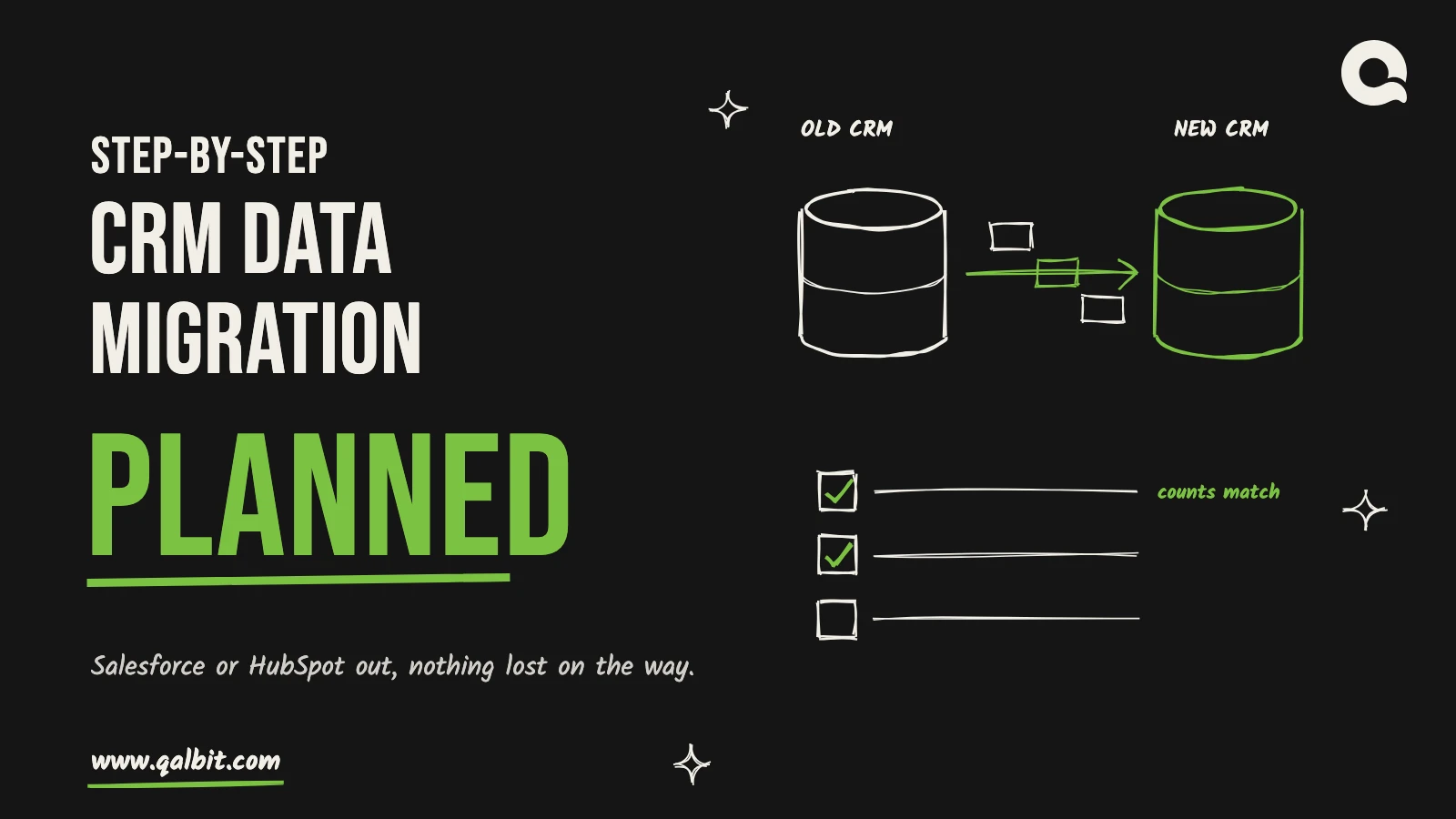
Data migration. Moving five years of messy spreadsheet data — deduplication, history preservation, verification — is real work. Budget $1,500–$5,000 for reasonably clean data; legacy or CRM-to-CRM migrations with dirty data run considerably higher.
Vertical complexity. A real-estate CRM with property inventory and site-visit scheduling, or a healthcare CRM with patient journeys, costs more than a generic pipeline — but it’s exactly where custom development beats configuring a one-size-fits-all tool.
Who builds it. A Philadelphia or London agency bills $120–$220/hour. A senior India-based team like QalbIT delivers the same Laravel/Node.js + React stack at roughly a quarter to a third of that, with US/UK/GCC time-zone overlap.
How AI-assisted development keeps the cost down
Part of the reason our numbers land below typical agency quotes is how we build. We use AI coding tools (Cursor, Claude and similar) throughout delivery — and used well, they meaningfully speed up the repetitive 60–70% of a CRM build: data models, CRUD screens, API scaffolding, form validation, test coverage and migrations.
Two honest caveats, because this is a “real numbers” guide:
AI accelerates the boilerplate, not the thinking. Process mapping, integration design, edge-case handling and security still take human senior engineers. Independent 2025 research even found AI can slow experienced developers on complex, unfamiliar codebases — so we apply it where it genuinely helps and don’t pretend it replaces judgement.
The savings are already in the price. AI-assisted delivery is one of the reasons a typical QalbIT first release lands at $10,500–$30,000 instead of 2–3× that. It’s baked into the ranges above, not a separate discount — which is exactly why our numbers beat agencies still billing pure hourly on hand-written boilerplate.
The net effect: faster first releases, fewer hours on plumbing, and more of your budget spent on the workflows that actually differentiate your business.
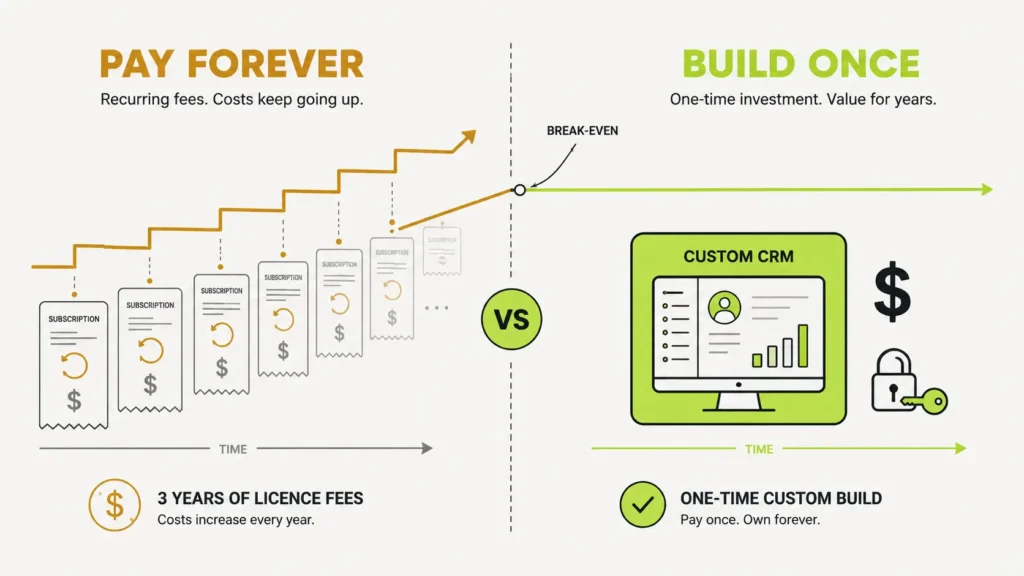
Custom CRM vs licence fees: the real 3-year math
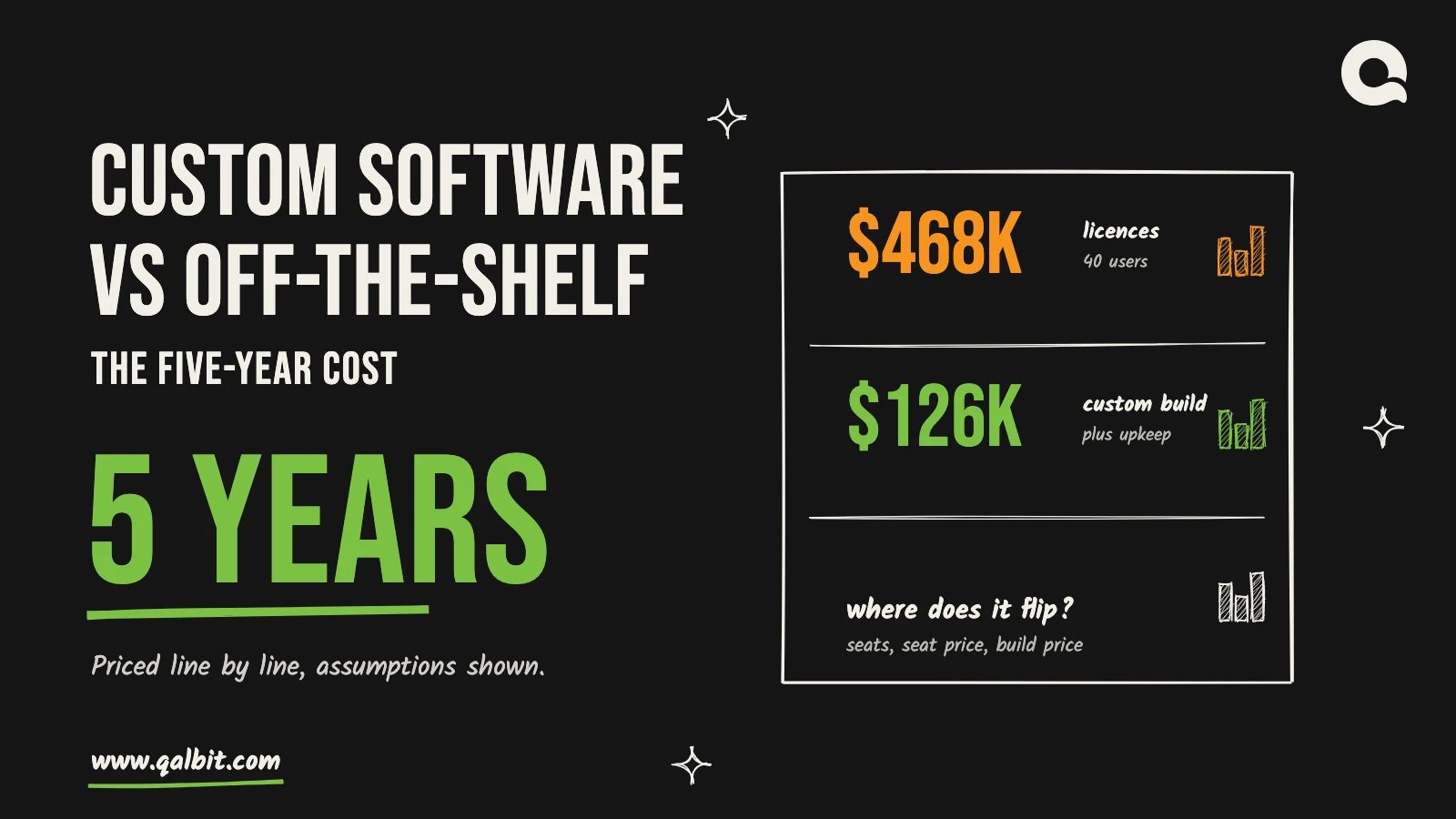
The comparison that matters isn’t “custom vs free” — it’s custom vs three years of per-seat fees. Here’s what 25 users on mid-tier plans actually costs over three years at 2026 list prices (software only, before implementation and add-ons):
Platform (mid-tier, 25 users)
Per user / month
3-year cost
Zoho CRM Professional
$23
~$20,700
Zoho CRM Enterprise
$40
~$36,000
HubSpot Sales Hub Professional
$90 + $1,500 onboarding
~$82,500
Salesforce Sales Cloud Enterprise
$175
~$157,500
A few things those numbers hide: Salesforce raised its Enterprise list price to $175/user/month in August 2025; HubSpot’s quoting/CPQ is a separate ~$84/user/month add-on; and none of the figures include implementation, AppExchange apps or per-seat growth as you hire.
Now set that against a custom build:
A $20,000 custom CRM is paid for once. Years two and three cost only hosting and a modest support retainer — and it fits your process exactly, with no per-seat meter running.
Even against Zoho Enterprise (~$36K/3yr) the build breaks even inside the first two years; against HubSpot or Salesforce it’s not close.
The break-even usually lands between month 14 and month 30 — faster the more seats you have. (Full comparison: see our guide to custom CRM vs Salesforce, HubSpot and Zoho.)
Where teams overspend (and how to avoid it)
Building all modules at once. Launch with leads + pipeline + customer 360; add quoting and automation once your team has adopted the core. Phased rollouts cut first-release cost by 30–40% — one common pattern trims an 18-week build to 10 weeks.
Rebuilding what integration solves. Don’t rebuild accounting inside your CRM — sync with Tally, Zoho Books or QuickBooks instead. Same logic for CRM–ERP integration: connect systems, don’t duplicate them.
Custom design where patterns work. Sales teams want fast, keyboard-friendly screens, not award-winning visuals. Proven UI patterns save 10–15%.
Ignoring scope creep. A majority of CRM projects overrun their timeline by 30–50%. A phased, fixed-scope first release is the single best guard against it.
Is a custom CRM worth it? The ROI view
CRM done right returns real money — recent independent research puts realized average CRM ROI around $3 for every $1 spent, and the highest-performing implementations return far more. The catch is that generic platforms only deliver that when your process happens to match theirs. A custom CRM earns its return by removing the workarounds, duplicate data entry and licence bloat that quietly tax teams every day — and by belonging to you rather than resetting to zero every renewal.
Get a number for your CRM
Two free ways to move from “roughly” to “exactly”:
Talk to our CRM team — we’ll map your sales process and send a module-by-module estimate within 48 hours, compared directly against your current licence spend.
TagsBuild vs BuyCRM 2026CRM CostCRM DevelopmentSoftware Development Cost
Works with QalbIT clients on the commercial side of a software decision: budgets, operating models, sector platforms and the operational gains that pay for a build. Writes about how ERP, CRM and outsourcing choices look from the business seat rather than the engineering one.
If you’re weighing a custom CRM against another year of per-seat licence fees, one question comes first: what does custom CRM development actually cost in 2026?
Here’s the honest answer from our delivery data on custom CRM development projects: a production-ready custom CRM built by an experienced India-based team costs $10,500–$30,000 for a typical first release, delivered in 8 to 14 weeks. Advanced and vertical CRMs, with heavy integration or compliance work, run higher. Most cost guides you’ll find online quote $30,000–$300,000 — but those numbers assume US or Western European teams. India-based delivery is where the same Laravel/Node.js + React stack ships for a fraction of that, with US, UK and GCC time-zone overlap.
This guide breaks down where the money goes, what pushes a project to either end of the range, and when a custom CRM finally beats paying Salesforce, HubSpot or Zoho forever.
Quick answer: custom CRM cost ranges in 2026
Lean and standard builds are the typical first release, $10,500 – $30,000. Advanced and vertical builds sit above that range. *Vertical first-release figure. Healthcare and fintech run higher once full HIPAA/PHI or financial-compliance architecture is scoped — that can’t be bolted on later.
For comparison, US and Western European agencies typically quote 2–3× these numbers for identical scope — and more on raw hourly rates. Want a figure for your exact requirements? Our free cost calculator gives you an instant range in under a minute.
What you’re actually paying for
A custom CRM isn’t one thing — it’s a set of modules. Understanding module costs makes every agency quote easier to judge.
Core modules (always included):
Common additions (each adds roughly 5–12% to the budget):
The five factors that move the price
How AI-assisted development keeps the cost down
Part of the reason our numbers land below typical agency quotes is how we build. We use AI coding tools (Cursor, Claude and similar) throughout delivery — and used well, they meaningfully speed up the repetitive 60–70% of a CRM build: data models, CRUD screens, API scaffolding, form validation, test coverage and migrations.