Recruitment · HR tech
Recruitment software development case study: Bloomford hiring portal.
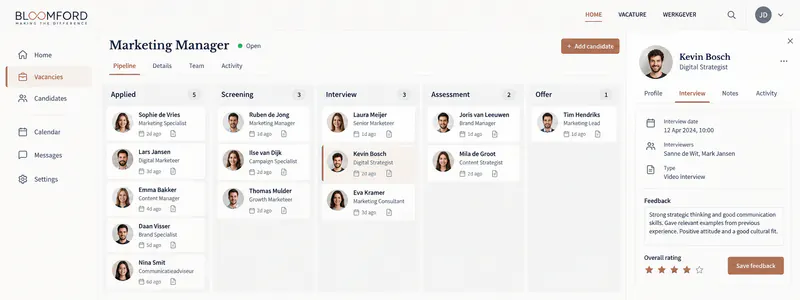
“Where are we with that role?” Bloomford is a hiring portal connecting employers, recruiters and candidates: custom recruitment software that turns scattered CVs, inboxes and interview notes into one searchable, structured talent pipeline.
Recruitment does not fail on sourcing. It fails when nobody can say where a candidate got to.
- Industry
- Recruitment · HR tech · talent
- Platform
- PHP (modular MVC) · MySQL · REST
- Engagement
- Discovery → MVP → feature rollout
- Users
- Recruiters, employers and candidates
Vacancies, candidates, interviews & assessmentsDelivered · since retired
1
Pipeline, not four inboxes
Structured
Candidate records, not CVs
Multi-lang
Vacancies and content
Shipped
Discovery to rollout
About the client
About the client
Bloomford is a recruitment-oriented business matching ambitious talent with the right employer. Working primarily with HR professionals, they needed a system that could assess candidates and then centralise the process across multiple roles and seniority levels.
Before launching the Bloomford platform, the team worked through traditional channels: email, spreadsheets, off-the-shelf job boards and manual follow-ups. They wanted to offer HR teams something better: a hiring portal built around candidate workflows, where employers, recruiters and candidates live in one structured workspace instead of across a dozen tools. That is digital transformation for operations in practice: the work stops living in inboxes and starts living in a system.
- Recruitment / HR tech
- Talent
- Belgium & wider Europe
Client at a glance
- Business type
- Recruitment services & consultancy
- Primary users
- HR professionals, hiring managers and recruiters
- Region
- Belgium & neighbouring markets
- Previous system
- Job boards, email, spreadsheets and shared drives
- Our role
- Product design, engineering and ongoing delivery
The challenge
Before Bloomford
The challenge
Consultants juggled multiple channels, job boards, email, LinkedIn messages and CV attachments, with no single record of where a candidate had reached.
Vacancy status, interview feedback and assessment results lived in different places, so answering "where are we with this role?" meant asking three people.
Employers and candidates both had to chase, because nobody could see the same pipeline at the same time.
Key challenges we uncovered
- Candidate information scattered across job boards, email, spreadsheets and shared drives.
- No single record of where a candidate had reached in a given role.
- Manual re-keying of CV data into spreadsheets, with the errors that always follow.
- Limited visibility for employers into their own live vacancies and pipelines.
- Difficulty comparing candidates fairly when their records were in different formats.
- No reporting to show where the hiring process was actually stalling.
These challenges shaped the data model, the permissions design and the order we built things in.
Goals & success criteria
Project goals & success criteria.
Clear goals up front let us make intentional trade-offs during UX and engineering, and define what "successful launch" actually meant for the client team.
Business goals
- Become a hiring portal that HR professionals trust as their daily working tool, not a secondary system.
- Shorten time-to-shortlist by having candidates in one place, searchable and comparable.
- Give employers a clear view of their open vacancies, pipeline stages and candidate conversations.
- Create a consistent, branded experience for employers: their reputation on placement.
Product & technical goals
- Design role-based dashboards for admins, recruiters, employers and candidates.
- Implement structured candidate profiles with CV parsing and reduced manual data entry.
- Support multi-language vacancies and content for Belgium and neighbouring markets.
- Build a modular PHP/MySQL platform that can scale to future HR tech integrations.
Staged approach
We agreed to launch vacancies and candidate management first, prove the pipeline was visible to both sides, then add interviews, assessments and reporting.
Our solution
Our solution
QalbIT partnered with Bloomford to design and build a modern hiring portal that acts as a single point of truth for employers and recruiting professionals.
We started by mapping the full hiring journey for each user type: recruiters, employers and candidates. From there, we defined the information architecture, a secure role-based access model, vacancy management and candidate profiles. Structured data pulls candidate details into a searchable, comparable pipeline instead of an inbox.
The result is a lightweight applicant tracking system with vacancy management, candidate profiles, video interviews and assessments in one place, and analytics that show where a role is actually stuck. It ran as a fixed-scope project: the first release was priced and dated before any code was written.
See how it works →Key solution pillars
End-to-end product collaboration
Discovery, UX, architecture and delivery in one team.
Custom, not flexible
Candidate and employer records shaped around real recruitment workflows.
Responsive, secure layered access
Each user type sees only what their role allows.
Structured candidate data
Comparable records instead of a folder of PDFs.
Product features & UX
Key product features & UX highlights.
Everything HR teams need to run a vacancy, compare candidates and keep both sides informed.
Role-based dashboards
Dedicated workspaces for recruiters, employers and candidates, each showing only the information and actions they need.
Vacancy management
Create, publish and manage job posts with detailed fields, multi-language support and controlled visibility.
Candidate profiles & CV parsing
Structured candidate records, populated with experience, skills and education, with less manual data entry.
Search & filters
Locate candidates by role, experience, availability and location, with filters that stay usable at scale.
Employer & company management
Manage employer accounts, contacts, branded profiles and vacancy visibility from one place.
Pipeline tracking
Track candidates across stages, applied, shortlisted, interviewed, offered, with visibility for both sides.
Notifications & communication
Automated alerts and status updates keep employers and candidates informed without a chase email.
Reporting foundation
Baseline reporting on vacancies, pipeline stages and time-to-hire, so the process can actually be improved.
Architecture & stack
Architecture & technology stack.
The technology stack is deliberately simple, maintainable and aligned with the team's long-term roadmap: powerful enough for today's needs without locking the product into unnecessary complexity.
Backend & infrastructure
- Modular PHP application layer separating recruitment, employer, vacancy and candidate domains.
- MySQL schema with structured tables for vacancies, candidates, employers and users.
- RESTful API for future integrations with HR tools and job boards.
- Role-based access control with granular permissions for each user type.
Frontend & UX
- Responsive web UI supporting desktop-first recruiter workflows and mobile candidate access.
- Clear information architecture for dashboards, vacancies and candidate records.
- Reusable components for tables, filters, forms and pipeline views.
- Progressive enhancement so core flows work on modest connections and older browsers.
- PHP
- Modular MVC
- MySQL
- Bootstrap
- jQuery
- REST API
- CDN
A modular monolith was the right answer here: one deployable the client can host anywhere, with clean seams for the integrations HR platforms always end up needing.
Delivery process & collaboration
Delivery process & collaboration.
We used a transparent, iterative delivery model with enough structure to keep momentum, and enough flexibility to adjust as we learnt from real usage.
- 012 weeks
Discovery & hiring workflow mapping
Workshops with the client to understand recruiting workflows, employer and candidate journeys, and define the core scope for the first release.
- 023 weeks
UX flows & interface design
Design of dashboards, vacancy forms, candidate profiles and search views, aligned to a HR-professional-friendly visual language.
- 038 weeks
MVP implementation
Vacancy, candidate and employer management built and hardened, released in fortnightly demos with feedback at each one.
- 043 weeks
Pilot with selected employers
Launched to a subset of employers and recruiters, improving matching logic and usability based on real usage.
- 05Ongoing
Rollout & continuous improvements
Extended to more roles and employers, with additional reporting, filters and integrations layered on since.
Engagement model used
A dedicated pod delivered the MVP, then moved to an ongoing engagement for interviews, assessments and reporting as the client learnt what recruiters actually used.
- Fixed-scope MVPWritten scope, milestone billing
- Pilot employers firstReal vacancies before full rollout
- Ongoing iterationReporting and integrations after launch
Results & impact
Results & impact.
From scattered CVs to a structured, searchable talent pool for HR professionals.
- StructuredRecords, not attachments
- ShippedDiscovery to rollout
Story behind the numbers
Launching the Bloomford hiring portal achieved the headline recruitment process it set out to solve. Rather than emailing CVs and endlessly chasing status, recruiters and employers now work in one shared pipeline, and the question that used to take three phone calls is answered by opening a page.
Related case studies
More work built the same way.
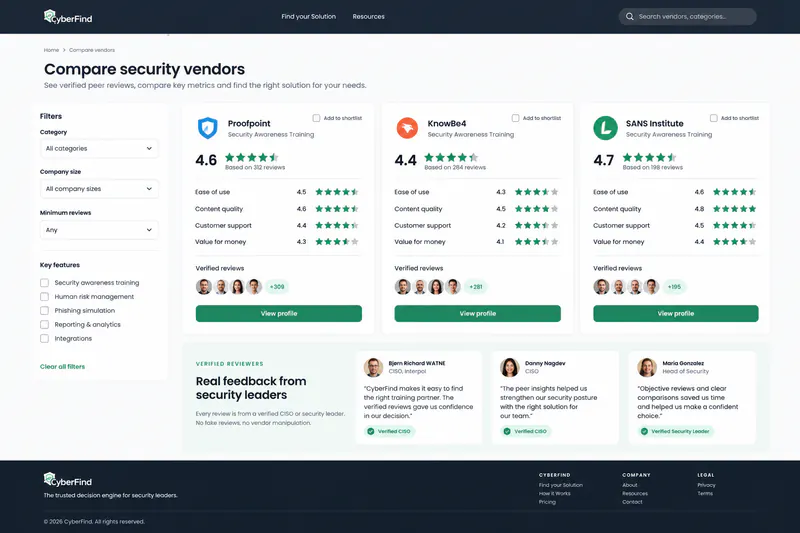
Different sectors, same discipline: written scope, sprint releases, and the client owning the code from day one.
Start here
A hiring portal or HR tech platform tailored to your workflows.
Tell us how your hiring process runs today and where it stalls. You get a written scope, an architecture recommendation and a price range within 48 hours.
- A written scope with the exclusions listed
- Role-based access designed in, not bolted on
- The name of the engineer who would lead it
- Free, and yours to keep either way
Get your free estimate
Three quick questions: scope, approach and a price range back within 48 hours. No sales call required first.
Next step
Still running hiring out of an inbox?
Send two lines about your hiring workflow. You get a written scope, timeline and price range within 48 hours, free, and yours either way.