


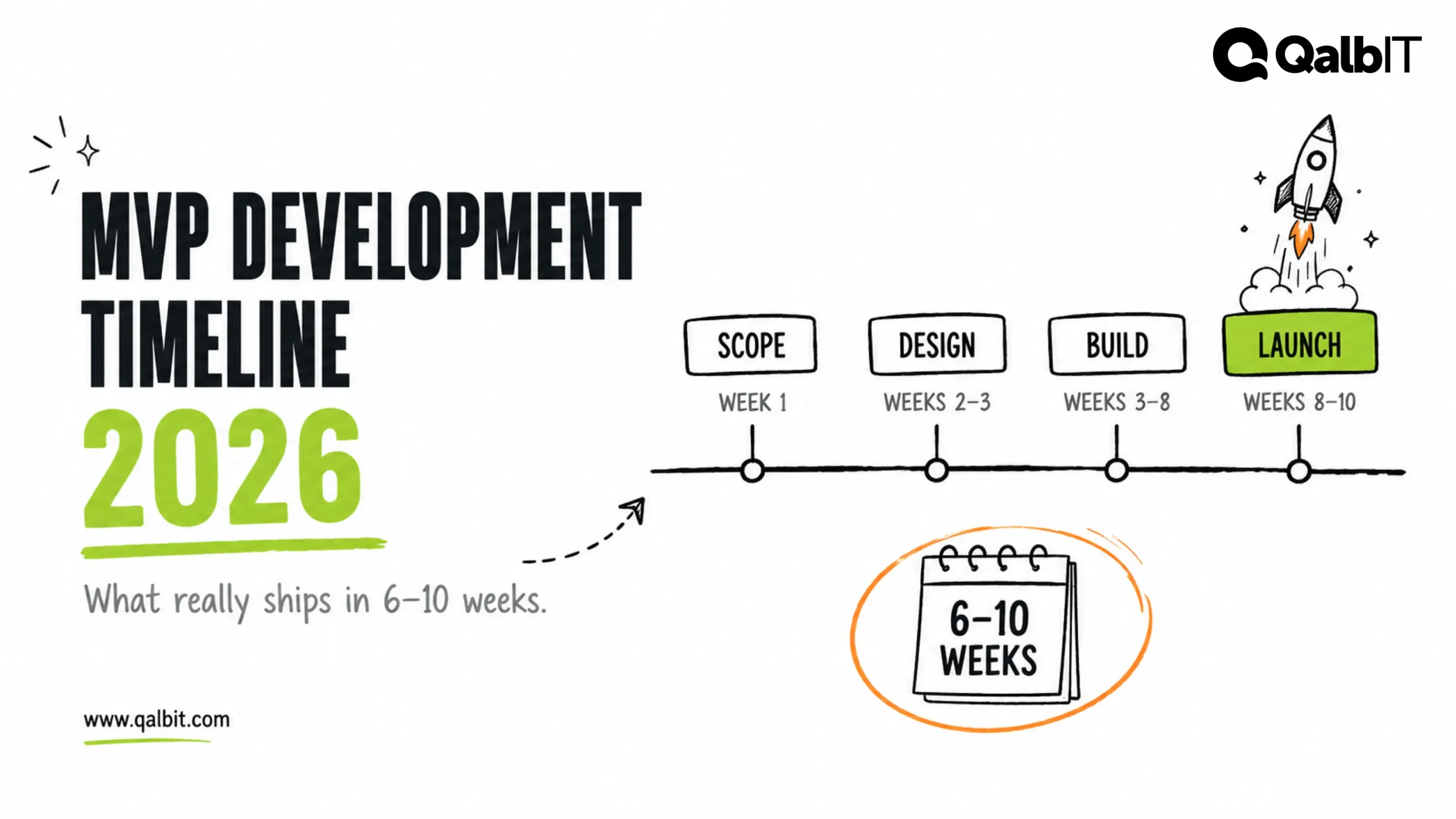



Every founder asks us the same question on the first call: how long does it take to build an MVP? Here’s the answer we give, with no sales gloss on it. If your scope is genuinely lean — one core journey, one user type, web-first — an experienced team can take you from kickoff to a live, instrumented product in 6 to 10 weeks. We run this MVP development timeline on our own MVP development services engagements, and it holds.
But we’d be lying if we called that the industry average. Once you add a second user type, payments, compliance, or native mobile, most MVPs land in the 8–16 week range — call it three to four months. Older survey data across 150+ software projects put the average closer to four and a half months, and that broadly matches what we still see in 2026 when scope isn’t controlled.
So treat 6–10 weeks as the fast lane, earned through ruthless scoping. Anyone who quotes you a flat number before asking a single question about your product is selling, not estimating.
The short answer: MVP timeline by phase
| Phase | Duration | Output |
|---|---|---|
| 1. Scoping sprint | ~1 week (2–3 for complex domains) | One-page spec, fixed budget, launch criteria |
| 2. Design the core journey | 1–2 weeks | Clickable prototype, approved before code |
| 3. Build in weekly increments | 3–6 weeks | Working product, demoed every Friday |
| 4. Launch & instrument | ~1 week | Live MVP with analytics and error tracking |
One gut check before we go deeper. In our experience, anything quoted under four weeks is a prototype wearing an MVP costume, and anything stretching past sixteen weeks has quietly become a full product. Both are fine things to build. Just know which one you’re paying for.
The week-by-week MVP development process
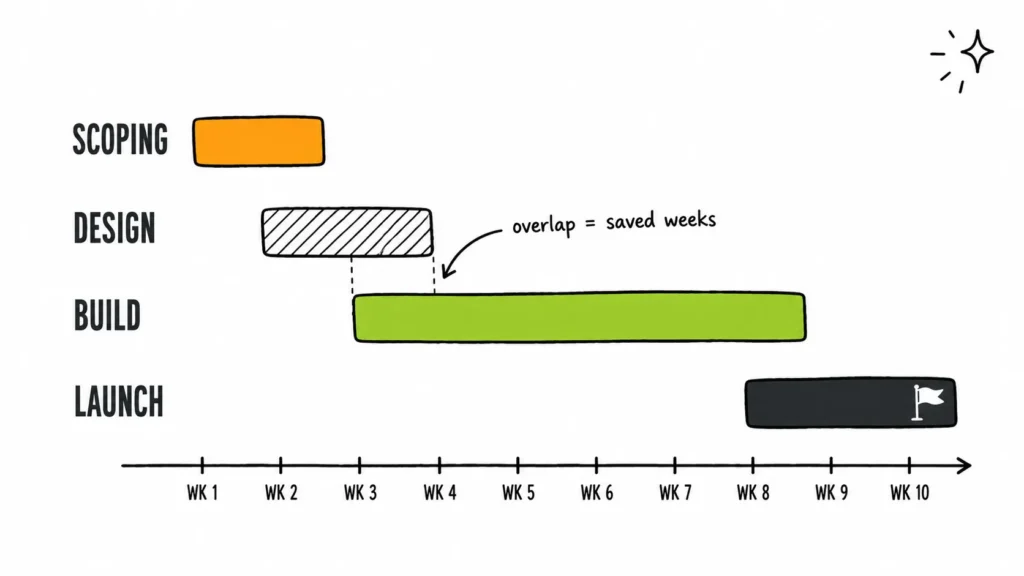
Week 1 — Scoping sprint. The most valuable week of the entire project, and the one founders most want to skip. We won’t let you. We find your riskiest assumption — “restaurants will pay for this,” “users will connect their bank account” — and cut every feature that doesn’t test it. If you can’t state your MVP’s purpose in one sentence, the scope is too broad. The output is a one-page spec, a fixed cost (our MVP cost guide covers the numbers side), and measurable launch criteria.
Why so much fuss over one week? Because the cost-of-change curve is one of the oldest findings in software engineering: problems fixed after delivery cost many multiples of the same fix made at the requirements stage — classic research puts the gap anywhere from 4× on small projects to far higher on large ones. A proper discovery sprint typically pays for itself several times over in rework you never have to do.
Weeks 2–3 — Design. The core user journey, designed end to end and clicked through with you before production code exists. We lean on proven UI patterns everywhere except the moments users actually judge you: onboarding and the “aha” screen. Design approval is your last cheap change point. Everything after it costs engineering hours.
Weeks 3–8 — Build. Backend work starts while final screens get polished, so the phases overlap rather than queue. You see a working demo every Friday and course-correct in days, not months. The build order matters: auth and app skeleton first, the core journey second, payments and admin third. And the discipline that protects the date — new ideas go on the post-launch backlog, not into the sprint.
Weeks 8–10 — Launch and instrument. Production deploy, analytics events mapped to your launch criteria, error tracking, user acceptance testing, and your first users onboarded — often manually, which is not a hack, it’s the point. Launch isn’t the finish line. It’s the start of the learning loop the whole MVP exists to feed.
What adds weeks to an MVP timeline
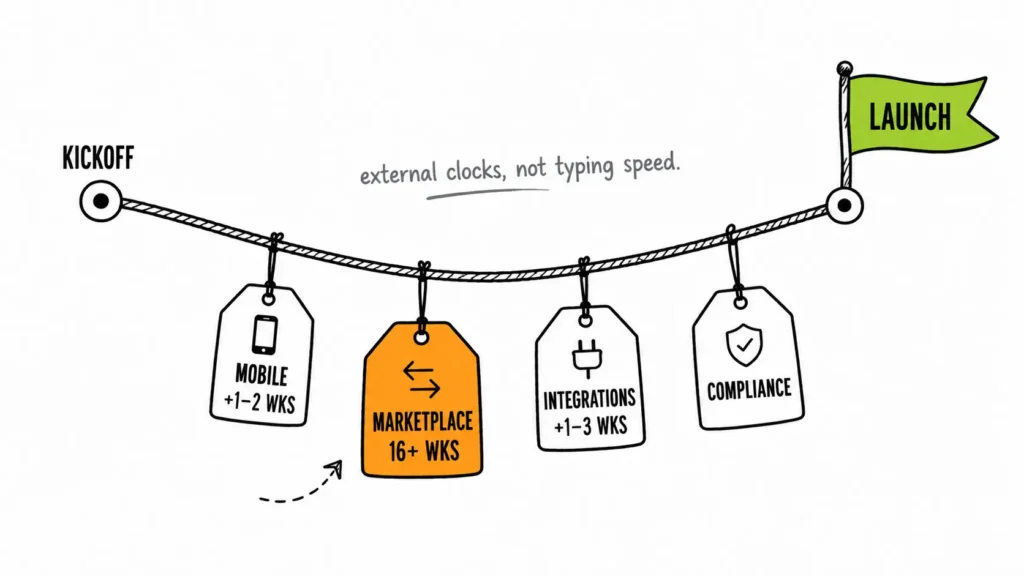
Mobile apps: add 1–2 weeks. Store review itself is quicker than founders fear — Apple clears the large majority of submissions within about a day, and Google Play updates usually go live within hours, with new apps taking up to a week. The trap most first-timers miss is on Android: a brand-new personal Google Play developer account must first run a closed test with at least a dozen opted-in testers for fourteen continuous days before it can even apply for production access. Plan that fortnight from day one, not week eight.
Two-sided marketplaces: plan for 16+ weeks. This is the scope founders underestimate most, and our original instinct to call it “a few extra weeks” was wrong — the data corrected us. A marketplace means two onboarding flows, escrow-style payments, trust-and-safety tooling, and the chicken-and-egg problem of activating both sides at once. Agencies that have shipped hundreds of them consistently report marketplace MVPs running past the four-month mark, at roughly 50–100% more cost than an equivalent single-sided app.
Integrations with external clocks. KYC providers, bank APIs, and app-store review all run on someone else’s schedule. Budget one to three weeks per payment or identity integration, and treat a clean API-first KYC hookup as several engineering-weeks on its own. These rarely blow up on technical difficulty — they blow up on support queues, thin documentation, and account-verification waits. We front-load the risky ones into weeks 3–4 so surprises surface while they’re still cheap.
Regulated industries. HIPAA, PCI-DSS, SOC 2 — compliance can add a few weeks or double the whole schedule. Identify it in discovery. Never mid-build.
The delays that come from your side of the table
After a hundred-plus first releases, we can tell you the delays almost never come from typing speed.
- Slow decisions. Dev teams hit small blockers constantly. If each one waits two days for an answer and a project has thirty of them, you’ve silently added weeks. In our projects, the single best predictor of hitting the launch date is one empowered decision-maker who answers within 48 hours.
- Mid-build scope creep. “While you’re in there, can we add…” — every yes moves the date. The scoping sprint exists precisely so these become backlog items, not sprint items.
- Content and assets. Product copy, legal pages, seed data — the classic silent blocker. We flag every asset dependency in week 1 with an owner and a deadline.
- The one-more-polish loop. Perfection before evidence is procrastination with a design tool. Ship at credible, not flawless. Real users will tell you what deserves polish.
What fits in 6–10 weeks (and what doesn’t)
Fits comfortably: one core journey done well, auth and roles, Stripe or Razorpay billing, a lean admin panel, transactional email, analytics. That’s a fundable, chargeable product.
Doesn’t fit — and shouldn’t: native iOS and Android and web at once, chat plus social plus gamification, multi-language everything, AI beyond one focused use case. Those are phase-two candidates, funded by the evidence your MVP produces.
Frequently asked questions
Six to ten weeks for a genuinely lean web MVP with an experienced team. Eight to sixteen weeks — roughly three to four months — is the honest range once you add billing, a second user type, mobile, or compliance.
Occasionally, with no-code tools or a single tightly defined feature. But be honest with yourself: much under four weeks and you're usually shipping a prototype, not a product real users can rely on.
No — it means fixed scope. Tests on critical paths and clean architecture stay non-negotiable, because the MVP that wins has to survive success without a rewrite.
Two to four weeks of listening, then two-week iteration sprints — the cadence most agile teams settle on — driven by real usage against your launch criteria. If the metrics say grow, the same team scales it. If they say pivot, you found out in weeks, not quarters.
Run it through our free cost calculator for an instant cost-and-weeks range, or book a scoping call with QalbIT's MVP team — you'll leave with a fixed launch date, usually within one call.
