




Every SME that outgrows spreadsheets ends up staring at the same three doors: an open-source package like Odoo, an enterprise suite like SAP Business One or Dynamics 365 Business Central, or custom ERP development. Each is the right answer for someone. The problem is that nobody puts the five-year numbers side by side — vendors have no reason to, and most comparison articles just recycle each other’s guesses.
We build custom ERPs for a living, so we have a bias. We’re stating it upfront, and we’re also going to tell you plainly when Odoo or SAP is the better call — because roughly a third of the companies who talk to us should not build custom, and we say so.
Here’s the honest comparison, with 2026 prices you can verify.
The comparison at a glance
| Odoo | SAP B1 / Dynamics BC | Custom ERP | |
|---|---|---|---|
| Upfront cost | $10K–$40K implementation | $60K–$150K+ | $20K–$75K phased |
| Recurring | Per-user licences + partner fees | Licences + ~18–20% AMC | Hosting + ~10–15%/yr support |
| Standard processes | Excellent fit | Excellent fit | N/A — built to yours |
| Non-standard processes | Customisation gets expensive fast | Consultant-heavy, slow | Native |
| Upgrade risk | Custom modules break every annual version | Vendor-controlled roadmap | You control the roadmap |
| Ownership | Partial (open core, your instance) | Vendor’s | Fully yours |
| Best for | Standard SMEs starting fast | Larger SMEs wanting a recognised suite | Operations-led SMEs whose process is their edge |
When Odoo is the right call
Odoo earns its popularity. Choose it when:
- Your processes are close to standard. Wholesale with simple flows, basic manufacturing, straightforward accounting — Odoo’s defaults cover it, and good implementation partners are everywhere.
- You need many modules on day one and can live with how they work out of the box.
- Your budget is genuinely capped under ~$20K and someone internal will own the system.
Now the part vendors skip: what Odoo actually costs to keep.
At 2026 US list prices, Odoo’s Standard plan runs about $31/user/month and the Custom plan — which you need the moment you want Studio, the external API or your own modules — about $61/user/month at renewal. For 25 users on Custom, that’s roughly $18,000 a year in licences alone, before your partner touches anything. Pricing is geolocated (India and the Gulf are cheaper), and Odoo raised US and Canada prices by up to 30% in 2026 with an annual indexation clause of around 7%, so check odoo.com/pricing for your country rather than trusting any blog — including this one.
Then there’s the upgrade treadmill. Odoo ships a major version every October, and Odoo’s own documentation is clear that your custom modules won’t survive an upgrade until someone rewrites them for the new version — that someone being your partner, at day rates. From April 2026, running a version more than three releases old also attracts a 25% surcharge on your subscription. In our experience — and this is our observation from client work, not an industry statistic — once you’re customising more than about a third of how Odoo behaves, you’re paying to fight the framework, and every upgrade re-breaks what you paid for. We regularly meet companies whose “cheap” Odoo instance has quietly cost more than a custom build, and they still don’t own it.
When SAP-class suites are the right call
If you’re a genuinely large operation — multiple legal entities, group consolidation, hundreds of users, auditors who expect a recognised suite — this article isn’t for you; you need a proper enterprise selection process, and S/4HANA-class projects realistically run $150K–$500K+ for mid-market firms and well beyond that for complex ones.
For SMEs, SAP Business One and Dynamics 365 Business Central are the realistic options. B1’s perpetual Professional licence sits around $3,200 per user plus 18–20% annual maintenance; Business Central runs $80–$110/user/month after Microsoft’s late-2025 price rise. Implementations typically land between $25K and $100K, stretching to $150K+ for multi-site complexity. These are solid products — but they’re consultant-led, the roadmap belongs to the vendor, and 25+ users on per-seat licences is a bill that never stops.
When custom wins
Choose custom ERP development when:
- Your process is your competitive advantage. Job-work chains, batch tracking, multi-location stock rules, unusual costing — the workflows that make you better than competitors are exactly what packages flatten into defaults.
- You’ve already failed with a package. Gartner predicts that by 2027 more than 70% of recent ERP initiatives will fail to fully meet their original business-case goals — and a quarter will fail badly. On the ground, that looks like staff quietly going back to Excel; surveys consistently find most managers do exactly that when the system fights them. A surprising share of our ERP work replaces half-adopted installs.
- You want to keep your accounting tool. Custom ERPs sync with Tally (via its XML/ODBC interfaces), Zoho Books and QuickBooks (via their REST APIs). Your CA keeps their system; your operations get theirs. Packages want to be your accounting.
- Per-user pricing punishes your growth. Forty warehouse, floor and sales users on package licences is a permanent tax. Custom has no seat meter.
- Ten-year ownership matters. Your code, your data, your upgrade schedule. No forced migrations, no surcharges for staying put.
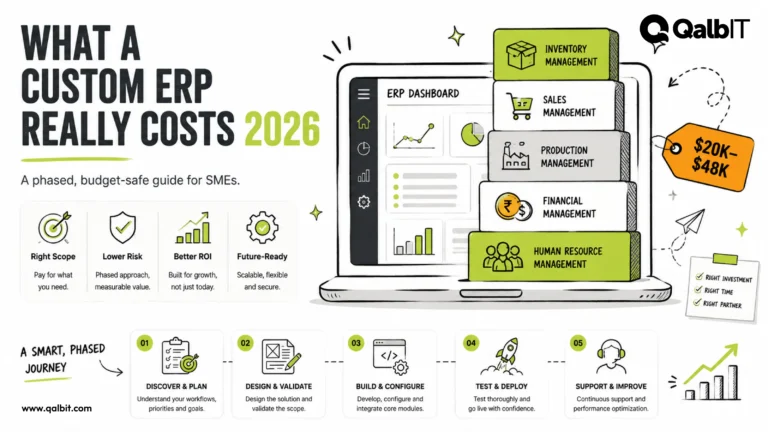
Full pricing detail is in our ERP development cost guide — phase one typically lands at $20,000–$42,000.
The five-year math (25 users, illustrative)
These are modelled examples, not quotes — your numbers depend on region, plan and scope:
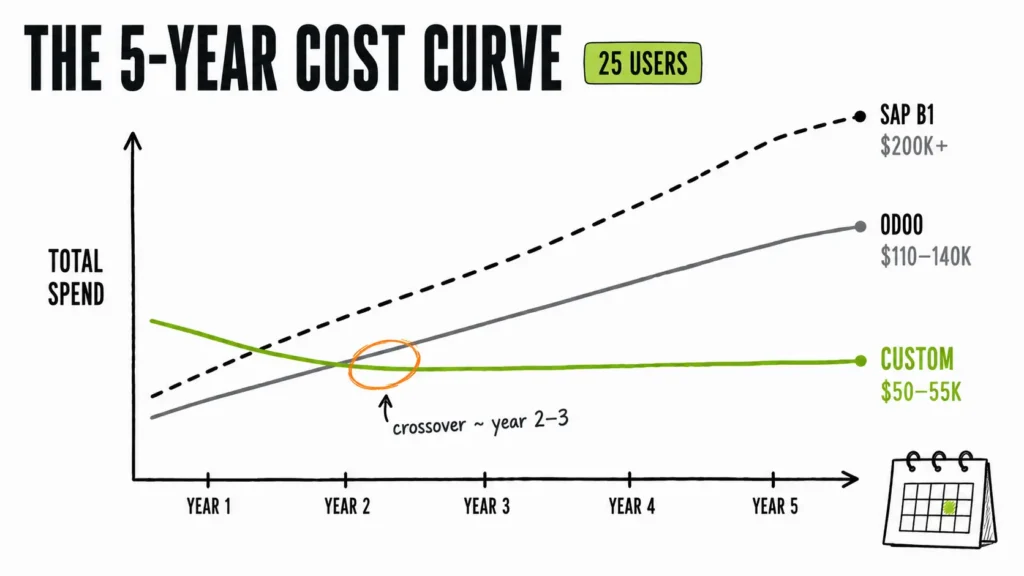
- Odoo, Custom plan, moderate customisation: ~$25K implementation + $15K–$18K/yr US-list licences + partner maintenance + one paid version migration ≈ $110K–$140K. Ownership: partial.
- SAP B1: $60K–$100K implementation + licences + compounding AMC ≈ $200K+. Ownership: none.
- Custom, phased: ~$32K build + ~$5K/yr support ≈ $50K–$55K. Ownership: total.
Custom’s cost curve is front-loaded and then flattens. Package curves start low and never stop climbing. The crossover usually lands in year two or three.
A fair decision framework
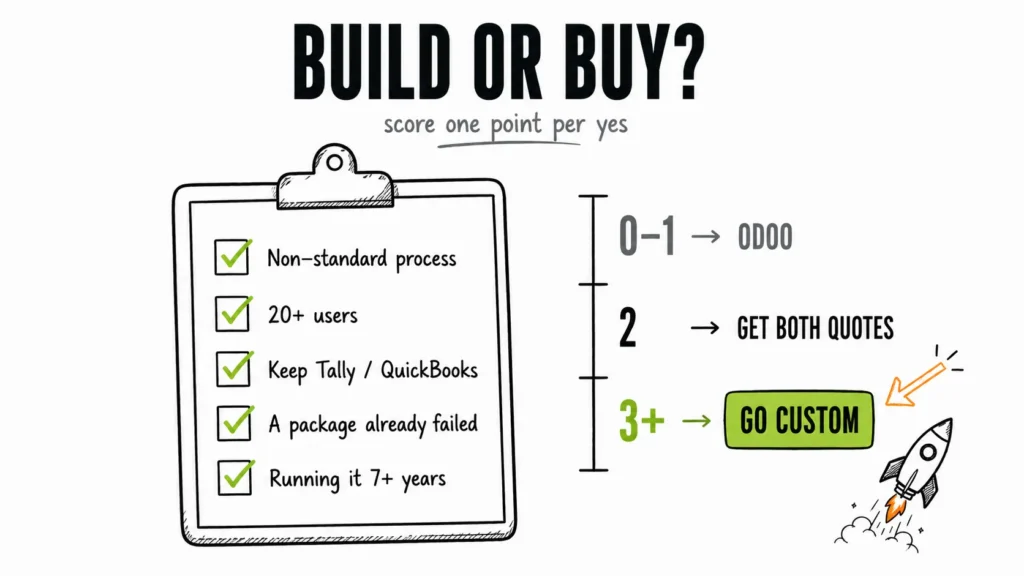
Score one point per “yes”:
- Our core process differs meaningfully from industry standard
- We have (or will soon have) 20+ system users
- Keeping Tally/QuickBooks/our accountant’s tool matters
- We’ve tried a package and adoption failed
- We plan to run this system for 7+ years
0–1: implement Odoo with a good partner. 2: get both quotes — phased custom vs Odoo. 3+: go custom, phased, with a parallel run.
Frequently asked questions
Yes. Masters, transactions and history all migrate, and we normally run both systems in parallel until the numbers reconcile. Migration effort should appear in any honest custom quote.
The risk is different, not higher. Package risk is adoption failure and customisation debt; custom risk is scope discipline. Phased, fixed-scope delivery — one module proven before the next is funded — is how you manage it.
Ours: Laravel or NestJS backends, React frontends, PostgreSQL or MySQL with strict constraints, and integrations to accounting and e-invoicing systems. Boring, proven technology any future team can maintain.
Run your modules through the free cost calculator, or book a discovery call with the QalbIT ERP team. If Odoo is honestly the better fit, we'll tell you.
